

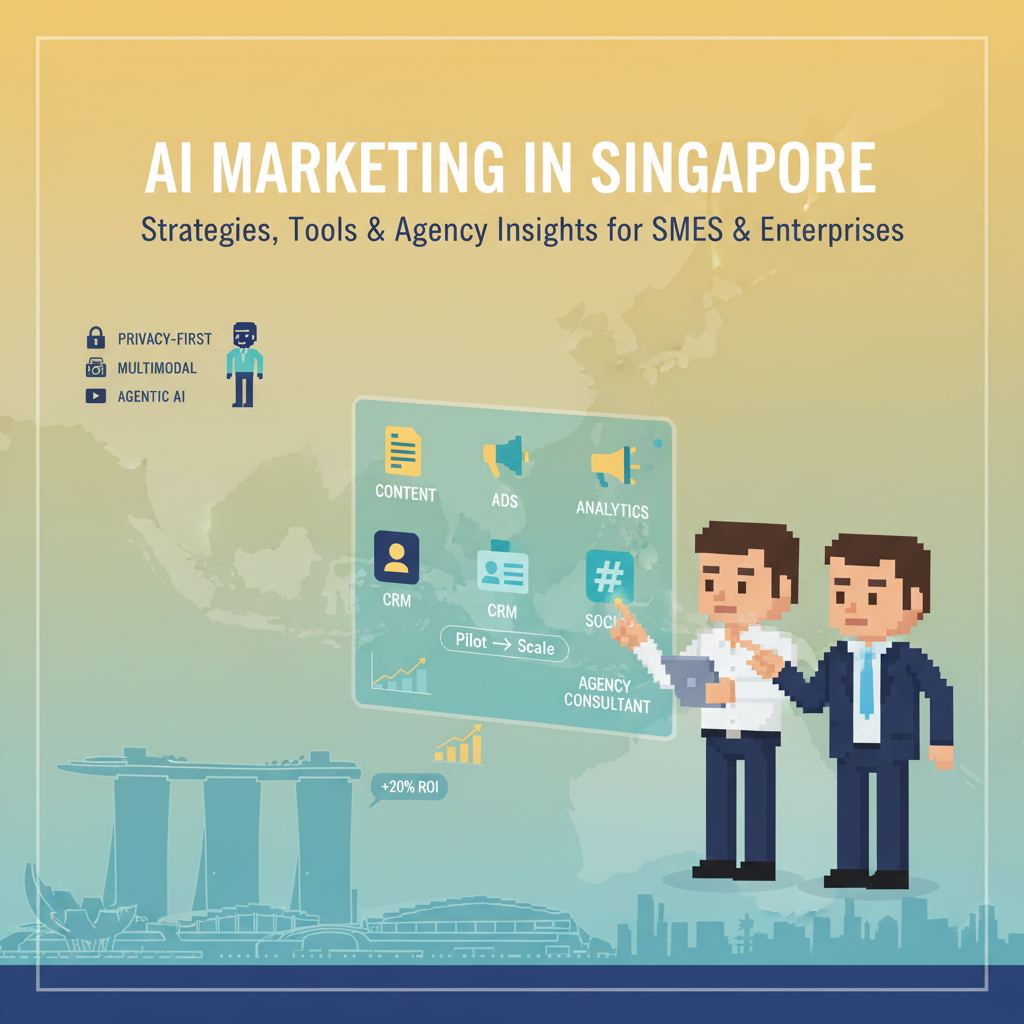
AI Marketing in Singapore: Strategies, Tools, and Agency Insights for SMEs & Enterprises
Introduction: The Rise of AI Marketing in Singapore
Artificial intelligence is no longer a distant frontier for Singapore’s marketing landscapeit is reshaping how businesses engage customers, optimize campaigns, and measure impact today. Singapore’s digital economy reached S$128.1 billion in 2024, representing 18.6% of GDP, with AI adoption serving as a primary growth catalyst. For small and medium enterprises (SMEs), the shift has been particularly dramatic: AI adoption among Singapore SMEs tripled from 4.2% in 2023 to 14.5% in 2024, according to the IMDA Singapore Digital Economy report. Larger enterprises have moved even faster, with non-SME adoption jumping to 62.5% in 2024.
Yet adoption alone does not guarantee success. Many organizations are experimenting with AI tools without clear strategies, governance frameworks, or measurement disciplines. This article provides Singapore and Southeast Asian marketerswhether leading SMEs or managing enterprise teamswith practical frameworks, local context, and step-by-step guidance to navigate AI marketing effectively.
Understanding AI Marketing: What It Means for Singapore Businesses
Key Concepts and Benefits of AI Marketing
AI marketing refers to the use of machine learning, natural language processing, and automation to enhance marketing workflows across the customer journey. Rather than replacing marketers, AI augments human creativity and decision-making by handling repetitive tasks, surfacing insights from data, and personalizing experiences at scale.
- Accelerated content production: AI-powered tools generate blog drafts, social captions, email copy, and video scripts in minutes, enabling teams to scale output without proportional headcount increases.
- Improved targeting and personalization: Machine learning models identify high-value audience segments and tailor messaging, offers, and channel timing to individual preferences.
- Autonomous optimization: AI systems continuously test ad creatives, bidding strategies, and email send times, learning from performance data to improve ROI without manual intervention.
- Cost efficiency: SMEs using AI solutions under Singapore’s Productivity Solutions Grant (PSG) reported average cost savings of approximately 52%, with AI-enabled cybersecurity solutions achieving 71% savings.
- Real-time insights: AI analytics platforms consolidate data from multiple channels, detect patterns, and surface actionable recommendations faster than traditional dashboards.
How AI is Transforming the Local Marketing Landscape
Singapore’s marketing ecosystem is undergoing three simultaneous shifts driven by AI adoption.
First, social commerce and live commerce are becoming primary revenue channels. Southeast Asian consumers spend an average of 4 6 5 hours daily on social platforms, with high engagement in live shopping events. AI tools that automate short-form video creation, influencer matching, and real-time inventory management are becoming essential for e-commerce brands competing in this space.
Second, multilingual and localized campaigns are now feasible at scale. With AI content generation tools supporting multiple languages and cultural contexts, Singapore-based enterprises can rapidly test and deploy campaigns across Indonesia, Malaysia, Thailand, and Vietnamcritical for regional expansion.
Third, data-driven governance is maturing. Enterprises are moving beyond point-tool adoption to building integrated AI stacks with centralized data platforms, model governance, and causal measurement disciplines. This shift reflects both regulatory pressure (Singapore’s strong data governance culture) and competitive necessity.
Choosing the Right AI Marketing Agencies in Singapore
What to Look for in a Local AI Marketing Partner
Selecting an AI marketing agency is not simply about finding the vendor with the most advanced technology. The right partner aligns with your organization’s maturity, budget, and strategic priorities.
For SMEs, prioritize agencies that offer:
- Managed services with clear ROI: Look for partners who run 60 6 90 day pilots with defined success metrics (e.g., lead cost reduction, content throughput increase) before committing to longer contracts.
- Off-the-shelf tool expertise: Agencies proficient in ChatGPT, Jasper, Canva, Hootsuite, and similar platforms can deploy solutions quickly without custom development.
- Local market knowledge: Partners familiar with Singapore’s regulatory environment, consumer behavior, and competitive landscape provide faster time-to-value.
- Transparent pricing: Avoid agencies with hidden implementation costs; seek fixed-fee pilots or performance-based models.
For enterprises, evaluate agencies on:
- Data and MLOps capability: Can they integrate with your CDP, data warehouse, and ad platforms? Do they have experience building data governance frameworks?
- Experimentation rigor: Do they employ randomized controlled trials, holdout groups, and causal inference methods to measure incremental impact?
- Governance and compliance: Can they navigate Singapore’s data protection requirements and support multi-market deployments with regional data residency?
- Scalability and team depth: Do they have dedicated data scientists, analytics engineers, and strategists to support long-term transformation?
Agency Categories and Unique Offerings
Singapore’s AI marketing agency landscape includes several distinct categories, each serving different needs:
- Boutique AI-first agencies specialize in generative AI and automation. These firms typically employ data scientists and prompt engineers, offering custom LLM fine-tuning, RAG implementations, and agentic AI pilots.
- Full-service digital agencies with AI divisions combine traditional creative and media expertise with AI capabilities for end-to-end campaign management.
- Performance marketing agencies embed AI for creative optimization, audience targeting, and attribution modelingideal for SMEs and growth-stage companies with clear conversion goals.
- Managed SaaS and platform partners provide pre-built AI solutions (e.g., Zoho, HubSpot) with local support, ideal for SMEs looking for low-friction implementations.
Essential AI Tools for Marketing in Singapore
Popular AI-Powered Platforms and Software
Content Generation and Repurposing: ChatGPT, Jasper, Copy.ai; Surfer SEO; Canva Magic Studio; Lumen5; Synthesia.
Advertising and Programmatic Buying: Albert.ai, Adext.ai; Pathmatics.
Analytics and Measurement: Improvado, Hockeystack, FullStory, Pecan.ai.
CRM and Conversational AI: Salesforce Marketing Cloud (Einstein AI), HubSpot, Zoho CRM; Drift, Conversica, ManyChat, Yellow.ai.
Social Media Management and Social Commerce: Hootsuite, Buffer, FeedHive, Predis.ai; TikTok Shop Manager, Shopee tools.
Integrating AI Tools with Existing Marketing Systems
- Audit your current stack to find data gaps and manual handoffs.
- Prioritize one use case with clear ROI before expanding.
- Ensure data connectivity via APIs/middleware (Zapier, Make) to CRM and data warehouse.
- Establish governance and document processes in a runbook.
- Measure and iterate over 60 6 90 days; scale if successful.
Crafting Effective AI Marketing Strategies for SMEs and Enterprises
Tailoring AI Approaches for SMEs vs. Enterprises
SMEs: Focus on 1 6 2 high-impact use cases (email personalization, social content, chatbots). Assign an AI champion, avoid heavy custom ML, and budget $500 6 2,000/month for tools.
Enterprises: Build an integrated stack (CDP + CRM + autonomous ads + analytics), set up governance and MLOps, and staff a cross-functional AI marketing team.
Case Examples of Successful AI Marketing Campaigns
Scenario 1: SME E-Commerce Personalized emails drove 28% higher opens, 35% higher CTR, 18% higher revenue per email; $12K incremental revenue in 60 days; ~2,400% ROI.
Scenario 2: Enterprise B2B SaaS Predictive scoring + AI assistants delivered 22% higher first-call conversion, 15% shorter cycle, 12% higher deal size; ~$3.2M incremental annual revenue.
Maximizing ROI: Measuring the Impact of AI Marketing
Key Metrics and Analytics for AI-Driven Campaigns
Define primary, secondary, and health metrics by use case (content, email, ads, chatbots) and monitor universal KPIs (incremental revenue, CPA changes, time saved, model performance, data quality).
Overcoming Common Challenges in AI Adoption
- Attribution complexity: use controlled experiments and holdouts.
- Data readiness: standardize tracking and unify IDs.
- Skills gaps: train teams and partner with specialists.
- Model/creative decay: monitor and refresh regularly.
- Privacy and compliance: align with Singapores data protection regulations and prioritize first-party data.
- Cost vs. benefit: calculate incremental ROI and sunset underperformers.
Future Trends: The Evolution of AI Marketing in Singapore
Emerging Technologies and Innovations
Generative AI maturation & RAG, multimodal AI, agentic AI, and privacy-first marketing will define the next wave.
Predictions for the Next 3 6 5 Years
2025 6 62026: generative AI standardization; 2027 6 62028: multimodal mainstream; 2029 6 62030: autonomous campaign agents with human guardrails. In SEA: live commerce acceleration, localized agents, and low-/no-code adoption.
Conclusion: Navigating the Future of AI Marketing in Singapore
AI marketing is now a competitive necessity. SMEs should prioritize high-ROI pilots with clear metrics; enterprises must invest in data foundations, governance, and causal measurement. With the right roadmap, Singapore businesses can lead AI adoption across Southeast Asia.
Ready to transform your marketing with AI? Contact us at Hamilton & Sherwind to discuss your AI roadmap.
Frequently Asked Questions
What is the difference between AI marketing and traditional marketing automation?
Traditional automation relies on predefined rules; AI learns from data to personalize and optimize decisions in real-time.
How much should an SME budget for AI marketing tools and implementation?
Typically $500 6 2,000/month for tools, plus 40 6 80 hours of setup and training for a 60 6 90 day pilot.
How do I measure the ROI of AI marketing initiatives?
Baseline, controlled experiment (treatment vs. control), then scale while monitoring for model drift. Use incremental revenue vs. incremental cost.
What are the main challenges in adopting AI marketing in Singapore?
Data readiness, skills gaps, measurement complexity, model decay, compliance, and TCO underestimation. Address with data infrastructure, training, controlled tests, and governance.
Which AI marketing tools are most popular in Singapore and Southeast Asia?
ChatGPT, Jasper, Canva, Hootsuite, FeedHive, HubSpot, Zoho, Albert.ai, Adext.ai, Improvado; select by use case and integration fit.
Related Hamilton & Sherwind resources
- AI marketing services in Singapore
- AI-powered social media content production in Singapore
- Social media portfolio
- Digital marketing services
- Social media marketing services
- Branding services
- Video production in Singapore
- Hamilton & Sherwind Blog