

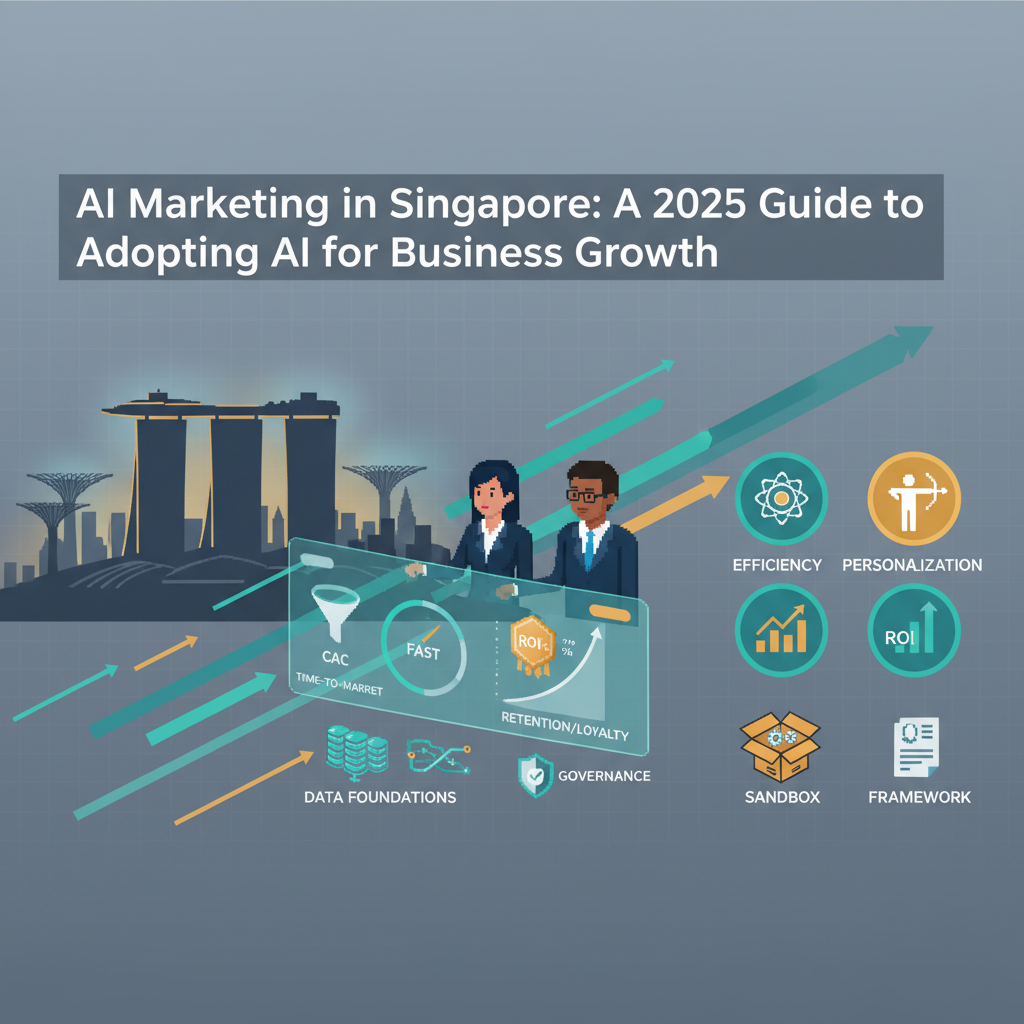
AI Marketing in Singapore: A 2025 Guide to Adopting AI for Business Growth
The Rise of AI Marketing Singapore in 2025
Singapore’s marketing landscape is undergoing a fundamental transformation. As artificial intelligence reshapes customer engagement, content creation, and campaign optimization, business leaders face an urgent choice: adopt AI strategically now, or risk losing competitive ground to faster-moving rivals. The question is no longer whether AI will impact marketing—it already has. The real question is how quickly your organization can harness it responsibly and effectively.
This guide provides marketing leaders, CMOs, founders, and digital managers across Singapore and Southeast Asia with a practical roadmap for AI marketing Singapore adoption in 2025. You’ll discover the drivers accelerating AI adoption Singapore, the emerging trends shaping digital marketing AI 2025, and actionable frameworks for building an effective AI marketing strategy Singapore that delivers measurable business outcomes.
Executive Summary
- AI adoption in Singapore is accelerating: Government support, cloud accessibility, and competitive pressure are driving adoption across SMEs and enterprises, with marketing as a leading use case for visible ROI.
- 2025 marks the transition from pilots to production: Organizations are embedding AI into core workflows with emphasis on governance, measurement, and outcomes.
- Practical barriers remain surmountable: Data readiness, talent gaps, ROI proof, and integration challenges are addressable with structured approaches and local support programs.
- Singapore’s governance ecosystem is world-leading: IMDA’s frameworks, testing toolkits, sandboxes, and grant programs provide a clear pathway for responsible AI deployment at lower cost and risk (IMDA AI governance, AI Verify, SMEs Go Digital).
Understanding AI Adoption Singapore: Why Now?
Key drivers of AI adoption in Singaporean businesses
Competitive and economic pressure is the primary driver. Singaporean businesses operate in a highly competitive regional market where differentiation through speed, personalization, and efficiency is non-negotiable. Companies that adopt AI to reduce CAC, accelerate time-to-market, and deliver hyper-personalized experiences gain measurable advantages. For marketing teams, this translates to pressure to achieve more with constrained budgets—AI enables content scaling, campaign optimization, and customer engagement at a fraction of traditional costs.
Labor market tightness and talent scarcity create a second incentive. AI tools allow teams to multiply their output without proportional headcount increases—generative AI for content, chatbots for first-touch customer interactions, and marketing automation for multi-step campaigns.
Technology accessibility has democratized AI. Cloud-based services and pre-built platforms let SMEs access enterprise-grade capabilities via SaaS and managed services.
Regulatory clarity and government support reduce adoption friction through clear frameworks and toolkits.
Government initiatives and support for AI in marketing
- Model AI Governance Framework: Practical guidance on explainability, fairness, robustness, and human-centric design (see IMDA AI governance resources).
- AI Verify and Project Moonshot: Open-source testing to validate model behavior for safety, explainability, and bias (AI Verify official).
- GenAI sandboxes and pre-approved solutions: Experimentation in controlled environments and tools vetted for safety under SMEs Go Digital.
- SkillsFuture and TeSA: Workforce upskilling pathways for AI-related roles (SkillsFuture SG).
2025 AI Marketing Trends Singapore: What’s Shaping the Future?
Emerging technologies and their impact on digital marketing
- Generative AI and agentic assistants embedded across creative, service, and workflow tools; moving toward AI-coordinated workflows with human oversight.
- Multimodal and visual search expanding personalization; visual discovery becomes a core channel for retail and travel.
- Real-time personalization engines enabling sub-second decisions, valuable for programmatic bidding and dynamic creatives.
- Predictive analytics and causal inference shifting from descriptive to prescriptive insights.
- Retrieval-augmented generation (RAG) grounding outputs in brand and product data for factual accuracy.
Industry-specific trends in Singapore
- Financial services: Segmentation, personalisation, and conversational banking.
- E-commerce & retail: Recommendations, dynamic pricing, and visual search.
- Healthcare & wellness: Patient engagement and personalized education.
- Professional services: Thought leadership content and proposal acceleration.
- Hospitality & travel: Personalised recommendations and conversational booking.
Building an Effective AI Marketing Strategy Singapore
Steps to integrate AI into your marketing plan
Step 1: Define business outcomes and KPIs (e.g., CAC reduction, conversion lift, time-to-publish, LTV, efficiency ratio).
Step 2: Audit current capabilities and gaps across data, tech stack, talent, governance, and budget.
Step 3: Identify high-value, low-risk pilots (e.g., dynamic email personalization, AI-assisted content, chatbot lead-qualification, creative optimization).
Step 4: Build your data foundation (unified IDs, real-time events, consent controls, data quality).
Step 5: Select and integrate tools that solve KPIs, integrate with your stack, provide governance, and show ROI.
Step 6: Implement governance and human-in-the-loop (review workflows, style guides, factuality checks, escalation paths, audit trails).
Step 7: Measure and iterate using baselines, holdouts, productivity and business metrics, and qualitative feedback.
Aligning AI with business goals and customer needs
Map initiatives to strategy, be transparent about AI use, provide controls, protect privacy, and test for fairness using AI Verify style assessments.
Related reading: AI marketing strategies
Essential AI Tools for Marketing Singapore Businesses
Overview of top AI-powered marketing tools
- Marketing automation & orchestration: Multi-channel coordination and ML optimization. Pair with digital marketing services.
- Content generation & creative: AI copy, images, and variants; see AI-powered social media content.
- Analytics & digital experience: Predictive scoring, lift measurement, anomaly detection.
- Personalization & recommendations: Real-time decisioning with unified data.
- Chatbots & conversational AI: Lead qualification and support, integrated with CRM.
- Social listening: Sentiment, trend, and competitor monitoring; explore our social media approach.
- Experimentation platforms: Controlled A/B/n tests and holdouts.
How to choose the right tools for your business
- Define the problem and KPI.
- Assess data readiness.
- Evaluate integrations (CRM, CDP, analytics).
- Check governance and transparency features.
- Validate ROI evidence with case studies.
- Consider total cost of ownership.
- Budget for change management and training.
Real-World Success: AI Marketing Case Studies Singapore
Local business examples
Case 1: E-commerce recommendations—AOV +18%, repeat purchase +12%, 3.2x ROI in 6 months.
Case 2: B2B content acceleration—time-to-publish −60%, volume +40%, email CTR +22%, organic +15%.
Case 3: Financial segmentation—response +28%, CAC −19%, cross-sell +35%, 4.1x ROI in 9 months.
See our digital marketing portfolio and branding portfolio for campaign outcomes.
Lessons learned and best practices
- Start with outcomes, not tools.
- Invest in data foundations.
- Measure with holdouts; avoid vanity metrics.
- Govern from day one; keep humans in the loop.
- Iterate continuously and invest in people.
Overcoming Challenges in AI Digital Marketing Singapore
Common barriers and how to address them
Data fragmentation: Unify with CDP and real-time pipelines. Our digital marketing services can help integrate stack and data.
Talent gaps: Upskill via SkillsFuture and partner with agencies.
Cost & ROI: Use IMDA sandboxes (SMEs Go Digital) and run focused pilots.
Integration complexity: Prioritize native connectors; plan iterative integrations.
Governance uncertainty: Start with IMDA governance resources and AI Verify.
Change management: Executive sponsorship, training, and internal champions.
Ensuring data privacy and compliance in Singapore
- Understand local requirements; align with industry and sector guidance.
- Adopt privacy-by-design: minimization, pseudonymization, access controls, encryption, retention policies.
- Manage consent and transparency; provide opt-outs and document practices.
- Conduct privacy impact assessments prior to deployment.
- Vet vendors for security, data residency, and compliance.
- Monitor and audit regularly with incident response plans in place.
90-Day AI Marketing Adoption Plan
Weeks 1–4: Foundation and Planning
- Week 1: Sponsors, steering, KPIs; governance charter.
- Week 2: Data & tech audit; readiness assessment.
- Week 3: Select 2–3 pilots; success metrics & holdouts.
- Week 4: Tool evaluation & selection; implementation plan.
Weeks 5–8: Pilot Implementation
- Week 5: Data prep, integrations, monitoring setup.
- Week 6: Team training; content review & escalation paths.
- Week 7: Launch pilot; daily metrics & feedback.
- Week 8: Mid-pilot analysis; optimizations.
Weeks 9–12: Analysis, Learning, and Scale Planning
- Week 9: Statistical analysis; ROI report.
- Week 10: Executive decision on scale/iterate.
- Week 11: 12-month roadmap; talent plan.
- Week 12: Scaling playbook; team readiness.
AI Marketing KPI Scorecard Template
| KPI Category | Metric | Baseline | Target | Actual | Status | Notes |
|---|---|---|---|---|---|---|
| Efficiency | Time-to-publish (days) | 7 | 3 | — | — | Content creation |
| Content volume (pieces/month) | 20 | 40 | — | — | Same team, same budget | |
| Campaign setup time (hours) | 16 | 8 | — | — | End-to-end campaign | |
| Performance | CAC (SGD) | 45 | 38 | — | — | 15% reduction |
| Conversion rate (%) | 2.5 | 3.0 | — | — | 20% improvement | |
| Email open rate (%) | 18 | 22 | — | — | Personalization | |
| Click-through rate (%) | 2.1 | 2.8 | — | — | Creative optimization | |
| Customer Experience | NPS | 42 | 50 | — | — | Personalization |
| Repeat purchase rate (%) | 28 | 32 | — | — | Recommendations | |
| Average order value (SGD) | 120 | 135 | — | — | Upsell | |
| Business Impact | Marketing ROI | 3.2 | 4.5 | — | — | Revenue per $ |
| Customer lifetime value (SGD) | 850 | 950 | — | — | Retention + upsell | |
| Marketing efficiency ratio (%) | 12 | 15 | — | — | Revenue per marketing $ | |
| Governance | Bias testing completion (%) | 0 | 100 | — | — | AI Verify |
| Content review compliance (%) | — | 100 | — | — | Human-in-the-loop | |
| Data security incidents | — | 0 | — | — | Compliance tracking |
Frequently Asked Questions
Q: How long does it take to see ROI from AI marketing initiatives?
Quick wins can show results within 4–8 weeks; broader impact typically takes 3–6 months. Measure with holdout groups to isolate true lift.
Q: What’s the minimum budget needed to start with AI marketing in Singapore?
A focused pilot can start around SGD 15,000–30,000; plan separately for data infrastructure. Grants and sandboxes may offset costs.
Q: How do I ensure AI-generated content maintains brand consistency?
Use brand style libraries, human-in-the-loop review, and RAG to ground outputs in approved assets.
Q: What are the main data privacy concerns with AI marketing?
Unauthorized collection, opaque decisions, and bias risks. Address with consent, transparency, opt-outs, fairness testing, and security controls.
Q: How do I measure the true impact of AI on marketing performance?
Randomized experiments with holdouts; track productivity and business metrics; avoid vanity metrics.
Q: What skills do I need to support AI marketing?
Data engineering, analytics, AI product management, and marketing operations; upskill via national programs and partners.
Q: Build custom vs. use off‑the‑shelf?
Start with off‑the‑shelf for speed and lower risk; build custom only for proprietary differentiation and when ROI justifies it.
Conclusion: The Future of AI-Driven Marketing for Singapore Businesses in 2025
Singapore’s supportive ecosystem, technology accessibility, and competitive intensity make 2025 the year to move from experimentation to production. Start with outcomes, invest in data and governance, measure rigorously, and build capability through people and processes. Organizations that act decisively will reduce CAC, accelerate time-to-market, and scale retention.
Explore more: AI marketing strategies and AI-powered social content.
Ready to Transform Your Marketing with AI?
Speak with a local agency team that combines human creativity with intelligent automation. From strategy and governance to implementation and measurement, we help Singapore brands adopt AI responsibly and deliver outcomes.
Contact our Singapore AI marketing experts →
Also see: Digital marketing services, Social media, Branding, Video production, and our digital and branding portfolios.