

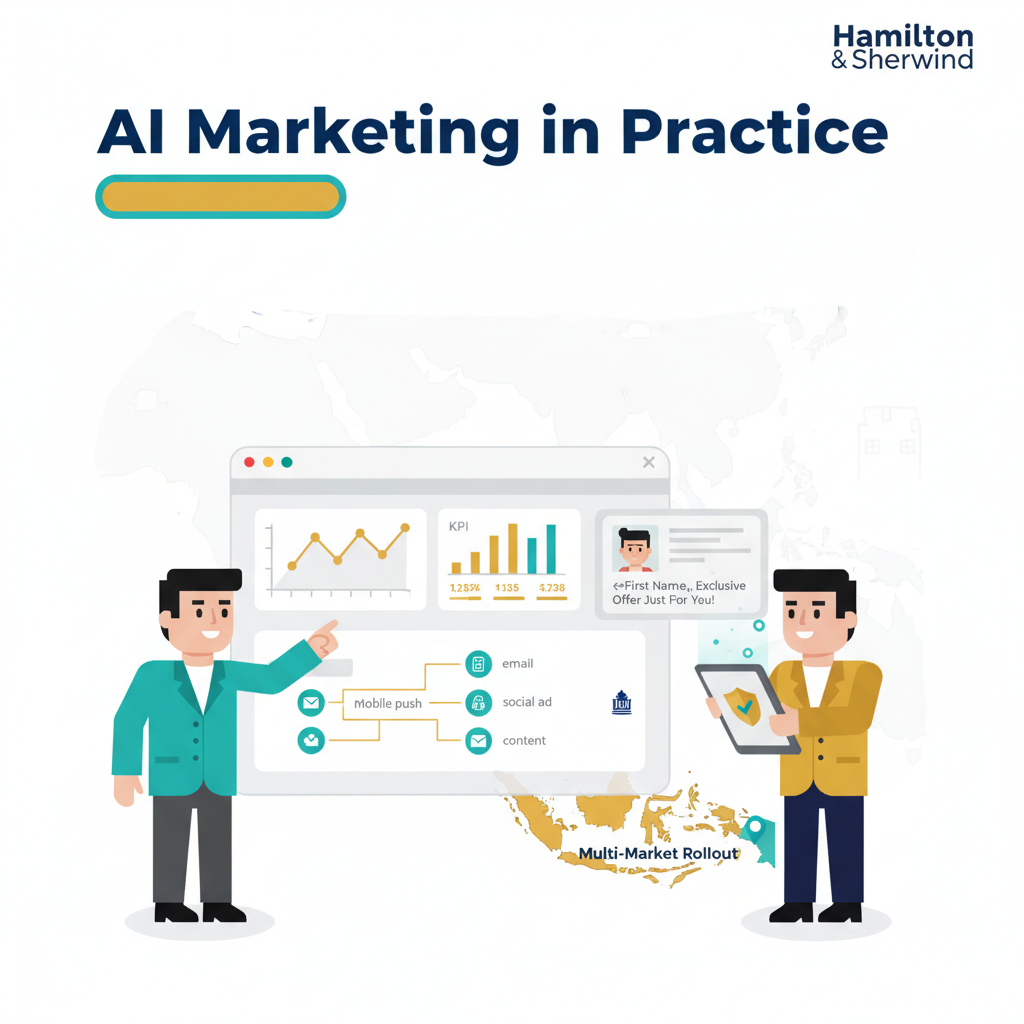
AI Marketing in Practice: A Practical Guide for Modern Brands
AI marketing is no longer a distant future. Today, savvy brands in Singapore and across SEA are embedding AI-driven capabilities into core marketing processes to personalize experiences at scale, automate repetitive tasks, and optimize content and campaigns in real time. This guide provides practical, field-tested frameworks, checklists, and regional context to help marketing leaders plan, deploy, and govern AI marketing initiatives responsibly and at scale.
What AI in marketing means today
Overview of capabilities
AI marketing today encompasses three core capabilities that together unlock relevance and efficiency:
- Personalization at scale: AI analyzes signals from individual customer journeys to tailor messages, offers, and recommendations across devices and channels, without requiring proportional human effort. See Klaviyo’s AI marketing personalization overview and Salesforce’s Marketing AI for cross-channel personalization and autonomous decisioning signals.
- Automation of campaigns and workflows: AI automates repetitive marketing tasks, audience segmentation, and cross-channel activation. Definition via Creatio: AI marketing automation.
- Content optimization and generation: AI assists in creating, testing, and optimizing content and creative assets to improve relevance and performance across channels. Platform references: Salesforce Marketing AI; SEA case studies from Sephora SEA (Braze) and Pomelo (AWS).
- Predictive analytics and experimentation: Forecast customer behavior and outcomes, enable automated experimentation, and accelerate learning cycles. See Braze’s Sephora SEA case and research context in MDPI Sustainability.
Current trends and signals shaping the landscape
- Generative AI for content and creative optimization is accelerating creative cycles and enabling rapid experimentation across channels. See APAC/SEA signals in SAS’s 2026 marketing AI trends report.
- Cross-channel orchestration and autonomous marketing are becoming a common operating model for real-time experiences, including multi-app SEA ecosystems. Reference: Salesforce – Marketing AI.
- Attribution and measurement are shifting to unified, cross-device views in multi-market SEA contexts. Regional perspectives: IAB SEA+India and GeoSpot APAC.
SEA context at a glance: brands deploy AI across e-commerce, retail media, and super-app ecosystems; predictive personalization and cross-channel optimization help manage language diversity and fast-changing behavior. Regional vendors include Appier and ViSenze.
Core benefits of AI-driven marketing
Personalization at scale and relevance
AI enables personalized experiences across channels and geographies, delivering relevance at scale without proportional increases in manual effort. In SEA, where audiences are diverse (languages, cultures, shopping behaviors), personalization at scale supports localized experiences and higher engagement. Practical examples include Sephora SEA’s cross-channel personalization and Pomelo’s AI-enabled shopping experiences.
Operationalize personalization with a grounded data strategy, real-time decisioning, and content optimization. SEA-focused guidance appears in Marketech APAC and the case studies above. For execution support, see our AI-powered digital marketing strategies.
Efficiency, optimization, and decision support
AI improves efficiency by automating routine tasks and supporting decision-making with data-driven insights. Real-time optimization in attribution and cross-channel spend helps marketers reallocate budgets for greater impact. References include Affise on real-time optimization and IAB SEA+India.
Key AI marketing strategies to implement
Frameworks for strategic alignment (goals, data, governance)
Translate business goals into AI-enabled outcomes, align data readiness, and establish governance. In SEA, where multi-market deployment and privacy expectations are pronounced, a framework that balances growth with data discipline and responsible AI is crucial.
- Link business goals (growth, retention) to AI outcomes (personalization at scale, automated workflows, content optimization, predictive analytics).
- Use governance anchors: Singapore’s Model AI Governance Framework and PDPC’s Model AI Governance Framework; global references include OECD AI Principles and the NIST AI Risk Management Framework.
Roadmap templates and quick-win activations
Adopt a phase-based roadmap: (0) strategy, (1) data governance, (2) MVP design, (3) pilot deployment, (4) scale, (5) institutionalize—with clear outputs and success criteria at each phase.
- Quick wins: cross-channel personalization pilot (welcome series, re-engagement) with AI-optimized content; ensure governance gates before scaling.
- Templates: ProductPlan marketing roadmap and Smartsheet marketing automation roadmap. For brand fundamentals, consider branding considerations in AI-powered campaigns and AI-enabled social media marketing.
Must-have AI marketing tools and platforms
Tool categories (automation, content creation, analytics, attribution)
- Automation and orchestration: Salesforce Marketing AI, Braze (SEA case), HubSpot Marketing Hub.
- Content creation and optimization: Jasper, Copy.ai, Writesonic.
- Analytics and visualization: Looker, Tableau, Power BI (AI features), Adobe Analytics.
- Attribution and measurement: AppsFlyer, Adjust, Branch.
- SEA-specific signals: Appier, ViSenze.
Evaluation criteria and vendor considerations
- Capabilities fit with goals and cross-channel orchestration.
- Data readiness and governance: connectors, consent management, data residency, auditability.
- Multilingual/localization support for SEA markets.
- Integration depth and API maturity with your stack.
- Security/compliance posture and certifications.
- ROI and cost clarity; evidence from pilots.
- SEA presence and support; local case studies and partners.
Measuring ROI and performance with AI marketing
Metrics, dashboards, and case-study benchmarks
Prove value by aligning metrics to business outcomes and delivering dashboards that communicate ROI clearly.
- Business impact: incremental revenue, margin uplift, ROAS, CAC payback, CLTV uplift.
- Marketing performance: CTR, CVR, CPA lift, test-win rate, automation rate, content velocity.
- AI performance: model accuracy, drift, calibration, explainability.
- Data governance: data quality scores, privacy compliance status, bias audit results.
- Governance: policy adherence, audit findings resolved, vendor risk posture.
Benchmarks and cases: Sephora SEA, IAB SEA+India, and research context from MDPI Sustainability.
ROI modeling and risk assessment
Build a simple model contrasting incremental revenue uplift against AI costs to estimate payback periods. Run scenarios across uplift rates and costs; attribute uplift to AI-enabled channels in a multi-market context for precision.
Ethical and governance considerations in AI marketing
Data privacy, fairness, and transparency
Trusted AI marketing depends on privacy-by-design, fairness, and transparency. Emphasize consent-aware designs and data minimization; consider on-device or federated learning where appropriate. Use Singapore’s governance resources as a baseline for enterprise practices (see Model AI Governance Framework and PDPC guidance).
Mitigate bias via regular audits and fairness objectives; tools include Fairlearn and IBM AIF360. For transparency, maintain model cards and explainability dashboards (see Model Cards, SHAP, and LIME).
Compliance and governance frameworks
- Global standards: OECD AI Principles, IEEE Ethically Aligned Design, NIST AI RMF, EU AI Act (reference), and ISO references for AI governance and information security (see ISO/IEC JTC 1/SC 42 and ISO/IEC 27001).
- Cross-border data flow: see EU resources on international data transfers for general guidance.
Synergy with human teams: roles and collaboration
Reskilling needs and team design
Design a hybrid operating model that balances governance with local market speed. Roles span data engineering, ML engineering, data science, personalization leads, content optimization, channel owners, and governance/privacy. Invest in data and AI literacy for marketers, technical fluency for marketing, and language-aware training across SEA. Use a skills matrix, a 90-day plan, and a cross-functional RACI for a core use case like personalization at scale.
Change management and governance practices
Adoption should include communication plans, stakeholder engagement, and governance rituals (weekly AI reviews, monthly ROI reviews, quarterly governance audits). These embed data, privacy, and model risk management into the marketing operating model.
Practical takeaways and next steps for AI marketing
Final notes: AI MARKETING
- Start with SEA-ready governance and data foundations. Use Singapore’s Model AI Governance Framework and PDPC guidance as baselines; then adapt to local SEA markets.
- Pilot with clear ROI targets and governance gates. Move from strategy/data readiness into MVPs and scale using SEA use cases (cross-channel personalization, retail media optimization) and robust dashboards.
- Build a cross-functional AI marketing team with clear roles, decision rights, and continuous reskilling. Establish collaborative rituals that fit SEA market realities.
References and further reading
- Salesforce – Marketing AI (Agentforce and agentic marketing)
- Klaviyo – AI marketing personalization
- Creatio – AI Marketing Automation
- Sephora SEA Case Study (Braze)
- Pomelo Case Study (AWS)
- MDPI Sustainability – Generative AI for Consumer Behavior Prediction
- SAS – Navigating AI in Marketing: Future Trends for 2026
- IAB SEA+India – AI Media Buying & Optimisation Breakthrough
- GeoSpot APAC – Programmatic Advertising in APAC Guide
- Appier – AI Marketing Platform
- ViSenze – Product recommendations
- OECD AI Principles
- NIST AI Risk Management Framework
- IEEE – Ethically Aligned Design
- Model Cards; SHAP; LIME
- Fairlearn; IBM AIF360
- EU – International data transfers
- Hamilton & Sherwind – Digital Marketing Services
- Hamilton & Sherwind – Branding
- Hamilton & Sherwind – Social Media