

AI Marketing in 2026: Strategies, Best Tools & Real-World Examples
Artificial intelligence has moved from the “nice-to-have” category into the operational backbone of modern marketing. In 2026, the question is no longer whether to use AI in your marketing—it’s how to use it responsibly, strategically, and in ways that actually move the needle for your business.
If you’re a marketing leader or business owner in Singapore or Southeast Asia, you’re navigating a unique landscape. Your audiences span multiple languages, your customers shop across social platforms and marketplaces, and your team is likely lean. AI marketing tools promise efficiency, but without the right strategy, they can become expensive distractions.
This guide cuts through the hype. We’ll define what AI marketing actually is, show you how it maps to your customer journey, walk through real examples from brands in your region, and give you a practical roadmap to get started—without the buzzword fluff.
What is AI marketing, really?
AI marketing is the use of machine learning, predictive analytics, and generative AI to automate, optimise, and personalise marketing decisions at scale. Rather than a single tool or platform, it’s a set of capabilities that sit across your entire marketing stack.
Here’s what that looks like in practice:
Predictive analytics forecasts which leads are most likely to convert, which customers might churn, or what demand will look like next quarter. Instead of treating all prospects equally, your sales team focuses on the highest-propensity accounts.
Automated optimisation adjusts your ad spend, creative rotation, and audience targeting in real time. Platforms like Google Performance Max and Meta Advantage+ now make thousands of micro-decisions per day—bid adjustments, creative combinations, audience overlaps—without human intervention. Google notes that Performance Max uses real-time intent and behavioural signals across channels to optimise for conversion value, improving performance for advertisers who supply strong first-party data and accurate conversion tracking (source: Google Ads Performance Max overview).
Content personalisation serves different versions of your website, email, or ad to different people based on their behaviour, intent, and profile. A first-time visitor sees a different hero message than a returning customer who abandoned their cart.
Generative AI creates copy, images, and video variations at speed. It drafts email subject lines, generates product descriptions in multiple languages, or produces short-form video captions for TikTok and Instagram Reels.
Intelligent routing and timing ensures your message reaches the right person on the right channel at the right moment. A WhatsApp message about a flash sale lands when someone is most likely to engage; a LinkedIn message to a B2B prospect arrives when they’re actively researching solutions.
The common thread: AI removes the guesswork and manual labour from repetitive decisions, freeing your team to focus on strategy, storytelling, and customer relationships.
For deeper strategy work that blends AI with brand, a partner like Hamilton & Sherwind can align these capabilities with your overall branding and marketing strategy.
Why AI marketing matters now—especially in Southeast Asia
Three forces have converged to make AI marketing essential in 2026:
First, data quality has become the competitive advantage. Third-party cookies are gone. Apple’s App Tracking Transparency has fragmented audience data. The winners are brands that have invested in first-party data—clean CRM records, server-side event tracking, and consent-based customer profiles. Google has reported that advertisers using enhanced conversion and first-party data see higher conversion rates and more accurate measurement in machine learning–driven campaigns (source: Google Ads Enhanced Conversions documentation).
If your data is a mess, AI amplifies the mess. If it’s clean, AI multiplies your edge.
Second, creative velocity matters more than creative perfection. Platforms now auto-test creative variations at scale. A single ad set on Meta Advantage+ might test multiple video crops, music tracks, and CTAs simultaneously. Meta emphasises that creative remains one of the largest drivers of performance even as automation increases (source: Meta Advantage best practices). The brand that can supply fresh creative weekly wins. Generative AI and creative-testing tools let lean teams produce and optimise creative at a pace that was impossible two years ago.
If you already work with an agency for your social media or advertising, this is where AI-enhanced workflows can dramatically increase your asset output.
Third, Southeast Asia’s unique channel mix demands localised AI strategies. Your customers don’t just shop on Facebook and Google. They browse Shopee and Lazada, chat on WhatsApp and LINE, and discover products on TikTok. Each channel has its own algorithm, its own audience intent, and increasingly, its own AI-powered ad-buying system. A centralised “AI marketing strategy” won’t work; you need a playbook that treats marketplace algorithms, social platforms, and messaging apps as distinct channels—each with its own data feeds and optimisation loops.
For SMEs in Singapore and the region, this is actually an advantage. You don’t need an enterprise martech stack to compete. A lean team armed with the right AI tools—marketplace optimisers, WhatsApp chatbots, and predictive lead scoring—can punch above their weight.
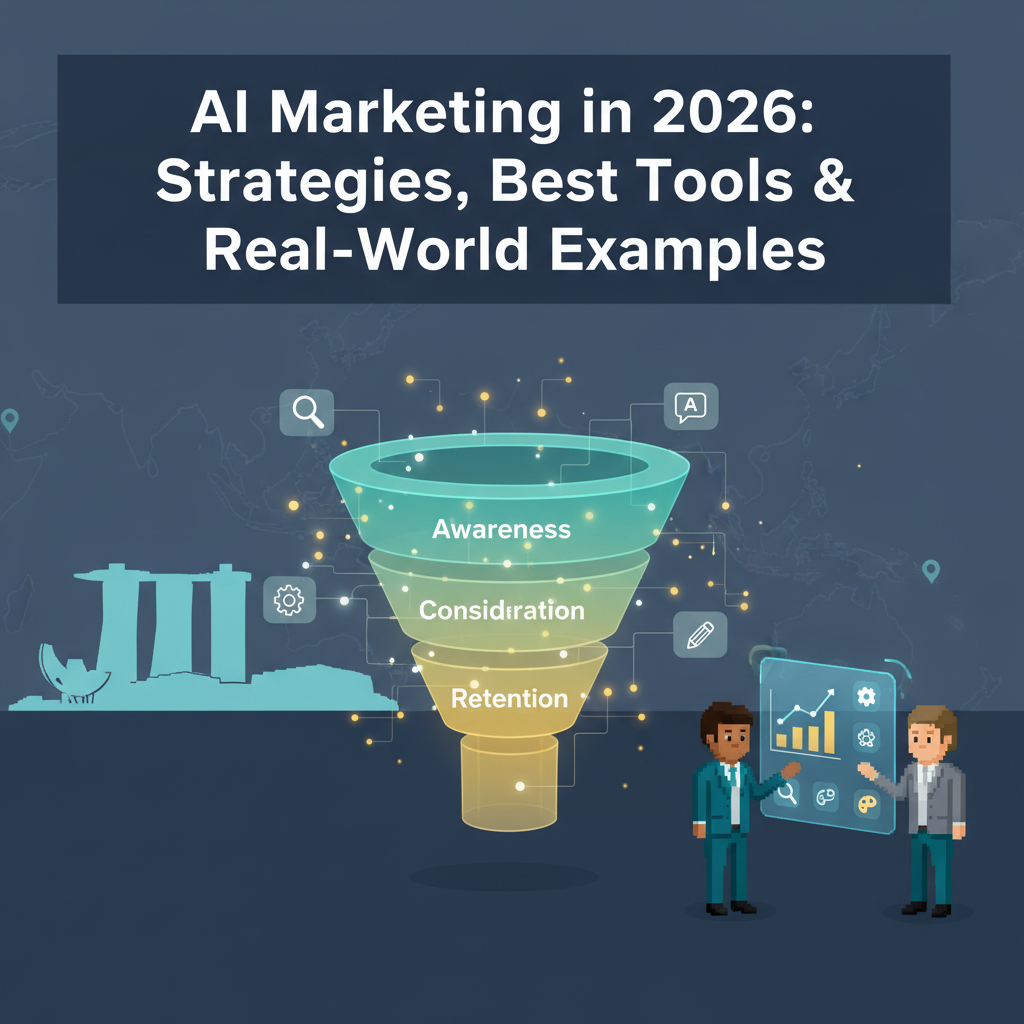
How AI maps to your marketing funnel
AI doesn’t work the same way at every stage of the customer journey. Here’s how to think about it:
Awareness: finding and testing at scale
At the top of the funnel, AI helps you discover new audiences and test creative quickly.
- AI-powered audience discovery: Tools within Google Performance Max or TikTok’s Smart Performance automatically find new audiences that resemble your best customers based on signals like search queries, viewing behaviour, and on-site actions.
- Creative generation and testing: Generative AI tools draft multiple versions of headlines, descriptions, and visuals. The platforms then test which combinations perform best, reallocating impressions in real time.
Your job at this stage: define clear objectives (e.g., cost per acquisition or lead), provide strong creative inputs, and ensure tracking is robust.
Consideration: nurturing and personalisation
Once prospects are aware of you, AI helps nurture them more intelligently.
- Predictive email and messaging: AI can predict the best time and channel to send a follow-up (email, WhatsApp, SMS) based on past behaviour and time zone. It can also generate content that speaks to their specific interests (e.g., highlighting case studies from their industry).
- On-site personalisation: Personalisation engines show different banners, product recommendations, or CTAs depending on whether a visitor is new, logged-in, high-value, or at risk of churning. McKinsey has reported that companies getting personalisation right can generate 40% more revenue from those activities than average players (source: McKinsey & Company).
- AI chatbots: Chatbots trained on your FAQ and knowledge base can answer questions 24/7, handle common objections, and route high-intent prospects to human sales.
Decision: prioritising and closing
At the decision stage, AI focuses your resources on the best opportunities.
- Lead scoring: Models analyse firmographic (company size, industry) and behavioural signals (pages visited, content consumed, replies to emails) to rank leads. High-scoring leads get priority outreach; lower-scoring ones can be nurtured with automated sequences.
- Offer optimisation: AI can test which offers (free trial length, discount amount, bundle composition) work best for specific segments, and then automatically surface the highest-converting ones.
Retention and expansion: protecting and growing value
After the sale, AI keeps customers engaged.
- Churn prediction: For subscription or repeat-purchase businesses, AI flags customers whose behaviour signals they’re likely to lapse—so you can intervene with tailored retention campaigns.
- Next-best-action recommendations: Models suggest the most relevant upsell, cross-sell, or education content based on a customer’s past purchases and usage.
Across all stages, the quality of your data—and the clarity of your objectives—will determine how well AI performs.
Real-world style examples from Southeast Asia
The examples below are anonymised but based on realistic scenarios across Singapore and the region.
Case 1: Modest fashion brand in Malaysia boosts marketplace ROAS
A Shopee seller offering modest fashion faced a classic SME constraint: a RM3,000 monthly ad budget spread across multiple SKUs in several colours. Manual bid management was eating up hours each week, and ROAS was stuck at 3.2.
They implemented Shopee’s AI-based budget optimiser, which automatically shifted spend toward the best-performing products and variants. They also used generative AI to:
- Rewrite product titles and descriptions in Malay and English.
- Incorporate marketplace search terms into titles and bullets.
- Generate consistent visual styles for product images.
Within eight weeks:
- Impressions grew by roughly 90%.
- ROAS climbed above 8.
- Time spent on bid management dropped from 6 hours per week to about 30 minutes.
Case 2: Singapore café chain scales WhatsApp orders with AI chatbot
A micro-café chain with three outlets in Singapore wanted to reduce friction at the counter and better handle peak-hour orders.
They integrated WhatsApp Business API with an AI-powered chatbot tool. The bot was trained on:
- Menu items and prices.
- Ingredients and allergen info.
- Common questions around opening hours, outlets, and delivery options.
Customers could text the café, browse the menu, place orders, and receive confirmation—without waiting in line.
After two months:
- WhatsApp orders increased by more than a third.
- Cashiers saved 20+ hours per week across outlets.
- The bot successfully handled the majority of inquiries, with complex cases escalating to staff.
Case 3: B2B SaaS in Singapore & Indonesia increases SQL-to-meeting rate
A B2B SaaS provider of invoicing software, targeting SMEs in Singapore and Indonesia, had a sales team of four and a strong inbound pipeline—but too many unqualified leads.
They implemented AI lead scoring using their CRM’s built-in model, trained on three years of closed-won and closed-lost deals. It learnt which attributes correlated most strongly with high-value conversions (e.g., company size, country, engagement pattern).
In parallel, they adopted an AI outreach tool to:
- Generate personalised email variants in English and Bahasa Indonesia.
- Tailor messages by industry and use case (e.g., “retail outlets”, “professional services”).
In three months:
- SQL-to-meeting conversion jumped from just over 20% to above 30%.
- Sales focused on the top-scoring 20% of leads.
- Average time to first response dropped significantly, improving customer experience.
AI marketing tools worth considering
The martech landscape is noisy. To keep this practical, think in categories rather than chasing individual logos.
1. Ad optimisation and budget automation
These tools sit between your ad platforms and your data:
- Automate budget shifts between campaigns and ad sets.
- Pause under-performers and boost winners automatically.
- Suggest creative and audience experiments.
Many SMEs start simply by using native tools like:
- Google Performance Max for multi-channel campaigns.
- Meta Advantage+ for conversion campaigns and shopping.
For businesses with larger spends, third-party optimisers can add:
- Consolidated reporting across platforms.
- Custom rules (e.g., minimum ROAS per audience).
- Deeper integration with your CRM or data warehouse.
This layer is especially powerful if you already run always-on digital campaigns or digital marketing services with an agency.
2. Lead scoring and pipeline AI
For B2B and high-ticket B2C:
- CRM-native AI scoring (e.g., Salesforce Einstein, HubSpot’s AI features) can prioritise leads based on historical patterns.
- Simple models can be built from a blend of firmographic (industry, size) and behavioural (pages viewed, events triggered) data.
This works best when:
- Your CRM data is de-duplicated and consistent.
- Sales and marketing agree on what a “qualified” lead looks like.
- You monitor model performance over time and retrain periodically.
3. Personalisation and recommendation engines
These tools serve personalised content and products:
- For e-commerce: product recommendations based on browsing and purchase behaviour.
- For B2B: dynamic CTAs and messaging tailored to industry, company size, or funnel stage.
Even simple approaches—like “recently viewed” or “people also bought”—can increase average order value and repeat visits.
4. Social media and content AI
Content is often where SMEs feel the biggest pain. AI can help by:
- Generating post ideas, captions, and hooks for platforms like TikTok, Instagram, LinkedIn.
- Translating content into regional languages while keeping brand voice consistent.
- Suggesting best times to post based on engagement history.
Paired with a partner that understands your brand voice and local culture, AI can help you ship more—and better—content across your social media campaigns.
5. Chatbots and conversational AI
Chatbots now go far beyond basic FAQs. With the right setup, they can:
- Handle order status queries and appointment bookings.
- Capture leads with qualifying questions.
- Escalate complex issues to your team with full context.
For SMEs in Singapore/SEA, the biggest wins tend to be:
- WhatsApp bots for order management and support.
- Messenger bots integrated with Facebook and Instagram.
- Website chatbots that can hand off to human agents during working hours.
Done well, they free up your customer-facing teams while giving customers faster responses.
Common myths and pitfalls to avoid
AI marketing is powerful—but also easy to misunderstand. Some myths to watch out for:
Myth 1: “AI will replace my marketing team.”
Reality: AI automates repetitive tasks but still relies heavily on human direction.
You still need people to:
- Define positioning and messaging.
- Decide which audiences and markets to prioritise.
- Review outputs for nuance, culture, and brand safety.
- Interpret data and make strategic trade-offs.
Think of AI as giving your team exoskeletons, not replacements.
Myth 2: “We can just plug in a tool and watch results explode.”
Reality: Without clean tracking, clear KPIs, and a plan for change management, even the best tool will struggle.
Teams often:
- Turn on AI bidding without proper conversion tracking.
- Feed incomplete or outdated customer data into models.
- Forget to update reporting dashboards and benchmarks.
Before buying tools, invest in a short data audit and tracking clean-up. An experienced partner—like Hamilton & Sherwind—can do this as part of a digital marketing or AI readiness engagement.
Myth 3: “More data is always better.”
Reality: Messy or irrelevant data can mislead more than it helps. Focus on:
- A small number of accurate, trusted data sources.
- Aligning those sources with your funnel stages and KPIs.
- Regularly cleaning and de-duplicating records.
Myth 4: “We’ll see ROI in a few weeks.”
Reality: While some quick wins are possible (e.g., ad budget optimisation), broader transformations usually take months.
- Models need time to gather enough events.
- Teams must adapt their workflows.
- You’ll iterate through tests before finding durable improvements.
Set expectations early with leadership: run pilot projects first, define clear timeframes, and agree on minimum success thresholds.
Practical pitfalls
Some common mistakes to avoid:
- Treating AI as a side project: It needs ownership, budget, and a roadmap.
- Ignoring creative: Even the best algorithm can’t save weak, unclear offers.
- Under-investing in training: Your marketers need to know how and when to use each tool.
- Buying too many tools at once: Start with one or two lighthouse initiatives, prove value, then expand.
A 90-day AI marketing action plan for mid-sized companies
Here’s a practical, phased roadmap you can adapt.
Weeks 1–2: Align on goals and scope
- Pick one or two primary goals (e.g., reduce cost per lead on Meta, increase repeat purchase rate on your e-commerce site).
- Map your customer journey and identify where AI could have the highest impact in the short term.
- Decide which metrics you’ll track (e.g., CAC, ROAS, SQL-to-meeting rate, repeat purchase rate).
- Assign a project owner and core team members (marketing, data/IT, sales or customer service).
Weeks 3–6: Fix foundations (data and tracking)
- Audit your analytics and ad accounts:
- Are events set up correctly?
- Are UTMs consistent?
- Do leads flow properly into your CRM?
- Clean your CRM:
- Merge duplicates.
- Update lifecycle stages.
- Remove obviously invalid data.
- Implement or improve server-side tracking for major platforms.
- Document your data schema so future AI tools can integrate smoothly.
If you work with an agency, this is a natural moment to align your tracking and data model with your broader marketing and advertising services.
Weeks 7–12: Run an AI “lighthouse” project
Choose one main initiative—examples:
- Paid media optimisation
- Use AI bidding and budget optimisation on a portion of your campaigns.
- Keep a control group with your current setup to compare.
- Track changes in CAC, ROAS, and conversion rate.
- Lead scoring and qualification
- Turn on AI lead scoring in your CRM.
- Ask sales to focus first on high-scoring leads.
- Compare conversion and cycle times between scored vs. unscored leads.
- Personalised lifecycle journeys
- Use an AI-capable marketing automation tool to trigger personalised emails or messages based on behaviour.
- Test against your current “one-size-fits-all” journeys.
For whichever you choose:
- Start small (e.g., 20–30% of traffic or budget).
- Run for at least a full buying cycle where possible.
- Monitor results weekly and adjust thresholds or rules as needed.
Week 12 and beyond: Review, refine, and scale
- Review pilot performance against initial goals:
- Did CAC go down?
- Did SQL-to-close improve?
- Did repeat rate increase?
- Capture learnings:
- What data issues emerged?
- Where did AI save the most time?
- What required the most human oversight?
- Decide whether to:
- Scale the initiative.
- Tweak and rerun.
- Park and choose a different use case.
Once one initiative shows consistent value, you can add a second (for example, combining AI ad optimisation with AI-driven email personalisation).
Southeast Asia–specific considerations
When designing AI marketing in Singapore and the region, keep these realities in mind:
Multi-language and multi-cultural audiences
- Audiences may switch between English, Malay, Mandarin, Tamil, Bahasa Indonesia, Thai, Vietnamese, and others.
- Generative AI can help draft and translate, but you still need human review for nuance and context.
- Consider separate models or segments for different language clusters.
Social commerce and “super-apps”
- Customers often discover, evaluate, and buy inside platforms like Shopee, Lazada, Grab, TikTok, and Instagram.
- Each ecosystem has its own optimisation levers and AI tools.
- Work with partners who understand how these platforms work locally and can integrate with your overall digital marketing strategy.
Lean teams and budget constraints
- Pilot projects should be narrowly scoped and tightly measured.
- Look for tools that:
- Offer free or low-cost tiers.
- Consolidate multiple use cases (e.g., email + SMS + WhatsApp).
- Integrate with your existing stack.
How an AI-driven marketing agency can help
AI can be daunting if you’re already stretched managing day-to-day campaigns. That’s where an AI-aware creative and marketing partner adds real value.
An agency like Hamilton & Sherwind brings together:
- Brand and storytelling expertise
AI can’t define your brand, but it can help express it across many touchpoints. Our branding and advertising portfolio shows how strategy and creative connect in the region. - Channel execution in Singapore/SEA
From social media to events and video, we understand how campaigns actually run across channels like Meta, TikTok, YouTube, and regional marketplaces. Explore our social media portfolio and video production work. - AI playbook design
We help you:- Prioritise use cases.
- Select tools that fit your size and sector.
- Set up data flows and dashboards.
- Train your team to use AI confidently.
- Measurement and optimisation
We track the metrics that truly matter—CAC, LTV, pipeline velocity, and incremental lift—rather than just impressions or clicks, and adjust strategies based on evidence.
Ready to build your AI-powered marketing engine?
AI marketing is no longer a futuristic concept. It’s already embedded in the platforms your customers use daily—and in the tools your competitors are adopting.
The real question is whether you’ll approach it:
- As a series of disconnected experiments, or
- As a strategic capability that supports your brand, your funnels, and your growth targets in Singapore and Southeast Asia.
Hamilton & Sherwind helps organisations move from buzzwords to execution—combining creative storytelling, regional insight, and AI-enabled tools to build marketing systems that scale.
If you’d like to:
- Audit your current marketing and data stack,
- Identify the highest-impact AI opportunities for your business, and
- Design a practical 90-day roadmap to get started,
we’d be happy to explore this with you.
Contact Hamilton & Sherwind today to schedule an AI marketing strategy session for your team.
You can also browse our latest insights on branding, digital, and AI-driven campaigns on the Hamilton & Sherwind blog and explore our recent portfolio of work for brands across Singapore and Southeast Asia.