

AI Marketing in 2025: A Practical Guide to Strategy, Tools, and Future Trends
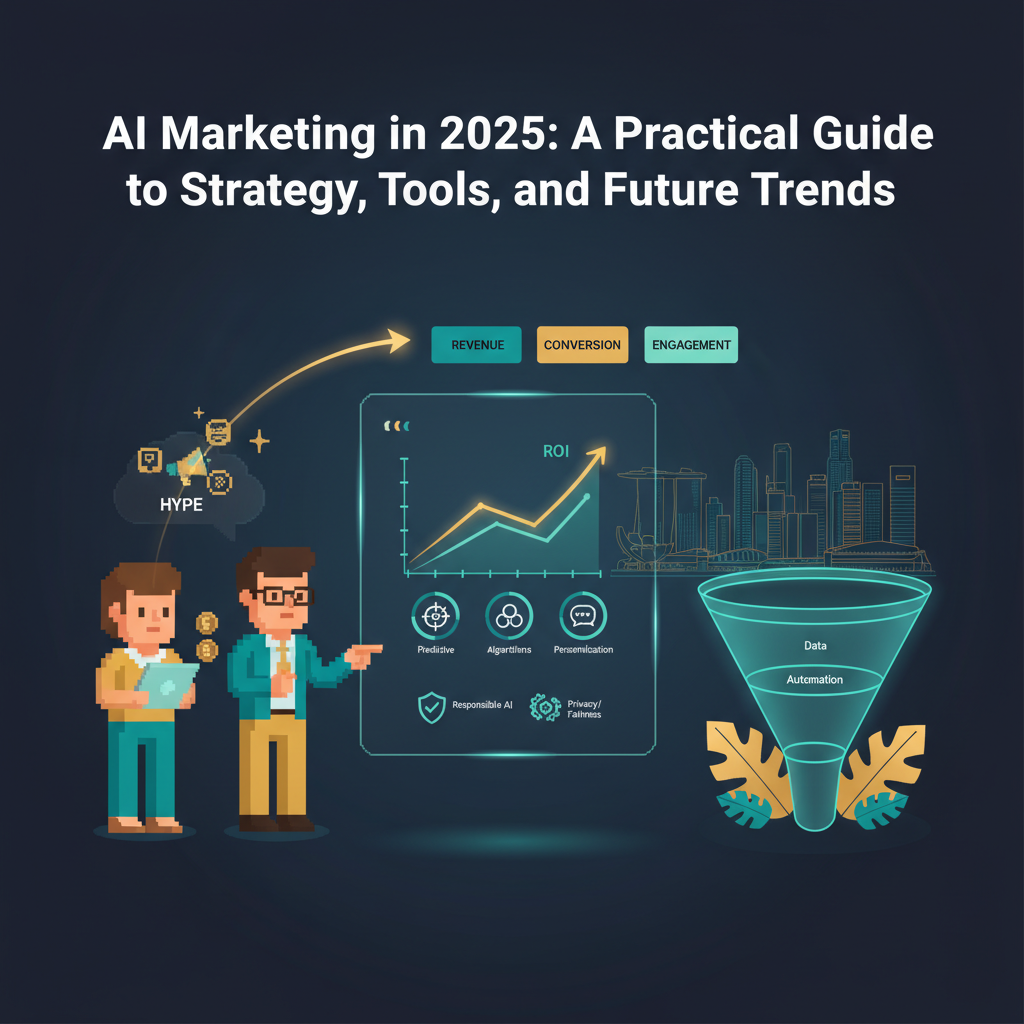
From Hype to Reality: Why AI Marketing Matters Now
The conversation around artificial intelligence in marketing has shifted dramatically. What was once a futuristic concept discussed in boardrooms is now a daily reality for marketers globally. In 2025, AI marketing has crossed a critical threshold—it’s no longer about experimentation or pilot projects. It’s about competitive survival.
Consider this: AI now quietly powers large portions of the paid ads, content recommendations, and email campaigns that customers see every day. Yet paradoxically, many brands have not yet seen consistent, measurable profit from their AI investments. This gap between adoption and actual business impact defines the current moment. The question is no longer “Should we use AI?” but rather “How do we use AI effectively to drive real revenue?”
For marketers in Singapore and Southeast Asia, the stakes are particularly high. The region’s digital-first consumers, mobile-dominant behavior, and rapidly growing e-commerce landscape create both urgency and opportunity. Companies that master AI marketing now will capture disproportionate market share. Those that lag will find themselves outmaneuvered by competitors who’ve already optimised their customer journeys, personalisation engines, and media spend.
The business case is compelling. Deep AI adopters in marketing and sales often report double-digit sales ROI gains. More impressively, organisations that have moved beyond pilots can see multiples on their investment within months, with conversion lifts, reduced customer acquisition cost, and significant workload reductions. These aren’t theoretical numbers—they’re being achieved by real companies across industries, from healthcare to telecommunications to financial services.
But here’s the critical insight: the winners aren’t necessarily the ones with the most sophisticated algorithms. They’re the ones who’ve built the right foundation—clean data, clear business objectives, and teams that understand both the technology and the marketing strategy it serves.
Foundational Concepts of AI Marketing
AI Marketing Defined: Core Principles
At its core, AI marketing is the application of machine learning, natural language processing, and predictive analytics to automate, optimise, and personalise marketing decisions at scale. But this definition only scratches the surface.
Think of AI marketing as having three interconnected layers:
1. The automation layer
This handles repetitive, rule-based tasks. Examples include sending emails at optimal times, adjusting bid prices in real-time, or triggering customer service responses. These tasks free your team from manual work, but they’re relatively straightforward—they follow predetermined logic.
2. The optimisation layer
This layer continuously improves performance based on data. AI algorithms test different subject lines, creative variations, audience segments, and channel mixes, then automatically allocate budget toward the highest-performing combinations. Unlike traditional A/B testing, which requires human interpretation, AI optimisation runs continuously and adapts in real time.
3. The intelligence layer
This is where AI becomes truly transformative. Algorithms uncover hidden patterns in customer behaviour, predict future actions (like churn propensity or purchase likelihood), and generate insights that humans might never discover. A customer service transcript, a social media comment, or a browsing pattern becomes actionable intelligence that shapes strategy.
For marketers in Southeast Asia, understanding these layers matters because they determine where to invest first. Many organisations start with automation (quick wins, visible ROI), but the real competitive advantage comes from the intelligence layer—understanding your customers so deeply that you can anticipate their needs before they articulate them.
The Data & Algorithms Powering Smart Campaigns
AI marketing doesn’t work without data. But not just any data—it requires the right data, structured correctly, and accessible to the algorithms that need it.
The foundation is first-party data: information you collect directly from your customers. This includes:
- Behavioural data: what they click, buy, and browse
- Transactional data: purchase history, order value, frequency
- Engagement data: email opens, video watches, content interactions
In Southeast Asia, where privacy regulations are tightening and third-party cookies are disappearing, first-party data has become your most valuable asset.
The algorithms that power artificial intelligence marketing fall into several categories:
Predictive models
These forecast future customer behaviour. A churn prediction model, for example, analyses historical patterns to identify which customers are most likely to stop engaging. A propensity model predicts the likelihood that a customer will purchase a specific product. These models are trained on historical data and continuously updated as new data arrives.
A telecommunications company in Singapore might use churn prediction to identify at-risk customers and proactively offer retention incentives before they switch providers.
Clustering algorithms
These segment customers into groups with similar characteristics or behaviours. Unlike traditional segmentation (which relies on demographic buckets), AI-driven clustering discovers natural groupings in your data. You might discover that your most valuable customers aren’t necessarily your highest-income segment—they might be a specific behavioural cohort that exhibits high lifetime value and low churn.
Recommendation engines
These suggest products, content, or offers tailored to individual users. For e-commerce companies in Southeast Asia, recommendation engines directly impact average order value and customer lifetime value.
An online retailer in Bangkok might use collaborative filtering (analysing what similar customers purchased) combined with content-based filtering (analysing product attributes) to suggest items with significantly higher conversion rates than generic recommendations.
Natural language processing (NLP)
NLP extracts meaning from unstructured text. This includes analysing customer reviews to identify sentiment and emerging product issues, processing call transcripts to understand customer pain points, or generating personalised email copy at scale.
A financial services company in Malaysia might use NLP to analyse customer service interactions and automatically flag high-risk situations that need human intervention.
Attribution modelling
Attribution connects marketing touchpoints to conversions. Traditional last-click attribution gives all credit to the final interaction before purchase, which is misleading. AI-driven attribution models understand the true contribution of each touchpoint.
A customer might see a social ad, click a Google search result, read a blog post, and then convert. AI attribution determines how much credit each touchpoint deserves, allowing you to optimise your media mix more effectively.
The practical implication: organisations that invest in data infrastructure first—cleaning data, integrating systems, establishing governance—see much faster time-to-value from AI initiatives than those that skip these steps.
Practical Applications Across the Funnel
Predictive Targeting & Customer Segmentation
One of the most immediate applications of AI in digital marketing is smarter customer segmentation and targeting. Traditional segmentation divides customers into buckets based on demographics or purchase history. AI-driven segmentation discovers patterns you wouldn’t find manually.
Consider a mid-market SaaS company in Singapore selling project management software. Traditional segmentation might divide customers into “Enterprise”, “Mid-Market”, and “SMB” based on company size. But AI analysis might reveal that the most valuable segment isn’t the largest companies—it’s mid-market companies in specific industries (e.g., marketing agencies) that have high adoption rates, low churn, and strong expansion revenue. This insight allows the company to focus sales and marketing efforts on the highest-value segment.
Predictive targeting takes this further. Instead of targeting customers based on who they are, you target based on what they’re likely to do. Here’s how it works in practice:
- A regional e-commerce platform in Thailand uses AI marketing tools to identify customers most likely to make a purchase in the next seven days.
- The model analyses browsing behaviour, cart abandonment patterns, seasonal trends, and past purchase cycles.
- Customers with a high purchase propensity score receive targeted promotions via email and retargeting ads.
- Customers with low propensity scores receive different messaging—perhaps educational content or loyalty rewards to increase engagement.
This approach can increase conversion rates dramatically compared to untargeted campaigns.
Similarly, churn prediction allows you to intervene before customers leave. A telecommunications company in Malaysia identifies customers at risk of switching providers by analysing usage patterns, support ticket frequency, and competitive activity. High-risk customers receive personalised retention offers—perhaps a service upgrade at a discounted rate or exclusive benefits. This proactive approach reduces churn and is far more cost-effective than trying to win back customers after they’ve left.
Implementation steps for predictive targeting and segmentation:
- Audit your data – Identify what customer data you have access to and what’s missing. Most organisations discover they have more data than they realise, but it’s scattered across systems.
- Define your business outcome – Be specific. “Increase revenue” is too vague. “Increase purchase frequency among existing customers by 20%” is actionable.
- Build or buy the model – Work with a data science team to build custom models, or use pre-built models from platforms like major CRMs, CDPs, or analytics vendors.
- Integrate predictions into your workflow – The model is only valuable if it influences decisions. Integrate predictions into your CRM, email platform, and ad platforms so they automatically adjust targeting and messaging.
- Measure and iterate – Track whether predictions are accurate and whether they drive the business outcome you defined. Refine the model based on results.
Automated Content Creation & Personalisation
Generative AI has transformed content creation. What once required hours of human effort—writing email copy, creating ad variations, generating product descriptions—can now be done in minutes. But the real power isn’t speed; it’s personalisation at scale.
Consider the challenge facing a large e-commerce company in Singapore with millions of customers. Personalising the shopping experience for each customer would be impossible with human copywriters. But with AI tools for marketing, it’s not only possible—it’s economical.
A practical scenario:
- A customer browsing running shoes receives a product page with copy emphasising durability and performance.
- Another customer browsing the same shoes sees copy emphasising style and comfort.
- A third sees copy emphasising value and savings.
Each version is generated by AI based on that customer’s browsing history, past purchases, and inferred preferences. Conversion rates increase because each customer sees messaging that resonates with their specific motivations.
Email marketing is another area where AI digital marketing delivers improvements:
- AI generates subject lines, preview text, and body copy.
- Send times are optimised per individual recipient, based on their historical engagement patterns.
- AI personalises product recommendations inside the email for each contact.
For content creation specifically, the workflow looks like this:
- Ideation and outlining – AI helps brainstorm content ideas, create outlines, and identify gaps in your content strategy. A marketing manager in Bangkok might ask an AI tool to generate blog topics for a financial services brand targeting young professionals in Southeast Asia, then refine the results.
- First-draft generation – AI generates initial copy for emails, ads, landing pages, and blog posts. Your team then edits and refines rather than starting from scratch.
- Personalisation at scale – AI generates variations of content for different segments. An e-commerce company might have one base email template, but AI generates multiple variations—each with different product recommendations, messaging, and offers—based on customer segments.
- Optimisation – AI continuously tests variations and learns which messaging resonates with which segments. Over time, the system becomes smarter about matching content to audience.
The key to success is maintaining human oversight. AI-generated content should always be reviewed by a human before publishing. The best results come from a human–AI collaboration where AI handles the heavy lifting and humans provide strategic direction and quality control.
Selecting & Deploying AI Marketing Tools
Evaluation Framework, Budget & Integration Steps
The AI marketing software landscape is crowded and confusing. There are hundreds of vendors claiming to offer AI-powered solutions, ranging from specialised point solutions to comprehensive platforms. How do you choose?
Start with a clear evaluation framework:
1. Define your use case first
Don’t start by looking at tools. Start by identifying the specific business problem you’re solving. Are you trying to improve email performance? Optimise ad spend? Reduce customer churn? Personalise product recommendations? Each use case has different tool requirements.
2. Assess your data readiness
Before buying any tool, honestly evaluate your data situation. Do you have clean, accessible customer data? Can you integrate new tools with your existing systems? Many AI projects fail not because the tool is bad, but because the data infrastructure isn’t ready.
3. Evaluate integration requirements
The best tool in the world is worthless if it doesn’t integrate with your existing martech stack. Ensure the tool can connect to your CRM, email platform, ad platforms, and analytics tools. Look for tools that offer native integrations or use standard APIs.
4. Consider the talent requirement
Some tools are designed for marketers with no technical background. Others require data science expertise. Be honest about your team’s capabilities. A sophisticated tool that your team can’t operate is a waste of money.
5. Budget realistically
AI marketing tools range from a few hundred to tens of thousands of dollars per month. But the tool cost is only part of the equation. Budget for implementation (often two to three times the annual tool cost), training, and ongoing optimisation.
For organisations in Southeast Asia, this often translates into starting lean—piloting a small number of focused AI marketing tools that support clear use cases, then scaling once ROI is proven.
Typical integration sequence:
- Phase 1: Assessment (Weeks 1–2) – Audit your current martech stack, identify data sources, and map out integration requirements.
- Phase 2: Data preparation (Weeks 2–4) – Clean and structure your data. Create data dictionaries. Establish governance.
- Phase 3: Tool setup (Weeks 4–6) – Configure the tool, establish API connections, and set up initial workflows. Start with a simple use case.
- Phase 4: Testing and optimisation (Weeks 6–10) – Run pilots, measure results, refine configurations.
- Phase 5: Full deployment (Weeks 10+) – Roll out to the full customer base. Establish monitoring and continuous optimisation processes.
Roadmap, Talent Gaps & Common Pitfalls
A successful AI marketing implementation requires more than just buying software. It requires a thoughtful roadmap, investment in talent, and awareness of common pitfalls.
A Crawl–Walk–Run Roadmap
Crawl (Months 1–3):
Start with one high-impact, low-complexity use case. Examples for Singapore/SEA brands include email send-time optimisation, basic product recommendation blocks on your homepage, or simple lead scoring for B2B pipelines.
Walk (Months 4–6):
Expand to two or three additional use cases, such as churn prediction for subscription businesses, content personalisation on key landing pages, or budget optimisation across paid media channels.
Run (Months 7+):
Integrate AI across your entire marketing operation—dynamic creative optimisation for ads, multichannel journey orchestration, advanced attribution models, and ongoing experimentation and learning loops.
Talent Gaps You Must Address
AI-literate marketers
Your existing marketers need to understand what AI can and can’t do, how to brief AI tools, and how to interpret outputs. They don’t have to code, but they must be comfortable working with marketing AI.
Data engineers / martech specialists
You need people who can connect systems, manage data pipelines, and ensure data quality. In Singapore/SEA, this might be an internal role, a regional hub team, or a specialist agency partner.
AI / analytics specialists
For more advanced organisations, a data scientist or machine learning specialist helps design models, evaluate vendors, and keep your AI marketing tools aligned with business goals.
Common Pitfalls to Avoid
- Shiny-tool syndrome – Buying the most hyped platform without a clear use case.
- Garbage in, garbage out – Poor data quality leading to bad predictions and eroded trust.
- No human in the loop – Letting algorithms run unchecked without strategic oversight.
- Measuring the wrong things – Focusing on model accuracy instead of revenue, LTV, CAC, or churn.
- Underestimating implementation effort – Thinking go-live equals success; in reality, it’s the start of the learning curve.
- No governance – Lack of clear rules around data usage, experimentation boundaries, and escalation when models behave unexpectedly.
Conclusion: Actionable Takeaways for Forward-Thinking Marketers
The AI marketing landscape in 2025 is no longer about whether to adopt AI—it’s about how to adopt it effectively. The competitive advantage goes to organisations that move beyond pilots and experimentation to build sustainable, scalable AI-powered marketing operations.
For marketers in Singapore and Southeast Asia, the opportunity is particularly significant. The region’s digital-first consumers, mobile-dominant behaviour, and rapidly growing e-commerce market create ideal conditions for AI-driven personalisation and optimisation. Companies that master AI marketing now will capture disproportionate market share.
Here are three priority actions to take this quarter:
1. Audit your data foundation
Before buying any AI marketing tool, understand what data you have, where it lives, and what condition it’s in. Consolidate, clean, and standardise your first-party data. This is the foundation everything else is built on.
2. Start with one high-impact use case
Don’t try to transform your entire marketing operation overnight. Pick a specific problem—email optimisation, lead scoring, churn prediction, or content personalisation—and solve it well with AI. Use this success to build internal momentum.
3. Invest in your team’s capability
Your tools are only as good as your team’s ability to use them. Invest in AI training for marketers, strengthen your martech/data capabilities, and create an internal “AI council” or working group to coordinate initiatives and share learnings.
The companies that will dominate marketing in the next few years aren’t necessarily the ones with the most sophisticated technology. They’re the ones that have built the right foundation—clean data, clear business objectives, capable teams, and a commitment to continuous learning and optimisation.
The time to start is now. The competitive window is closing, and the gap between AI leaders and laggards is widening. But you don’t need to be a technology company to succeed with AI marketing. You just need to be intentional, disciplined, and willing to learn.
Ready to Transform Your Marketing with AI?
The journey from AI experimentation to sustainable competitive advantage requires more than just tools—it requires strategy, expertise, and a clear roadmap. Whether you’re just beginning to explore AI marketing or looking to scale your existing initiatives, we’re here to help.
Hamilton & Sherwind combines creative strategy with data and emerging technology to help brands across Singapore and Southeast Asia turn AI into real marketing outcomes—not just buzzwords.
If you’re exploring how AI can enhance your digital marketing mix, our team can help you redesign journeys, content, and campaigns around intelligence, not guesswork. When AI is combined with strong social media marketing, compelling brand storytelling, and impactful advertising campaigns, you create a powerful growth engine that is both creative and data-driven.
We’ve helped organisations across the region evolve their content, campaigns, and even video marketing using smarter insights and automation. To see what this looks like in practice, explore our portfolio of work and the latest insights on our blog.
Let’s talk about your specific situation. We’ll help you assess your data readiness, identify your highest-impact use cases, and build a realistic roadmap to AI-driven marketing success in Singapore and the wider SEA region.
Contact us today to schedule a consultation with one of our strategists. Let’s explore how AI can transform your marketing performance and drive measurable business results for your brand.