

AI Marketing: Definition, Tools & Real-World Examples for Modern Marketers
Introduction – Why AI Is Transforming Marketing Today
The marketing landscape has shifted fundamentally in the past 18 months. What once required teams of analysts, copywriters, and media buyers to coordinate across weeks can now be executed in hours—or even minutes. The catalyst? Artificial intelligence.
According to Nielsen’s 2025 global survey, 59% of marketers now rank “AI for campaign personalisation and optimisation” as the single most impactful trend reshaping their industry [CITATION NEEDED]. This isn’t hype. From Southeast Asian e-commerce platforms optimising product recommendations in real-time to regional financial services firms automating lead scoring, AI is moving from pilot projects into core operations.
The transformation spans the entire marketing function. AI powers predictive models that identify high-value prospects before they even raise their hand. It generates copy, images, and video at scale. It dynamically adjusts pricing and offers based on individual customer propensity. It routes customer service inquiries to the right agent before complaints escalate. And critically, it frees marketing teams from repetitive grunt-work—78% of marketers report that AI already cuts manual tasks like note-taking and meeting scheduling, reclaiming time for strategic thinking [CITATION NEEDED].
For marketing leaders in Singapore and across Southeast Asia, the question is no longer whether to adopt AI, but how to do so responsibly and effectively. This guide walks you through the fundamentals, real-world applications, and a practical framework for moving from pilot to scale within 90 days.
What Is AI Marketing? An Easy-to-Grasp Definition
At its core, AI marketing is the use of machine-based intelligence—machine-learning models, natural-language processing, computer vision, and generative models—to automate or augment the many micro-decisions embedded in a modern marketing programme.
Think of it this way: traditional marketing automation might follow a simple rule: “If a customer abandons their cart, send them an email reminder after 24 hours.” AI marketing goes deeper. It learns from thousands of past customer interactions to predict not just whether to send an email, but when to send it, what subject line will resonate, which product image to feature, and what discount will convert that specific person without eroding margin.
In practice, AI is plugged into four major marketing workflows:
- Data ingest and analysis: Collecting, cleaning, and making sense of customer signals from websites, apps, CRM systems, and offline touchpoints
- Prediction and planning: Forecasting demand, identifying high-value prospects, and spotting churn risk before it happens
- Campaign creation and testing: Generating copy, images, and video; then automatically testing variations to find winners
- Personalisation and optimisation in-flight: Adjusting messaging, offers, and creative in real-time as campaigns run
The promise is straightforward: faster decisions, smarter targeting, lower costs, and measurable ROI. IBM research highlights real-time decisioning, higher return on ad spend, cleaner KPI measurement, and fewer hand-offs between teams [CITATION NEEDED]. Salesforce emphasises the leap from simple automation (doing the same thing faster) to predictive and generative capability (doing smarter things that humans might not have thought to do) [CITATION NEEDED].
Machine Learning vs Rule-Based Automation
Understanding the difference between these two approaches is crucial, because most mature AI marketing programmes use both.
Rule-based (if/then) systems rely on human marketers to codify the logic upfront. For example: “If a visitor is browsing from Singapore, show the Singapore-specific hero banner. If email open rate drops below 10%, trigger a resend.” These systems are transparent, cheap to deploy, and fully controllable for compliance. They work well for deterministic tasks with limited data.
But they have real limits. They’re brittle at scale—maintaining hundreds of rules becomes a nightmare. They’re blind to patterns you didn’t think to write rules for. And they can’t adapt in real-time as customer behaviour shifts.
Machine-learning systems take a different approach. Instead of humans writing rules, models learn patterns directly from historical data—conversion logs, browsing trails, creative performance, CRM events. Once trained, they predict the best asset, price, message, or moment for each individual customer. They’re adaptive, self-optimising, and handle high-dimensional data (lots of variables) that would overwhelm rule-based logic.
The trade-off? Machine-learning requires quality data and upfront training investment. Models can feel like a “black box”—you know they work, but understanding why they made a specific decision takes effort. And they need human oversight to catch bias, ensure explainability, and keep them aligned with brand values.
Best practice today is hybrid. Let business rules handle guard-rails—legal compliance, exclusions, hard caps on discounts. Then hand the remaining variables to machine-learning for constant micro-optimisation. This approach, emphasised by leading practitioners, balances control with adaptability.
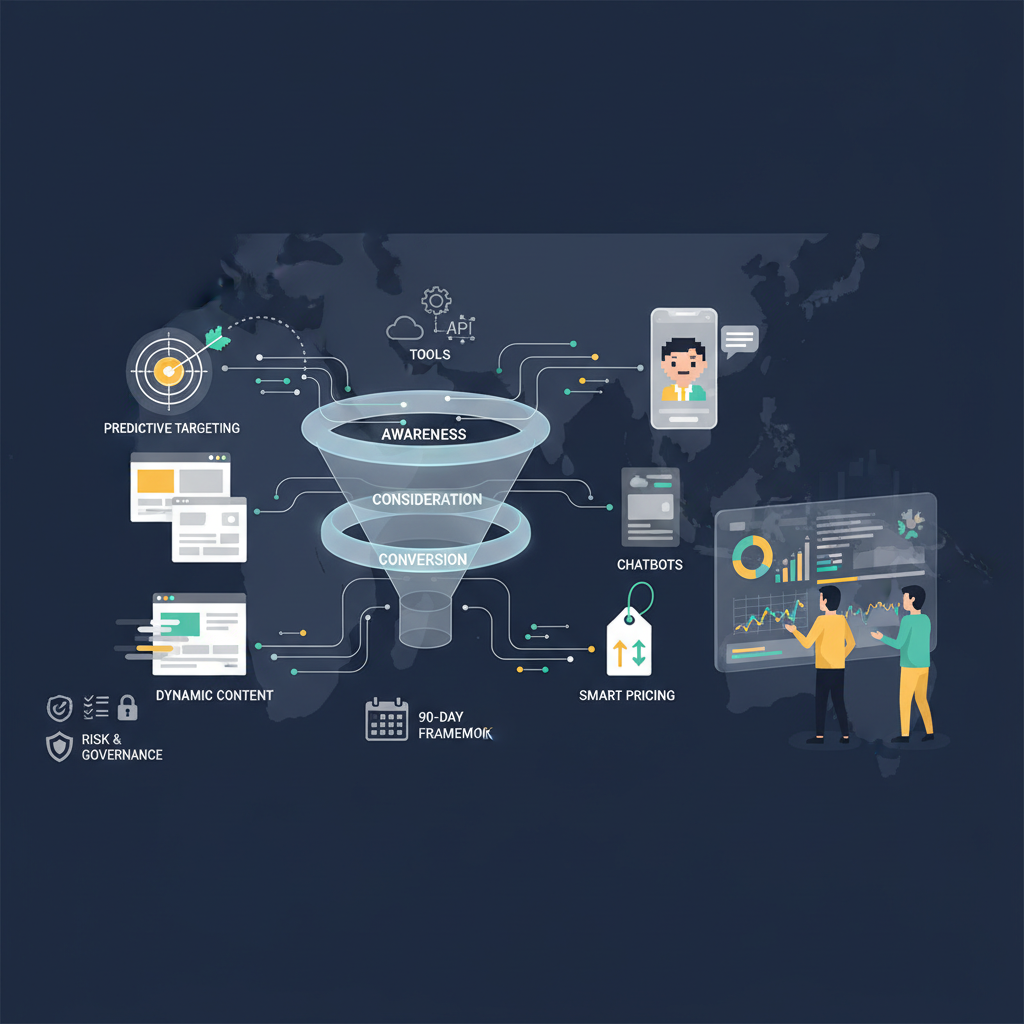
Core Use Cases Across the Funnel
AI delivers value at every stage of the customer journey. Here’s how leading organisations are deploying it.
Awareness – Predictive Ad Targeting
At the top of the funnel, AI helps you reach the right people with the right message before they even know they need you.
Programmatic media buying uses reinforcement-learning to move budget, bids, and creative in real-time. Platforms like Google’s Performance Max and Meta’s Advantage+ automatically test thousands of creative combinations and audience segments, then concentrate spend on the winners. Rather than a marketer manually managing dozens of campaigns, the AI learns what works and scales it [CITATION NEEDED].
Predictive audience discovery is particularly valuable in the cookieless era. As third-party cookies disappear, AI models trained on first-party data can identify look-alike audiences—people who share behavioural and demographic traits with your best customers—without relying on tracking pixels. This is especially relevant for Southeast Asian businesses navigating stricter privacy frameworks.
AI-assisted keyword and topic ideation accelerates SEO planning. Instead of manually brainstorming keywords, AI tools analyse search trends, competitor content, and your own performance data to surface high-intent, low-competition opportunities. One regional e-commerce firm used this to identify 200+ long-tail keywords in their category in a single afternoon—work that previously took a week [CITATION NEEDED].
Consideration – Dynamic Content & Chatbots
Once prospects arrive, AI personalises their experience and moves them toward a decision.
Dynamic on-site personalisation adapts content blocks, product recommendations, and messaging based on what the AI knows about that visitor. A visitor from a high-value segment might see premium product bundles; a price-sensitive segment sees entry-level options. Netflix’s artwork-swap feature—showing different movie posters to different users based on their viewing history—is the gold standard. Regional travel platforms are now doing the same with destination imagery and package descriptions [CITATION NEEDED].
AI-powered chatbots and voicebots using natural-language processing handle routine inquiries 24/7. They qualify leads, answer FAQs, and route complex issues to human agents. Unlike rigid rule-based bots, modern NLP-driven chatbots understand context and nuance. A customer asking “Is this jacket warm enough for winter?” gets a contextual answer, not a generic FAQ link. Southeast Asian fintech firms report 40-60% of customer service volume now handled by AI without human intervention [CITATION NEEDED].
Predictive lead scoring identifies which prospects are most likely to convert, so sales teams focus on high-probability opportunities. Rather than scoring based on static rules (for example, “anyone who downloaded a whitepaper gets 50 points”), machine-learning models analyse hundreds of signals—engagement patterns, company size, industry, email open rates, website behaviour—to predict conversion probability. This cuts sales cycle time and improves close rates [CITATION NEEDED].
Conversion – Smart Offers & Pricing
At the critical moment of purchase, AI maximises conversion and protects margin.
Dynamic pricing and offers adjust in real-time based on demand, inventory, and individual customer propensity. An airline might offer a deeper discount to a price-sensitive customer browsing economy fares, while a business traveler gets a premium cabin upgrade offer. E-commerce platforms use this to optimise both conversion rate and average order value simultaneously [CITATION NEEDED].
Email send-time and subject-line optimisation sounds simple but drives measurable lift. AI models predict the exact time each recipient is most likely to open an email, then schedules sends accordingly. Subject-line testing identifies which phrases resonate with different segments. One regional SaaS company saw a 23% lift in open rates and 18% lift in click-through rates after deploying this [CITATION NEEDED].
Smart retargeting chooses creative and bid based on likelihood to return. Rather than showing the same ad to everyone who visited your site, AI selects the creative most likely to resonate with that specific person, at the bid price most likely to win the auction. This reduces wasted spend and improves ROAS [CITATION NEEDED].
Leading AI Marketing Tools & Selection Criteria
The AI marketing technology landscape is crowded. Rather than naming specific vendors as “best,” it’s more useful to understand the categories and evaluation criteria that matter.
Data Foundations (CDPs & Clean Rooms)
No AI model is better than the data it learns from. This is why data infrastructure is the foundation.
Customer Data Platforms (CDPs) unify customer data from all touchpoints—website, app, email, CRM, offline purchases, call centre—into a single, clean customer view. This unified data is what machine-learning models need to make accurate predictions. A CDP also enables real-time activation: once a model identifies a high-value prospect, the CDP can instantly trigger a personalised email, push notification, or ad.
When evaluating CDPs, look for:
- Ability to ingest data from your existing martech stack without custom engineering
- Real-time data processing (not batch-only)
- Governance and audit trails (critical for compliance)
- Ease of creating audience segments without SQL coding
- Integration with your email, ad, and analytics platforms
Clean rooms are a newer category, designed for privacy-first collaboration. They allow you to match your first-party data with a partner’s (for example, a publisher or data provider) without either party exposing raw data. This is increasingly important as third-party cookies disappear. Clean rooms are particularly valuable for Southeast Asian businesses working with regional media partners or e-commerce platforms.
Content Generation & Personalisation Engines
This category has exploded in the past 18 months, driven by generative AI.
Generative AI for copy and creative uses large language models to produce email subject lines, ad copy, product descriptions, and even short-form video scripts. Harvard research shows that ChatGPT, Jasper, and similar tools have collapsed production cycles from hours to minutes [CITATION NEEDED]. 55% of AI-using marketers already deploy generative AI for text content; 38% for multimedia [CITATION NEEDED].
The catch: generative AI can hallucinate (invent facts), plagiarise, or produce off-brand content. This is why 43% of marketers cite accuracy and bias as top concerns [CITATION NEEDED]. Best practice is to use generative AI for drafts and ideation, then have humans review, fact-check, and refine before publishing.
Personalisation engines go beyond simple “if/then” rules to deliver 1-to-1 experiences at scale. They might generate a unique email newsletter for each subscriber, pulling in live inventory, pricing, and product recommendations tailored to that person’s browsing history. Or they might personalise a landing page headline, CTA, and imagery based on traffic source and device type.
When evaluating personalisation engines, prioritise:
- Ease of integration with your CMS and email platform
- Ability to test variations and measure lift
- Support for real-time decisioning (not just batch)
- Explainability (you should understand why a specific experience was chosen)
Analytics & Decisioning Platforms
The final piece is measurement and optimisation.
AI-powered attribution dashboards clean campaign data and surface winning assets automatically. Rather than manually comparing performance across channels, these platforms use machine-learning to model the contribution of each touchpoint to conversion. This is especially valuable in multi-touch journeys common in Southeast Asia, where customers interact with brands across web, mobile app, social, and offline channels.
Predictive analytics platforms forecast demand, churn risk, and customer lifetime value. These models help you allocate budget to the highest-impact initiatives. A regional bank might use churn-propensity models to identify at-risk customers, then trigger targeted retention offers before they leave.
Decisioning platforms orchestrate all the above—they ingest data from your CDP, run predictive models, and automatically execute the optimal action (send an email, show an ad, trigger a discount) across all channels in real-time.
When selecting these tools, ask:
- Can the platform integrate with your existing data stack?
- Does it support A/B testing and incrementality measurement?
- What’s the time-to-insight? (Can you get results in days, not months?)
- Is there a clear ROI case for your use case?
From Pilot to Scale – A Practical Implementation Framework
Moving from curiosity to production AI requires discipline. Here’s a framework that works.
Phase 1: Define the use case (Weeks 1–2)
Start narrow. Don’t try to “do AI marketing.” Instead, pick one specific problem: “Reduce email unsubscribe rate,” “Improve product recommendation accuracy,” or “Identify high-value prospects faster.”
For each use case, document:
- Current state: How is this done today? What’s the cost (time, money, missed opportunity)?
- Success metric: What will “better” look like? (for example, 15% lift in conversion rate)
- Data requirements: What customer signals do you need? Do you have them?
- Stakeholders: Who owns this process today? Who needs to buy in?
Phase 2: Pilot with clean data (Weeks 3–8)
Pick a small segment—maybe 5–10% of your customer base—and run the AI model in parallel with your current process. Don’t switch over yet; just observe.
During this phase:
- Validate that your data is clean and representative. Poor data will sabotage results.
- Monitor model performance daily. Is it making better decisions than the current approach?
- Gather feedback from the teams using it. Are there edge cases or brand concerns?
- Document everything: model accuracy, business impact, operational friction.
Phase 3: Expand and optimise (Weeks 9–12)
If the pilot shows promise, expand to 25–50% of your customer base. Continue monitoring, then gradually roll out to 100%.
During scale-up:
- Retrain the model regularly with fresh data. Models degrade over time as customer behaviour shifts.
- Set up automated alerts if model performance drops below acceptable thresholds.
- Document the process so it can be handed off to operations teams.
- Plan for the next use case. Success breeds momentum.
Risk, Ethics & Governance Checklist
AI marketing introduces new risks. A responsible approach requires governance.
Data governance
Establish clear protocols for how customer data is collected, stored, and used. This includes:
- Ensuring customer data is collected, stored, and used in line with local regulations and your privacy commitments
- Implementing access controls so only authorised teams can view sensitive data
- Maintaining audit trails of all data access and model decisions
- Regularly auditing data quality; poor data leads to biased models
Model governance
Define standards for how models are designed, tested, and monitored. For example:
- Documenting how each model works, what data it uses, and what decisions it makes
- Testing models for bias before deployment and remediating any systematic disadvantages for certain segments
- Keeping humans in the loop for high-stakes decisions, such as credit decisions or pricing
- Monitoring model performance over time and retraining when accuracy drops
Transparency and disclosure
Customers increasingly care about how AI is used. Consider:
- Being honest with customers about AI use; where relevant, disclosing that offers or recommendations are AI-generated
- Providing customers with ways to opt out of AI-driven personalisation if they prefer
- Avoiding AI applications that feel manipulative or deceptive
Practical checklist for your first AI project
- [ ] Use case is clearly defined and tied to a business metric
- [ ] Data is clean, representative, and governed
- [ ] Model performance is monitored daily during pilot
- [ ] Humans review high-stakes decisions (for example, credit, pricing)
- [ ] Privacy and compliance teams have signed off
- [ ] Team is trained on how to use and interpret the model
- [ ] Success metrics are tracked and reported to leadership
- [ ] Plan for model retraining and maintenance is documented
- [ ] Customers are informed about AI use where appropriate
- [ ] Escalation process exists if model performance degrades
Conclusion – Where AI-Driven Marketing Is Heading Next
AI marketing is no longer a future state—it’s operational reality for leading brands across Southeast Asia and globally. The question for marketing leaders is not whether to adopt AI, but how to do so in a way that drives business results while maintaining customer trust and brand integrity.
The trajectory is clear. Personalisation will become table-stakes; generic, one-size-fits-all marketing will disappear. Content production will accelerate further as generative AI improves. Predictive models will move from “nice to have” to core decision-making infrastructure. And the skills required of marketing teams will shift—entry-level production tasks will be automated, while demand for strategic thinking, model oversight, and creative problem-solving will grow.
For marketing managers in Singapore and across Southeast Asia, the path forward is pragmatic:
- Start with a single, high-impact use case. Don’t boil the ocean. Pick one problem, solve it well, and build momentum.
- Invest in data foundations first. Clean, unified customer data is the prerequisite for everything else. A CDP or clean room is often a better first investment than a fancy AI tool.
- Embrace the hybrid approach. Combine rule-based logic (for compliance and control) with machine-learning (for adaptation and optimisation).
- Keep humans in the loop. AI augments human judgment; it doesn’t replace it. The best results come from humans and machines working together.
- Measure rigorously. Track both hard metrics (revenue, cost per acquisition) and soft ones (customer satisfaction, content quality). Use data to make the case for scale.
- Govern responsibly. Build governance into your process from day one. It’s easier to add guardrails early than to retrofit them later.
The organisations that will win in the next three years are not those that adopt the most AI tools, but those that adopt AI thoughtfully—solving real problems, maintaining customer trust, and building sustainable competitive advantage.
Ready to Transform Your Marketing with AI?
The frameworks and use cases in this guide are designed for brands operating in Singapore and Southeast Asia. But moving from strategy to execution requires the right partner and approach.
If you’re ready to explore how AI can drive measurable results for your marketing programme—whether through predictive targeting, dynamic personalisation, content acceleration, or a broader digital marketing strategy—let’s talk. Our team has helped regional brands design and scale AI marketing pilots that deliver meaningful improvements in key metrics within 90 days.
We can help you identify the highest-impact use case, build a realistic roadmap, align your data foundations, and navigate the governance and change-management requirements along the way.
Contact us today to explore how AI marketing can work for your organisation.