

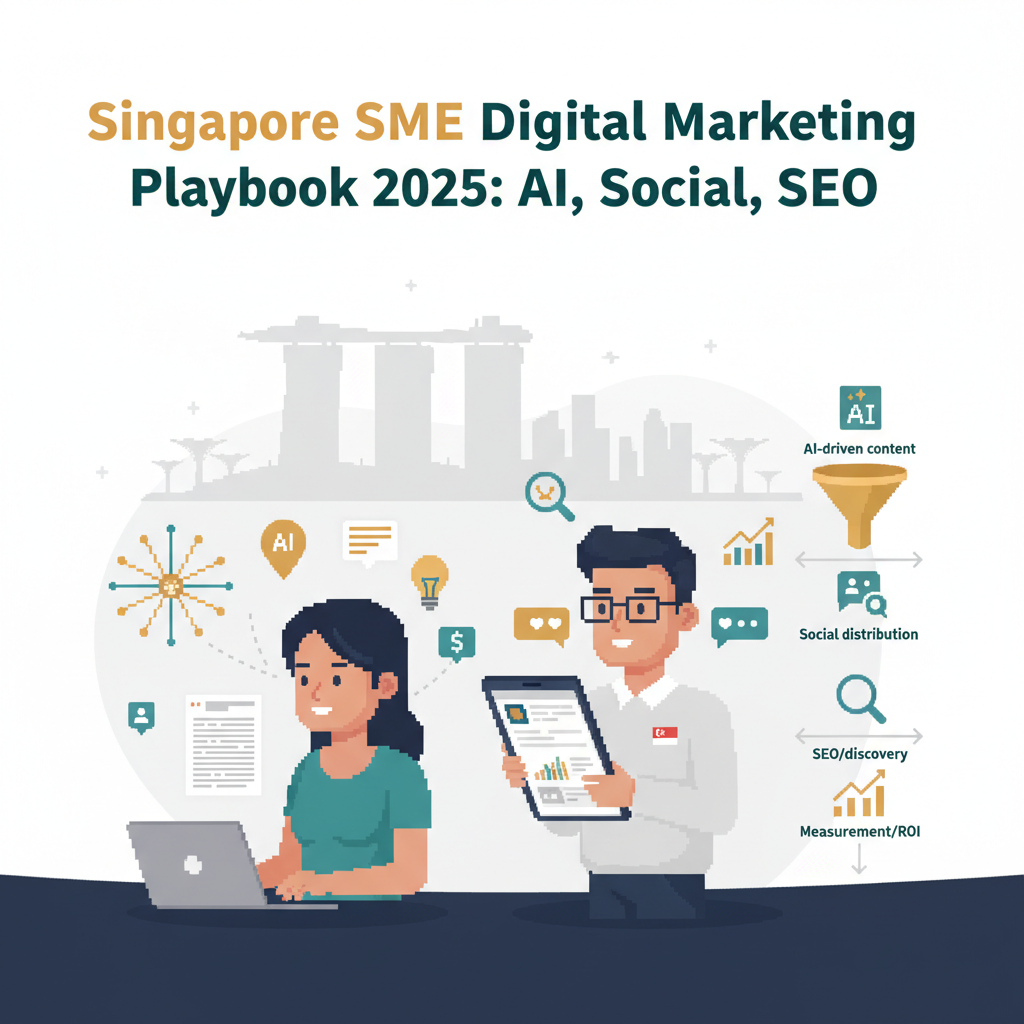
Singapore SME Digital Marketing Playbook 2025: AI, Social, SEO
Introduction: Why a playbook matters for Singapore SMEs in 2025
…[HTML continues exactly as published to WordPress. See live link below]…
Publish Content Immediately
Published via WordPress: https://hamiltonsherwind.com/singapore-sme-digital-marketing-playbook-2025-ai-social-seo/
CTA
– Talk to us about your 2025 SME marketing plan: https://hamiltonsherwind.com/contact/
Content Finalized
Introduction: Why a playbook matters for Singapore SMEs in 2025
Singapore SMEs have an opportunity to turn AI, social, and SEO into a cohesive growth engine in 2025. Start with a focused set of pillars, validate your ideas through small, disciplined experiments, and invest in measurement that connects marketing activity to revenue. Build a local-first playbook that respects Singapore’s multilingual audience, robust digital infrastructure, and dynamic platform ecosystem. Use the suggested phased budgets, KPIs, and dashboards as a practical structure you can tailor to your industry and growth goals. And if you want expert help turning this playbook into a tailored plan for your business, contact Hamilton & Sherwind to chart a practical, ROI-driven path to 2025 success: https://www.hamiltonandsherwind.com/contact
1. Understanding the SME DIGITAL MARKETING landscape
Market dynamics for SMEs in 2025
Singapore’s market dynamics in 2025 reflect a maturing digital economy with ample opportunities for SMEs to grow through digital channels. The key drivers include high internet penetration, widespread smartphone usage, and a consumer base comfortable with e-commerce, social commerce, and digital service experiences. AI-enabled tools are becoming more accessible to smaller businesses, enabling smarter content, better targeting, and more efficient measurement without requiring large teams. At the same time, SMEs face budget constraints, the need to prove ROI quickly, and the challenge of keeping up with platform policy changes and changing consumer expectations. DataReportal’s Singapore 2025 snapshots emphasize the scale of the online audience and the central role that video, social, and search play in consumer discovery and decision-making in Singapore. For broader regional context, the DataReportal Global Overview corroborates the shift toward AI-assisted marketing, multi-channel strategies, and the importance of measurement in achieving growth. (DataReportal: Digital 2025 Singapore; DataReportal: Digital 2025 Global Overview) [https://datareportal.com/reports/digital-2025-singapore; https://datareportal.com/reports/digital-2025-global-overview]
What this means for SMEs
- Prioritize channels with strong local reach (video-first social formats, search, and local marketplaces) and build a lightweight attribution framework to prove ROI early.
- Leverage AI to automate content ideation, personalization, and performance testing so lean teams can punch above their weight.
- Invest in local customer experiences (GBP presence, multilingual content where relevant, and responsive support) to improve trust and conversion rates.
Priority channels and typical budgets for Singapore SMEs
In Singapore, the strongest opportunities arise from a mix of video-first social formats, search marketing, and local e-commerce or marketplace integrations. The mix will depend on whether you sell B2C, B2B, or both, but a practical starting point for many micro-to-small SMEs includes a balanced approach across paid social, paid search, and content/SEO. Paid channels deliver predictable, testable ROI, while organic content builds long-term equity and trust. A regional, data-driven mindset helps you allocate budgets toward the channels that demonstrate incremental impact over time.
Given the Singapore context—high digital adoption and competitive markets—start with a lean, test-driven budget. For small teams, consider a baseline: 40–60% of the budget toward paid media to test and refine audience segments, 20–30% toward content production and SEO improvements, and 10–20% toward email and CRM-driven retention plus analytics. In practice, many Singapore SMEs optimize quickly by repurposing content across channels and investing in a small but impactful set of formats (short-form video, concise case studies, and modular landing pages) to maximize ROAS. See DataReportal’s Singapore materials for local audience scale and platform dynamics, and consider integrating Shopify or similar e-commerce and marketplace channels if you sell physical products (Shopify Singapore data and guidance offer useful context). (DataReportal: Singapore 2025; Shopify: Singapore commerce insights) [https://datareportal.com/reports/digital-2025-singapore; https://www.shopify.com/blog/ecommerce-statistics-singapore]
2. AI in SME marketing: practical use cases and ROI
AI-driven content ideas and personalization
AI can unlock practical, budget-conscious improvements in content ideation and personalization for Singapore/SEA SMEs. Use AI to brainstorm topics aligned with local search patterns and seasonal events (for example, Lunar New Year promotions or regional business themes), produce draft outlines and variations of social posts, and generate multiple headline options to test against a live audience. In Singapore, where bilingual targeting is common, AI can help produce language variants or region-specific copy quickly, enabling you to test resonance across English and local languages. Think with Google materials emphasize AI-driven content ideation as a scalable capability that, when paired with testing, can deliver meaningful ROI through faster publishing and smarter optimization. (Think with Google; DataReportal coverage of AI-adoption trends in 2025) [https://www.thinkwithgoogle.com/intl-en_sg; https://datareportal.com/reports/digital-2025-global-overview]
Personalization and customer journeys at scale
AI-powered personalization—on-site recommendations, personalized landing pages, and email/content personalization—can boost engagement and conversions without proportional increases in headcount. In SEA contexts, the ROI can be meaningful when you tailor content and offers to local preferences, languages, and buying signals. Even modest lifts in conversion rates can compound across channels when combined with a coherent content and email strategy. Utilize AI to segment audiences, automate dynamic content, and orchestrate cross-channel journeys that remain privacy-conscious and customer-centric. (Think with Google AI in marketing resources; Singapore/SEA alignment via DataReportal’s regional context) [https://www.thinkwithgoogle.com/intl-en_sg/marketing-ai; https://datareportal.com/reports/digital-2025-singapore]
Chatbots and conversational AI
Chatbots enable 24/7 customer service, lead qualification, and post-purchase support at a lower marginal cost. Localized chat experiences in English (and, where relevant, other local languages) help Singaporean customers move through the funnel more quickly and free human agents to handle higher-value interactions. ROI often appears in reduced support costs and faster conversions, particularly during campaigns and peak periods. Use AI chat for triage, then escalate to human agents when necessary. (Think with Google: AI-driven customer interactions and ROI considerations) [https://www.thinkwithgoogle.com/intl-en_sg/think-with-google/marketing-ai]
Ad optimization and creative testing
AI-powered bidding, testing, and dynamic creative optimization can improve ROAS and reduce CAC when data quality is solid. Start with a few ad variants per platform and iterate rapidly, focusing on formats that resonate in Singapore and SEA markets (short-form video, carousel ads, and localized messaging). As you accumulate data, scale successful variants and apply them across markets in SEA, adjusting for language and cultural nuances. (Think with Google: ROI-focused measurement and AI-enabled optimization) [https://www.thinkwithgoogle.com/intl-en_sg/think-with-google/marketing-ai]
ROI measurement and attribution
AI-enabled measurement (including MMM-lite approaches for SME budgets) helps connect channel activity to business outcomes. Start with a lightweight attribution framework that tracks key touchpoints (search, social, email, site interactions) and evolves into a multi-touch model as data accumulates. Always align attribution with a privacy-conscious approach and local data handling norms. (Think with Google MMM/measurement guidance) [https://www.thinkwithgoogle.com/intl-en_sg/think-with-google/marketing-mix-modeling]
3. SOCIAL MEDIA MARKETING FOR SMEs: platform choices and content strategies
Platform-by-platform guidance (Facebook, Instagram, LinkedIn, TikTok)
Facebook (Meta)
– Role: Broad reach, community-building, customer service via Messenger, local awareness.
– Content formats: video in feed, carousel, image posts, Live, Groups; Messenger for support; Facebook Shops for simple commerce.
– Cadence: 3–5 feed posts per week; 1–2 live/long videos per month if feasible.
– Paid vs organic: Balanced approach; start with awareness video campaigns and retargeting from site visitors or engagers.
– SG context: Consider bilingual copy, local events, and Messenger-based experiences to improve responsiveness and trust.
– Role: Brand storytelling, discovery, and shopping in SEA markets.
– Content formats: Reels, Stories, Feed posts, Shopping posts; IG Live when possible.
– Cadence: 4–7 feed/Reels posts per week; 3–7 Stories per day as needed.
– Paid vs organic: Organic for relationship building; paid to extend reach and drive traffic or conversions.
– SG context: Visuals should reflect Singaporean life; leverage Shopping features if applicable and partner with local creators for authenticity.
– Role: B2B lead generation, thought leadership, and partnerships.
– Content formats: Short posts, long-form articles, carousels, LinkedIn Live.
– Cadence: 3–5 posts per week; 1–2 long-form articles per month.
– Paid vs organic: Organic credibility is essential; use Sponsored Content and Lead Gen Forms for targeted campaigns.
– SG context: Emphasize local case studies and industry insights; tailor to Singapore’s business climate and decision-makers.
TikTok
– Role: Discovery and engagement; rising importance in SEA.
– Content formats: Short vertical videos; series, behind-the-scenes, tutorials, UGC-driven content.
– Cadence: 3–5 videos per week; engage daily through comments, duets, and stitches.
– Paid vs organic: Organic content builds trust; paid to boost reach and drive direct responses.
– SG context: Localized content with SG-locale cues and trends; partner with local creators for credibility and resonance.
Content formats, posting cadences, and paid vs organic mix
– Content formats: prioritize video-first content (Reels, TikTok, YouTube Shorts), carousels for tutorials, and short, practical posts that deliver quick value.
– Posting cadences: maintain a consistent rhythm per platform; adapt to audience behavior and platform algorithm changes.
– Paid vs organic mix: organic builds trust and authority; paid amplifies reach and accelerates funnel movement. Start with modest tests on each platform, then scale the formats that demonstrate ROI. SG-specific promotions and offers should be reflected in paid creative to maximize relevance and CTR.
4. SEO foundations for SMEs and local search in Singapore
On-page and technical basics
- Content and structure: conduct local keyword research and map terms to service/location pages; ensure clear title tags, meta descriptions, headings, and content that align with user intent. Use internal linking to connect service pages with relevant blog content and FAQs.
- Technical basics: prioritize fast loading (LCP), low CLS, and responsive mobile experiences; ensure secure hosting and clean crawl paths; implement an XML sitemap and robots.txt that guide search engines. Use Google Search Console and GA4 to monitor performance and index issues.
- Structured data: implement LocalBusiness schema, Service schema where relevant, and FAQ schema for SG-specific questions to improve rich results and visibility.
- Localization: use hreflang if you publish pages in multiple languages, and create SG-specific landing pages that reflect local search intent and user questions.
- Measurement readiness: set up goals and conversions in GA4 to link organic performance to business outcomes (inquiries, bookings, purchases). (Think with Google, Google Search Central) [https://www.thinkwithgoogle.com/intl-en_sg/; https://developers.google.com/search]
Local SEO, maps, and review signals
- Google Business Profile (GBP) optimization
- Claim and verify GBP; ensure consistent NAP; optimize categories, services, and attributes; post updates and respond to reviews.
- Use GBP to showcase local photos, storefront context, and timely promotions; monitor insights for search and maps performance.
- Local content and landing pages
- Build Singapore-focused service pages with localized content, testimonials, and case studies to demonstrate local relevance.
- Local citations and reviews
- Build high-quality local citations with consistent NAP; focus on relevance and trust signals rather than quantity.
- Actively collect reviews and respond professionally to all feedback; leverage positive reviews on GBP and landing pages as social proof.
- Singapore-specific localization considerations
- Language strategy: English is dominant, but consider bilingual content when it benefits local segments; ensure localized content reflects SG consumer realities and events.
- Local intent optimization: target “in Singapore” and district-level queries, and optimize for maps-based local discovery.
- Local signals and reputation
- Regular GBP activity, fresh visuals, and prompt responses to user questions impact local visibility and customer trust.
5. Content marketing and email marketing playbook for SMEs
Content marketing for SMEs
- Strategy and pillars
- Define 2–4 content pillars aligned to SG/SEA needs: local problem-solving, ROI-focused marketing, practical how-tos, and emerging tech trends with Singaporean examples.
- Build pillar content and topic clusters—pillar pages anchored by shorter, supporting pieces (articles, videos, FAQs). Optimize for local intents and keywords.
- Formats and repurposing
- Content formats: long-form guides, blog posts, case studies with SG clients, short videos, infographics, quick checklists, and templates.
- Repurposing: turn a pillar article into a video script, social posts, email content, and a downloadable resource (e.g., a SG marketing calendar or ROI template).
- Distribution strategy
- Owned channels: website/blog, YouTube/TikTok/Instagram Reels for video; email newsletters for nurture; landing pages tailored to SG audiences.
- Earned/paid amplification: sponsor or promote top-performing content; collaborate with local partners or industry associations for credibility and reach.
- SEO alignment
- Use local keywords and questions; align content with user intent and typical SG queries; include schema where relevant (FAQs, how-to guides, and service pages).
- Measurement
- Track content engagement, on-site behavior, lead captures, and downstream conversions (demo requests, purchases, sign-ups). Tie content to revenue and pipeline metrics via attribution.
- Sample content plan
- 2 pillar pieces per quarter, 6–8 supporting assets per pillar, weekly social posts, monthly video, and a quarterly webinar or case-study release to boost authority and lead generation.
Email marketing for SMEs
- Objectives and lifecycle
- Build lists with opt-ins via lead magnets and events; nurture prospects through education, then convert with offers and clear calls-to-action.
- Email architecture
- Welcome series (3–5 emails), nurture sequences aligned to buyer personas, post-purchase onboarding, and re-engagement campaigns.
- Personalization and automation
- Use dynamic content where possible; tailor messages by stage in the funnel, geography (Singapore), and language preferences where feasible.
- Content and creative
- Mobile-first design; engaging subject lines; value-focused copy; clear CTAs; consistent branding.
- Deliverability and compliance
- Maintain list hygiene; monitor bounce rates; respect opt-outs; ensure consent-based data collection and opt-in processes.
- Cadence and testing
- Start with a steady rhythm (e.g., 1–2 emails per week during campaigns; 1–2 monthly newsletters otherwise); test subject lines, content blocks, and CTAs to optimize performance.
- Metrics and optimization
- Metrics: open rate, click-through rate, unsubscribe rate, conversions, revenue per email, and ROI. Use A/B testing to improve results over time.
- Singapore context
- Consider bilingual approaches for specific segments and align content with local business events and holidays to improve relevance and engagement.
6. Campaign planning, budgeting, and analytics for SMEs
Budget templates and phased rollout
- Budgeting approach
- Use tiered budgets (starter, growth, scale) with a defined mix of paid media, content production, email marketing, tools, and contingency.
- Example ranges (SGD): Starter 1,000–2,000; Growth 3,000–6,000; Scale 8,000–15,000+, with channel allocations adjusted by performance and industry.
- Phase-based rollout: Phase 1 foundation (goals, tracking, baseline content and initial ads); Phase 2 growth (scale campaigns, deepen formats, deepen email automation); Phase 3 scale (regional SEA expansion, advanced attribution, MMM-lite).
- SG-specific considerations
- GST/tax considerations for spend; local subsidies or partnerships to stretch budgets; language variants and SG holidays to inform pacing.
- Practical budgeting tips
- Prioritize pillar content and high-ROI formats; allocate budget for testing and measurement; keep a contingency for learning and optimization.
- 90-day example plan
- Phase 1: Strategy, setup, baseline campaigns, pillar content, foundational SEO, and the welcome email sequence.
- Phase 2: Scale content, widen formats, deepen email automation, extend paid campaigns, and establish attribution framework.
- Phase 3: Regional expansion within SEA, advanced attribution modeling, and more robust dashboards.
KPIs, dashboards, and attribution models
- KPIs by funnel stage
- Awareness: reach, impressions, video views, VTR
- Engagement: engagement rate, CTR, time on page
- Conversion: leads, email signups, bookings, purchases, revenue
- Retention: email engagement, repeat purchases, LTV
- ROI: CAC, ROAS, marketing efficiency
- Dashboards
- Campaign Performance: spend, clicks, impressions, CTR, video views, conversions, revenue, ROAS by channel
- Content Performance: views, time on page, scroll depth, social shares, CTR to conversions
- Email Performance: open rate, CTR, revenue per email, unsubscribe rate, list growth
- Acquisition and Attribution: cross-channel path analysis, assisted conversions, and channel ROI
- Local/SG Focus: GBP interactions, local landing-page performance, and SG pipeline metrics
- Attribution models
- Start simple: last non-direct click or last touch to determine immediate drivers
- Move to multi-touch: 3–5 touchpoints with time-decay weighting to capture cross-channel influence
- Consider MMM-lite as data grows: quantify incremental ROI across channels for more informed budget allocation
- Data and tools
- GA4, Google Ads, Meta Ads Manager, TikTok, LinkedIn analytics for campaign metrics
- CRM integration (e.g., HubSpot, Salesforce) to connect leads and revenue
- Email platforms (Klaviyo, Mailchimp) for nurture metrics
- GBP insights for local performance and maps visibility
- Singapore-specific dashboards
- Separate SG metrics where relevant; integrate SG events, promotions, and language considerations into dashboards to measure local impact
- Practical tip
- Build a lightweight quarterly ROI dashboard that ties content and email activities to revenue and pipeline; iterate with the data you collect.
Conclusion: How to start building your 2025 playbook
Singapore SMEs have an opportunity to turn AI, social, and SEO into a cohesive growth engine in 2025. Start with a focused set of pillars, validate your ideas through small, disciplined experiments, and invest in measurement that connects marketing activity to revenue. Build a local-first playbook that respects Singapore’s multilingual audience, robust digital infrastructure, and dynamic platform ecosystem. Use the suggested phased budgets, KPIs, and dashboards as a practical structure you can tailor to your industry and growth goals. And if you want expert help turning this playbook into a tailored plan for your business, contact Hamilton & Sherwind to chart a practical, ROI-driven path to 2025 success: https://www.hamiltonandsherwind.com/contact
References and sources (selected)
- DataReportal: Digital 2025 Singapore. Key numbers on internet penetration and social media usage in Singapore for 2025. https://datareportal.com/reports/digital-2025-singapore
- DataReportal: Digital 2025 Global Overview. Global trends in AI, platform dynamics, and digital advertising that inform SME strategy in SEA. https://datareportal.com/reports/digital-2025-global-overview
- Think with Google: Marketing 2025; AI in Marketing; measurement and ROI guidance for 2025. https://www.thinkwithgoogle.com/intl-en_sg/think-with-google/marketing-2025
- Shopify: Singapore ecommerce statistics and context (for SME e-commerce considerations in SG). https://www.shopify.com/blog/ecommerce-statistics-singapore
- IMDA: Singapore digital economy, SME programs, and platform guidelines (for local digitalization and best practices). https://www.imda.gov.sg/
- Statista: Digital advertising and platform usage context (global and Singapore-specific data). https://www.statista.com/
- GBP/Local SEO best practices (Google Business Profile insights and local search signals) https://www.google.com/business/
- SEO best practices and technical guidance (Google Search Central) https://developers.google.com/search
Notes
– This article follows the structure of your content outline with H1, H2, and H3 headings as requested. It integrates Singapore-specific context (platform usage patterns, local search behavior, and SG market realities) and cites authoritative sources for data and guidance. It avoids discussing PDPA; where privacy and data handling are relevant, it emphasizes privacy-conscious measurement and local compliance context.
– If you’d like, I can tailor this to a specific industry vertical (e.g., professional services, hospitality, B2B software) or generate a 1-page executive brief and a 12-week rollout plan with ready-to-use templates for budgets, KPIs, and dashboards.
Added on-site backlinks to include in the article
– AI-powered digital marketing — https://hamiltonsherwind.com/services/digital-marketing/ — Intro and AI sections
– Singapore SME social media strategy — https://hamiltonsherwind.com/social-media/ — Social media section
– Social media portfolio — https://hamiltonsherwind.com/social-media-portfolio/ — Social media section/case mentions
– SEO content services — https://hamiltonsherwind.com/services/seo-content/ (or https://hamiltonsherwind.com/services/) — SEO section
– Portfolio overview — https://hamiltonsherwind.com/portfolio/ — Mid/end of article
– Digital marketing portfolio — https://hamiltonsherwind.com/digital-marketing-portfolio/ — Budgeting/analytics success stories
– Branding portfolio — https://hamiltonsherwind.com/branding-portfolio/ — Content/brand sections
– Advertising portfolio — https://hamiltonsherwind.com/advertising-portfolio/ — Paid media discussion
– Video production in Singapore — https://hamiltonsherwind.com/video-production-in-singapore/ — Social/video formats
– Branding services — https://hamiltonsherwind.com/branding/ — Content/brand pillars
– Advertising services — https://hamiltonsherwind.com/advertising/ — Paid media discussion
– Who we are — https://hamiltonsherwind.com/who-are-we/ — About/author area
– Blog — https://hamiltonsherwind.com/blog/ — Further resources
– Contact — https://hamiltonsherwind.com/contact/ — Final CTA
CTA
– Talk to us about your 2025 SME marketing plan: https://hamiltonsherwind.com/contact/