

How to Pick the Best Branding Agency in Singapore: A 5-Step Buyer’s Guide for 2025
1. Why Branding Matters in Singapore’s Competitive Market
In Singapore's hyperconnected marketplace, where internet penetration and daily social-media usage create an always-on, high-ad-density environment, a clear brand is no longer a luxury—it's your first handshake with customers. Without it, even the best product becomes invisible in the noise.
Branding's impact extends far beyond customer acquisition. Strong brands command price premiums, improve conversion, and attract better talent and partners. When you look at how Singapore itself is consistently ranked as one of the world’s most valuable nation brands by firms like Brand Finance, the lesson for companies is clear: brand equity is a balance-sheet asset, not a vanity cost.
Yet many executives still approach branding as an afterthought—a logo refresh or a quick design project. This mindset is costly. SMEs that skip proper strategy and buy “logo-only” solutions often find themselves rebranding again within 18–24 months, effectively doubling their investment. The right branding partner, by contrast, acts as a business architect, not just a designer—connecting brand strategy to commercial outcomes, digital execution, and long-term growth.
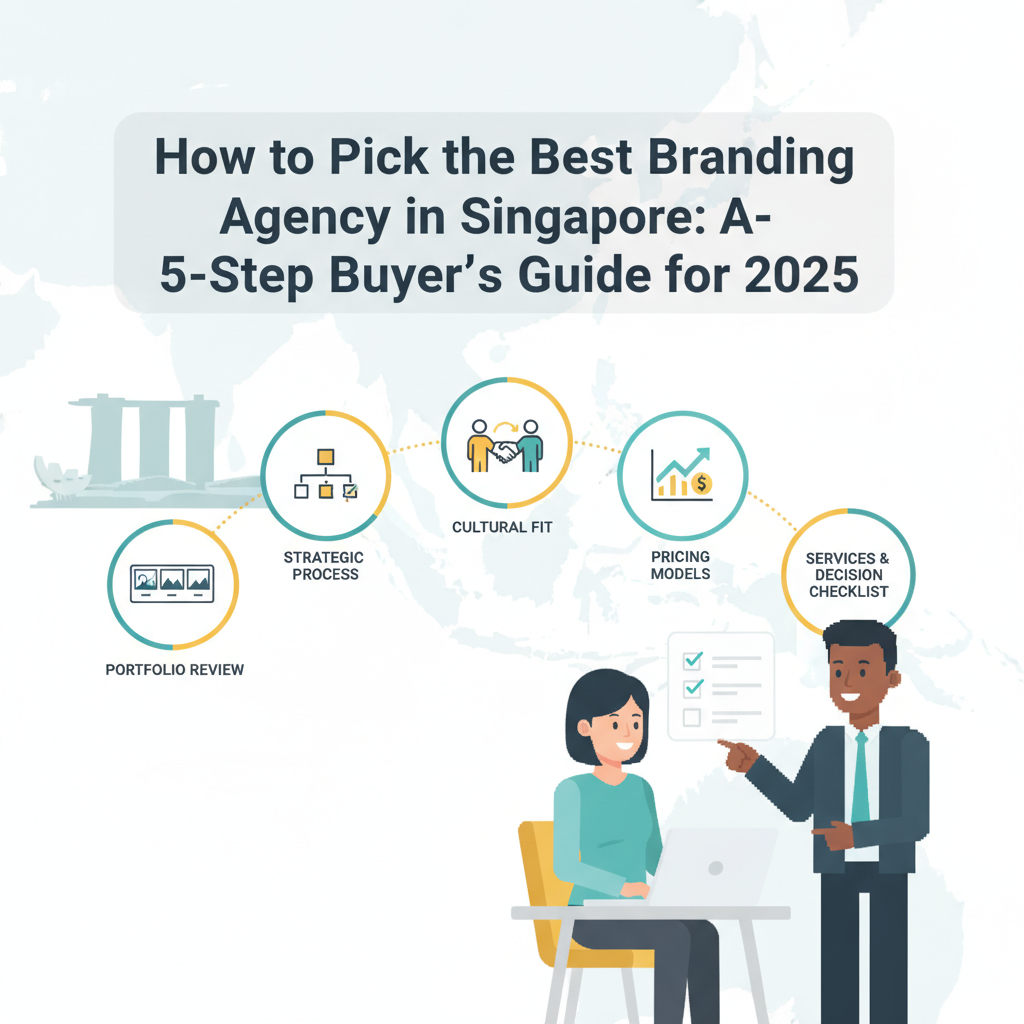
This guide walks you through a five-step framework to identify and select the branding agency in Singapore that can become your strategic partner, not just a vendor.
2. Shortlisting “Branding Agency Singapore” Candidates
The initial shortlist is where many executives stumble. They Google “branding agency singapore,” scan a few websites, and invite three firms to pitch. This approach misses critical signals about capability, cultural fit, and strategic depth.
A better approach begins with clarity on your own needs:
- Are you a heritage brand seeking repositioning?
- A scale-up needing to establish market presence?
- A multinational entering Singapore or Southeast Asia for the first time?
Each scenario demands different expertise. Once you’ve defined your challenge, use these two filters to build a credible shortlist.
Portfolio Depth & Case Studies
A portfolio is not just a gallery of pretty designs. It’s a window into how an agency thinks, what industries it understands, and whether it can articulate business outcomes alongside aesthetics.
When reviewing portfolios (for example, a page like Hamilton & Sherwind’s own branding portfolio), look for depth over breadth:
- Before-and-after context. Do case studies explain the situation before the rebrand, the strategic approach, and the outcomes? “We designed a new logo” is not enough. You want to see how the work impacted awareness, perception, or commercial metrics.
- Industry relevance. If you’re in financial services, review work done for banks, insurers, fintech, or adjacent highly regulated sectors. If you’re in F&B or retail, look for hospitality, malls, and consumer brands.
- Multicultural execution. Singapore is inherently multicultural. Review how the agency handles English and mother-tongue marketing (Mandarin, Malay, Tamil), as well as visual and verbal nuances for festive periods such as Lunar New Year, Hari Raya, and Deepavali.
- Omnichannel coherence. Check if identity systems hold together across web, social, video, print, events, and retail environments. Browse their overall services and specific executions like social media or advertising to see whether the brand feels consistent across touchpoints.
Awards, Certifications, and Social Proof
Third-party validation matters, but not all awards are created equal. A Cannes Lions or D&AD trophy signals creative excellence, but your main concern as a CMO or founder is: can this agency move the needle for my business?
Look for a blend of:
- Market recognition of their clients. Are their clients recognised locally or regionally? A portfolio of brands that have grown, expanded regionally, or launched successful campaigns is very telling.
- Relevant local experience. Has the agency worked with Singapore brands in sectors similar to yours—education, government-linked companies, malls, lifestyle, technology, or B2B? Browse their branding portfolio and other sections like the advertising portfolio to see this in context.
- Testimonials and case-study narratives. Look for specific quotes from clients that reference outcomes (“helped us clarify our story for international markets”, “simplified a complex service into a brand people understand”), not just “they were great to work with.”
Awards and social proof are helpful screening tools, but shouldn’t override evidence of strategic thinking and fit for your business stage.
3. Deep-Dive Evaluation Factors
Once you’ve shortlisted three to five branding agencies, it’s time to dig deeper. This is where you separate genuine strategic partners from vendors who simply “take orders” from your brief.
Strategic Methodology & Process Transparency
Ask each agency to walk you through their discovery and strategy process. A credible branding firm in Singapore will insist on clarity of strategy before any visual work starts.
Key questions to probe include:
- How do you uncover the brand foundation? Do they run stakeholder interviews (leadership, sales, frontline staff)? Do they review existing research, customer feedback, and market data? Do they benchmark you against local and regional competitors?
- What frameworks do you use for positioning and messaging? You don’t need jargon, but you do want a structured approach: brand essence, value proposition, audience segmentation, proof points, and so on. This is the “thinking skeleton” behind your eventual visuals and campaigns.
- How do you test and validate your strategy? Some agencies validate concepts with internal pilot campaigns, stakeholder workshops, or small audience tests before committing to full rollout.
- What does your typical timeline look like? A proper rebrand (strategy, identity, guidelines, key touchpoints) often spans 12–16 weeks. Agencies promising “full branding” in 3–4 weeks are likely skipping crucial steps.
Look for detailed, practical answers—milestones, sample workshop agendas, and examples of how they’ve handled complexity in previous projects.
Cultural Fit, Communication, and Project Management
Brand engagements are intense. You’ll interact with the agency team weekly for months. Misaligned working styles can derail even the best strategy.
Assess:
- Who will actually work on your account? Not just the pitch team. Meet the strategists, designers, and project managers who will run day-to-day with you.
- Communication rhythm. Weekly standups? Fortnightly steering-committee check-ins? A good agency will propose a structure that respects your internal approval layers while keeping momentum.
- Multilingual capability. If you need brand rollouts in multiple languages, ask whether they have in-house or tightly integrated partners for copywriting and localisation, not just basic translation.
- Project governance. Who is your single point of contact? How are decisions documented? How are scope changes handled? This project-management discipline is often as important as raw creativity.
In short: you want a partner that listens, challenges constructively, and runs a clear process.
4. Understanding Pricing Models & ROI
Branding budgets in Singapore vary significantly: from sub-S$20k “logo plus basic collaterals” for micro-businesses, to S$100k–S$250k+ for mid-market and regional brands doing holistic strategy and identity.
It’s crucial to understand both how agencies price and how to think about returns.
Project vs Retainer Structures
You will typically encounter three models:
- Fixed-scope project
Best for one-off or periodic rebrands, product launches, or “reboot” projects. The agency defines deliverables—e.g., discovery, strategy, visual identity, guidelines, a core set of collaterals (website design, pitch deck, key campaign assets)—with a fixed fee and timeline. This offers clear scope and budget predictability, but change requests and additional items are chargeable so you need to be disciplined about prioritisation. - Retainer or subscription
Best for brands that have ongoing creative and content needs, or those wanting continuous strategic support post-rebrand. You pay a monthly fee for a set number of hours or outputs—strategy sessions, design requests, content creation, social-media assets. This gives predictable monthly spend and seamless continuity, but there is under-utilisation risk if you don’t have enough internally organised demand. - Hybrid (project + retainer)
Best for medium to large organisations that need a major transformation followed by sustained marketing execution. A fixed-fee rebrand project is followed by a 6–12 month retainer for rollouts, content, and campaigns. This ensures your new brand doesn’t “die in a PDF guideline”, but actually appears consistently in social, web, events, and other channels. It requires upfront commitment and clear success metrics.
Whatever model you choose, request a transparent breakdown: strategy, creative, production, and any third-party costs (e.g., photography, video production). A good agency will willingly explain how the fee links to seniority, time allocation, and complexity.
How to Forecast Brand Equity Gains
Brand ROI is not as instantly visible as a performance campaign, but it’s very real. To make a rational decision, approach it in three layers:
- Commercial metrics
Average selling price or rate card uplift, conversion rates (lead-to-opportunity, opportunity-to-close), and new market or segment entry enabled by clearer positioning. For example, if better positioning and identity allow you to increase your average project size by just 10%, that compounded over 12–24 months can justify a six-figure branding investment. - Cost and efficiency metrics
Reduced rework because of clear guidelines, shorter briefing and approval cycles for marketing materials, and lower agency onboarding time if future partners can quickly understand your brand system. A robust brand system and templates can easily save dozens of staff hours each month. - Strategic and intangible gains
Employer brand (better quality applicants; reduced time-to-hire), investor confidence (clearer, more coherent story across decks, site, and PR), and partner or distributor alignment across the region. While these are harder to quantify upfront, you can track them over time through HR metrics, funding cycles, and partner performance.
Before your rebrand starts, agree with your agency on baseline KPIs and how you’ll measure change 6–12 months after launch.
5. Core Services Every Branding Firm in Singapore Should Offer
Not every agency needs to do everything in-house, but for a serious engagement you should expect them to cover or orchestrate three pillars: strategy, identity, and activation.
If you’re assessing Hamilton & Sherwind, you’ll see these mapped across services like branding, digital marketing, social media, and our wider portfolio overview.
Brand Strategy & Positioning
Core deliverables should include:
- Brand audit and competitive review
- Customer and stakeholder insights
- Brand platform (purpose, vision, values, promise, personality)
- Positioning narrative and key messages per audience (customers, partners, talent, investors)
- Brand architecture if you have multiple products or sub-brands
Ask to see a sample anonymised strategy deck so you can judge the depth and clarity of their thinking.
Visual Identity & Design Systems
Beyond logos, your agency should define a coherent design system that works across a modern marketing stack:
- Logo suite and lockups
- Colour palettes and typography
- Iconography, illustration, and photography style
- Layout systems for social, web, print, and presentations
- A usable, shareable brand guideline (not just a static PDF nobody opens)
Review how they applied these in their branding portfolio or digital marketing portfolio. Does each brand feel distinctive yet consistent across formats?
Integrated Marketing & Ongoing Support
A brand that lives only in guidelines has no commercial value. Look for a partner that can help you launch and steward the brand:
- Campaign concept and key visuals
- Website experience aligned with new positioning
- Social media frameworks and content pillars (see the social media portfolio for examples)
- Support for events, video, and experiential work (e.g., event portfolio, video portfolio)
This doesn’t mean you must give them every channel, but they should understand how brand translates into campaigns and content.
6. Decision Timeline & Final Checklist
At this point, you may have two strong contenders. Choosing between them requires internal alignment and a structured checklist.
Stakeholder Alignment Steps
To avoid stalling mid-project, take these steps before appointing your agency:
- Clarify decision-makers. Identify who has final say on strategy, creative, and budget. Document this clearly.
- Run a joint workshop. Invite your shortlisted agency to facilitate a short workshop with your core team. You’ll learn how they handle live discussions, conflict, and ambiguity.
- Align on success metrics. Agree what “success” looks like 12 months after launch, such as NPS improvement, RFP win rate, or inbound lead quality.
- Secure budget for rollout, not just design. Budget for website updates, launch campaign assets, and internal communications—not just the core identity work.
Red Flags and Deal-Breakers
Some signals should prompt caution:
- The agency can’t clearly explain its process, or avoids questions about timelines and governance.
- You never see the actual team who will work on your account.
- They dismiss the need for research or stakeholder engagement, claiming they already “know your industry” without evidence.
- Their contract makes intellectual property (IP) ownership murky; you should own your brand assets.
- Communication during the pitch is slow, disorganised, or defensive.
In contrast, a strong partner will be transparent, realistic about what branding can and can’t do, and willing to say “no” to unreasonable timelines.
Conclusion: Moving Forward with Confidence
Choosing a branding agency is effectively choosing a thinking partner for how your business shows up in the world. The right branding agency in Singapore will understand the nuances of the local and regional market, connect brand strategy to business outcomes, build a system that scales across channels and countries, and work with you, not just for you.
Use this guide as your due-diligence framework. Shortlist based on real case studies, interrogate process and cultural fit, understand pricing models, insist on full-funnel capabilities, and align stakeholders before you sign.
If you’re ready to explore a strategic rebrand or brand refresh, you can review Hamilton & Sherwind’s core branding services and related capabilities across digital marketing, social media, and our wider portfolio. When you’re ready to talk, contact us to schedule a confidential consultation with our team.