

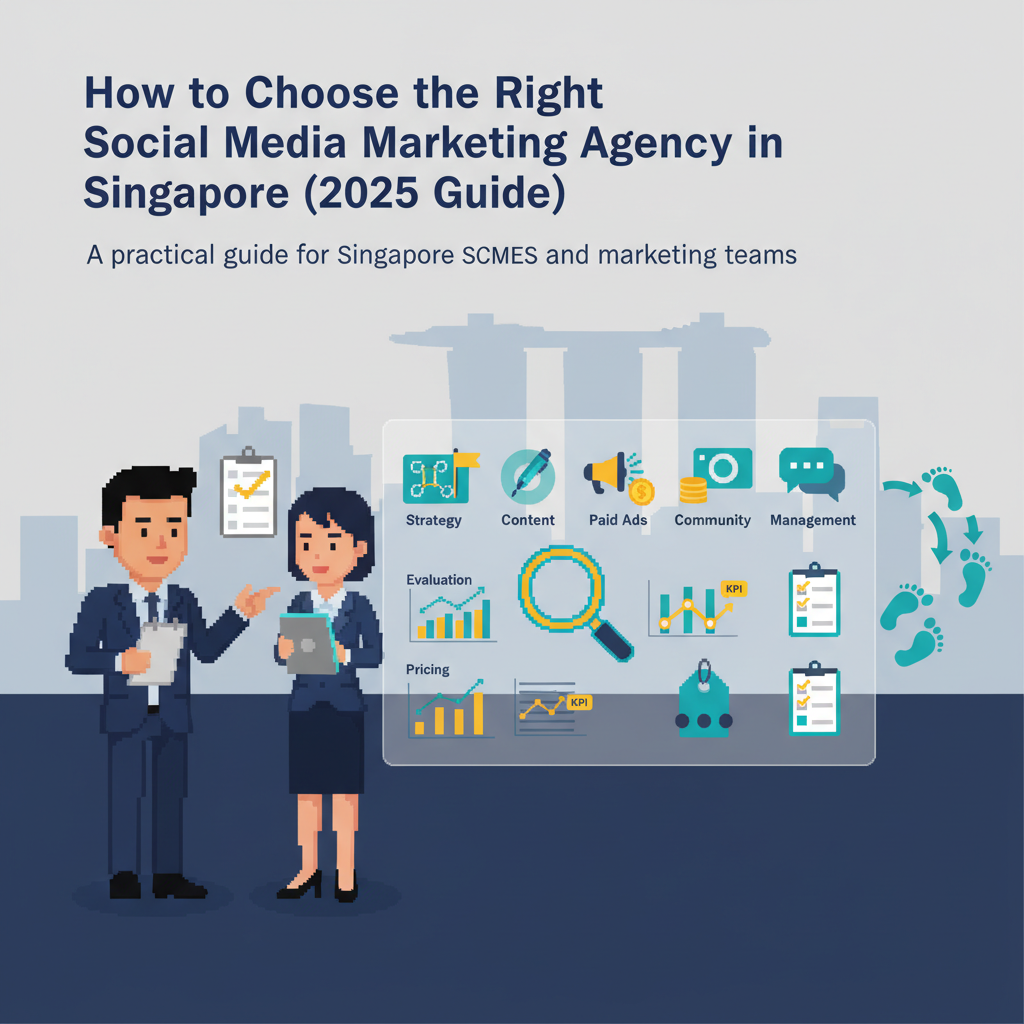
How to Choose the Right Social Media Marketing Agency in Singapore (2025 Guide)
Introduction – Why Getting the Right Fit Matters
Selecting a social media marketing agency is one of the most consequential decisions a Singapore-based business can make. With social platforms now serving as primary channels for customer discovery, engagement, and conversion, the stakes have never been higher. Yet many SME owners and marketing managers approach this decision reactively—often after a failed campaign or when an in-house team becomes overwhelmed.
The reality is that social media marketing has evolved far beyond posting content and hoping for engagement. Today's landscape demands strategic sophistication: understanding platform algorithms, managing paid budgets across multiple channels, creating culturally resonant content, and measuring return on investment with precision. A misaligned partnership can drain resources and damage brand reputation. Conversely, the right agency becomes a strategic extension of your team, unlocking growth that would be impossible to achieve alone.
This guide walks you through a vendor-neutral framework for assessing your needs, evaluating agency capabilities, and making a decision grounded in data rather than marketing promises. Whether you're a bootstrapped startup, a scaling e-commerce brand, or an established SME looking to refresh your social presence, the principles outlined here will help you find a partner that genuinely fits your business.
Clarify Business Goals and Audience Personas
Before you speak to a single agency, you must first understand what success looks like for your business. This foundational step is often skipped, leading to misaligned expectations and wasted spend.
Mapping Goals to Social Platforms
Not all social platforms serve the same purpose. Instagram excels at visual storytelling and e-commerce discovery. LinkedIn dominates B2B lead generation and thought leadership. TikTok drives viral awareness among Gen Z and younger millennials. WhatsApp Channels enable direct, intimate communication with loyal customers. The platform mix that works for a fashion brand will differ entirely from that of a B2B SaaS company.
Start by defining your primary business objective. Are you:
- Building brand awareness among a new audience segment? (Typically TikTok, Instagram Reels, YouTube Shorts)
- Generating qualified leads for a sales team? (LinkedIn, Facebook Lead Ads, Instagram)
- Driving e-commerce conversions through shoppable content? (TikTok Shop, Instagram Checkout, Shopee Live)
- Nurturing an existing customer base with loyalty and repeat purchases? (WhatsApp Channels, private IG Close-Friends lists, email-to-social retargeting)
- Managing reputation and community during a growth phase? (All platforms, with emphasis on community management and social listening)
Once you've identified your primary goal, map it to the platforms where your audience actually spends time. This requires research: use Meta's Audience Insights, TikTok's analytics, and LinkedIn's demographic data to confirm where your target customer is active. A good agency will validate these assumptions during the discovery phase, but you should arrive at the conversation with a hypothesis.
In-house Capabilities vs. External Expertise
The next critical question is: what can your team handle, and where do you need external support?
Many businesses operate with a hybrid model. Your in-house team might excel at brand voice and product knowledge but lack the technical expertise to manage paid advertising budgets or produce short-form video at scale. Alternatively, you might have a capable social media manager but no capacity for strategic planning or community management during peak seasons.
Be honest about your constraints:
- Bandwidth: How many hours per week can your team dedicate to social media?
- Skillset gaps: Do you have in-house video production, copywriting, or paid media expertise?
- Technology: Do you have access to social listening tools, analytics platforms, or design software?
- Scalability: If you double your social media ambitions next year, can your team scale, or will you hit a ceiling?
An agency should help you identify these gaps and propose a service model that complements your in-house efforts. Some agencies offer fractional support (e.g., a part-time strategist), while others take full ownership of execution. The best partnerships are transparent about what the client team will own versus what the agency will handle.
Core Services Offered by Singapore Agencies
Singapore's social media marketing agencies have matured significantly. The best ones now offer an integrated suite of services that span strategy, creative production, paid media, community management, and analytics. Understanding what each service entails will help you evaluate proposals and avoid paying for capabilities you don't need.
Strategy & Content Creation
A strong social media strategy is the foundation of all subsequent work. This is where an agency earns its value by thinking beyond individual posts.
Strategic planning typically includes:
- Competitive audits that map your positioning against 3–5 key competitors
- Audience persona development based on your CRM data, website analytics, and social listening
- Platform-specific roadmaps that outline content themes, posting cadence, and seasonal campaigns
- Integration with broader marketing initiatives (product launches, PR campaigns, seasonal promotions)
- KPI definition tied to business outcomes (e.g., cost per lead, return on ad spend, engagement rate)
Content creation is where strategy becomes tangible. Leading agencies now operate with a “video-first” mindset, recognizing that short-form vertical video dominates engagement across Instagram, TikTok, and YouTube. However, they also understand the value of repurposing: a single hero video can yield multiple assets—GIF cut-downs for carousel posts, thumbnail stills for static graphics, and transcripts for blog embeds.
Content services typically include:
- Copywriting and brand voice development
- Static graphic design (carousel posts, infographics, memes)
- Motion graphics and animated explainers
- Short-form video production (scripting, filming, editing, caption design)
- User-generated content (UGC) campaigns and influencer seeding
- Multilingual localization (English, Mandarin, Malay) to reflect Singapore's diverse audience
A 2025 trend gaining momentum is AI-assisted content creation. Agencies are using generative AI tools to accelerate ideation and concepting, but human editors remain essential for brand safety and cultural sensitivity. Ask prospective agencies how they integrate AI into their workflow and what guardrails they have in place.
Paid Advertising & Funnel Integration
Organic reach on social platforms has declined steadily over the past five years. For most businesses, paid advertising is now essential to reach scale. This is where many in-house teams struggle and where agency expertise delivers measurable ROI.
Paid social services include:
- Media planning: Determining budget allocation across Meta (Facebook, Instagram), TikTok, LinkedIn, YouTube, and emerging platforms like TikTok Shop and LazLive
- Audience research and targeting: Building custom audiences from your CRM, creating lookalike audiences, and testing interest-based and behavioral targeting
- Creative A/B testing: Running multiple ad variations to identify winning hooks, visuals, and calls-to-action
- Conversion tracking: Implementing platform pixels and server-side Conversion APIs to measure downstream actions (purchases, sign-ups, form submissions)
- Full-funnel reporting: Linking social spend to business outcomes (e.g., cost per acquisition, return on ad spend, customer lifetime value)
A critical capability in 2025 is first-party data integration. With third-party cookies being phased out, agencies that can sync your CRM data with ad platforms and use server-side tracking are at a significant advantage. This allows for more precise targeting and better attribution.
Ask agencies about their approach to privacy-compliant targeting and whether they have experience with Conversion API implementation. This is a technical skill that separates mature agencies from those still relying on legacy pixel-based tracking.
Community Management & Social Listening
Community management is the always-on function that keeps your brand responsive and builds loyalty. It's also where many businesses underinvest, treating it as a cost center rather than a revenue driver.
Community management services include:
- Monitoring and response: Tracking mentions, comments, and direct messages across platforms with guaranteed response times (most agencies promise under 24 hours; top-tier firms aim for 2 hours during business hours)
- Comment moderation: Filtering spam, managing negative feedback, and escalating customer service issues
- Proactive engagement: Running polls, hosting AMAs (Ask Me Anything), facilitating live shopping sessions, and nurturing superfans
- Crisis management: Pre-approved response templates and escalation pathways for reputation threats
Social listening goes deeper. Using specialized tools, agencies monitor sentiment trends, track share-of-voice against competitors, and identify emerging topics relevant to your industry. This intelligence feeds back into content strategy and product development.
For Singapore-based brands, social listening is particularly valuable because it captures real-time feedback from your audience and early signals of market trends. A good agency will deliver quarterly insights decks that highlight what's moving sentiment, which content themes resonate, and where competitive threats are emerging.
Evaluation Framework – Credentials, Culture & Case Studies
Once you've clarified your needs and understand the service landscape, it's time to evaluate specific agencies. This is where many businesses make mistakes—they focus on portfolio aesthetics or agency size rather than digging into performance metrics and cultural fit.
Metrics That Prove Performance
When an agency presents case studies, look beyond vanity metrics. Follower growth and engagement rates are easy to inflate; what matters is business impact.
Ask for evidence of:
- Cost per acquisition (CPA): How much did the agency spend on paid social to acquire one customer? This should be benchmarked against your industry and compared to other channels (e.g., Google Ads, email marketing).
- Return on ad spend (ROAS): For e-commerce brands, this is critical. A ROAS of 3:1 means every dollar spent on ads generated three dollars in revenue.
- Engagement rate trends: Did engagement increase over the campaign period? By how much?
- Conversion rate improvements: Did the agency's optimization efforts improve the percentage of visitors who took a desired action?
- Customer lifetime value (CLV): Did the agency's campaigns attract high-quality customers who made repeat purchases?
Red flags to watch for:
- Agencies that only show follower growth without linking it to business outcomes.
- Case studies that lack specific numbers or time periods.
- Agencies that claim “guaranteed results.”
- Vague metrics like “increased brand awareness” without defining how it was measured.
A strong agency will be transparent about what worked, what didn't, and why, and will focus on what they can optimize (creative, targeting, messaging).
Reading Client Testimonials & Third-Party Reviews
Client testimonials are valuable, but they're also curated. A business will naturally showcase its happiest clients. To get a fuller picture:
- Ask for references: Request contact information for 2–3 recent clients in your industry and speak to them directly.
- Check third-party review sites: Use platforms like Google Reviews, Clutch, and The Manifest to look for patterns in feedback.
- Assess cultural fit: Beyond performance, does the agency's communication style and values align with yours?
Pay attention to how long clients have stayed with the agency. Long-term relationships (3+ years) suggest genuine partnership and sustained results. High churn (clients leaving after 6–12 months) can indicate overpromising or underdelivering.
Pricing Models, Packages and Contract Terms
Social media marketing pricing in Singapore varies widely, from freelancers charging SGD 2,000–5,000 per month to enterprise agencies billing SGD 20,000+ monthly. Understanding the different models will help you evaluate value for money.
Hourly, Retainer and Performance-Based Options
Hourly billing is common for project-based work (e.g., a one-time content audit or campaign setup). Rates typically range from SGD 100–300 per hour depending on seniority and specialization. The downside is unpredictability: you don't know the final cost until the work is complete.
Retainer models are the most common for ongoing social media management. The agency charges a fixed monthly fee (typically SGD 3,000–15,000) in exchange for a defined scope of work: a set number of posts per month, hours of community management, and strategy time. Retainers provide budget predictability and incentivize the agency to deliver consistent results.
Performance-based pricing ties the agency's fee to outcomes. For example, the agency might charge a base retainer plus a percentage of revenue generated from social campaigns, or a cost-per-lead model. This aligns incentives but requires robust tracking and can create disputes if attribution is unclear.
Hybrid models are increasingly popular: a base retainer covers strategy and content creation, while paid media is billed separately (either as a percentage of spend or a flat fee). This separates the cost of thinking and creating from the cost of distribution.
When evaluating pricing, consider:
- What's included: Does the retainer cover strategy, content creation, paid media management, community management, and reporting?
- Scalability: How does pricing change if you increase your social media ambitions (e.g., add a new platform, increase posting frequency)?
- Transparency: Are there hidden costs (e.g., design revisions, rush fees, tool subscriptions)?
Hidden Costs to Watch For
Beyond the stated retainer, watch for:
- Tool subscriptions: Clarify whether social listening, design, and analytics tools are included or billed separately.
- Ad spend management fees: Some agencies charge a percentage of your ad budget (typically 10–20%) on top of the retainer.
- Revision limits: Additional revisions beyond what is scoped are often billed hourly.
- Rush fees: Expedited turnarounds (e.g., same-day content creation) typically incur a premium.
- Influencer commissions: If the agency manages influencer partnerships, they may take a commission on top of the influencer's fee.
- Contract minimums: Some agencies require a 6–12 month commitment with early termination penalties.
Before signing, request a detailed scope of work and pricing breakdown. Ask: "What happens if we need to revise a post three times instead of two?" or "If we increase our ad budget by 50%, how does that affect your fee?"
Key Takeaways and Next Steps
Choosing the right social media marketing agency is a strategic decision that will shape your brand's growth trajectory. Here's a summary of the framework:
Step 1: Clarify your goals and audience. Define what success looks like (awareness, leads, conversions, loyalty) and map it to the platforms where your audience is active. Be honest about your in-house capabilities and where you need external support.
Step 2: Understand the service landscape. Familiarize yourself with strategy, content creation, paid advertising, community management, and social listening. Know what you need and what's nice-to-have.
Step 3: Evaluate agencies rigorously. Look beyond portfolios and follower counts. Demand evidence of business impact (CPA, ROAS, conversion rates). Check references and third-party reviews. Assess cultural fit.
Step 4: Negotiate pricing transparently. Understand the different models (hourly, retainer, performance-based) and what's included. Ask about hidden costs and scalability. Ensure the contract terms align with your risk tolerance.
Step 5: Start with a pilot. If possible, begin with a 3–6 month engagement rather than a long-term commitment. This allows both parties to assess fit before making a larger investment.
The Singapore social media landscape is dynamic and competitive. Brands that partner with agencies staying ahead of trends—AI-assisted content creation, social commerce integration, first-party data strategies, and hyper-local creative—will outpace those relying on outdated playbooks.
Your next step is to audit your current social media performance, define your goals, and reach out to 3–5 agencies that align with your needs. Ask for discovery calls and use the framework above to evaluate their responses.
If you're ready to take your social media marketing to the next level, we'd love to help. At Hamilton & Sherwind, we specialize in helping Singapore-based SMEs and startups build integrated social media strategies that drive measurable business outcomes. Whether you need a full-service partner or fractional support to complement your in-house team, we're here to discuss your goals and explore how we can help.
Contact us today to schedule a free discovery call and learn how we approach social media marketing differently.