

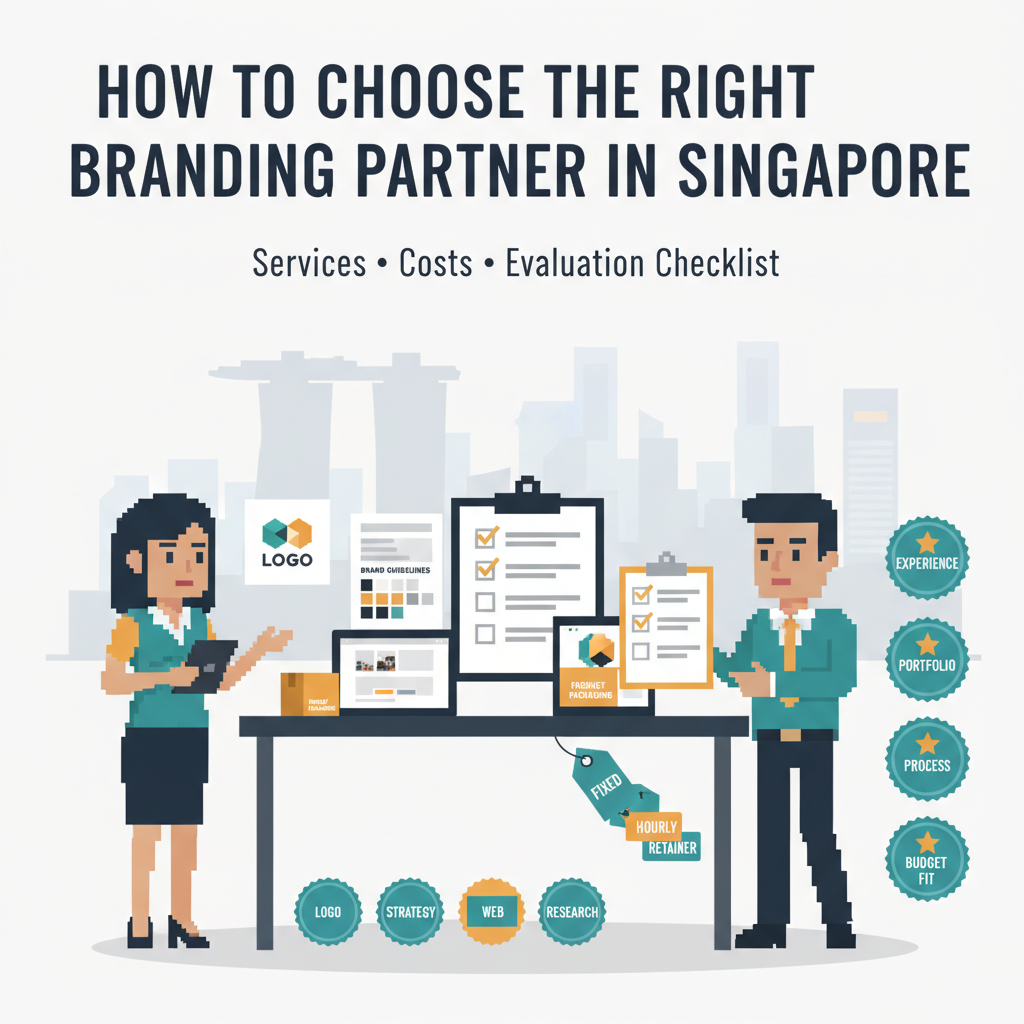
Introduction: Why Your Brand’s First Impression Starts with the Partner You Pick
Your brand is often the first—and sometimes only—chance to make a lasting impression on customers. In Singapore’s fast-paced, digitally-savvy market, that impression needs to be deliberate, authentic, and strategically sound. Yet many business owners and marketing leaders approach branding as a one-off design project rather than a partnership that shapes how the world perceives their company.
Choosing the right branding partner is arguably one of the most consequential decisions you’ll make for your business. The wrong agency can leave you with a logo that looks dated within two years, a brand identity that doesn’t resonate with your target audience, or worse—a visual system that fails to communicate your core value proposition. The right partner, conversely, becomes an extension of your leadership team, translating your vision into a cohesive, market-tested identity that drives customer loyalty and business growth.
This guide walks you through the landscape of branding services in Singapore, the investment required, and the practical criteria you need to evaluate potential partners. Whether you’re a startup founder launching your first brand, a marketing leader refreshing an established identity, or a business owner preparing for regional expansion, this checklist will help you make an informed decision that protects your investment and positions your brand for long-term success.
Singapore’s Branding Landscape at a Glance
Singapore’s branding and creative services market is experiencing robust growth, with analyst estimates placing the sector at approximately USD 115.5 billion in 2025, expanding at a compound annual growth rate of 10.5 percent through 2033. While this figure bundles pure-play brand-strategy shops, creative studios, digital-branding specialists, and management consultancies with brand-building arms, the directional trend is clear: Singapore is outpacing the broader Southeast Asian advertising market and commanding roughly one-third of regional creative spend.
Market drivers and sector demand
Three primary forces are fueling this expansion. First, post-pandemic recovery in tourism, aviation, and luxury retail has unlocked renewed marketing budgets. Second, government digitalisation grants are pushing SMEs to refresh brand identities for cross-border e-commerce, particularly as businesses expand beyond Singapore into regional markets. Third, multinational corporations are regionalising their APAC hubs in Singapore and routing brand work to local agencies for speed and cultural proximity—a trend that has accelerated since 2023.
The sectors generating the most branding spend today are:
- Tech & Telecom: Cloud vendors, fintech platforms, and AI companies are investing heavily in employer branding and investor-facing identity systems to compete for talent and capital.
- Banking, Financial Services & Insurance (BFSI): Digital banks, wealth-management arms, and emerging fintech players require trust-building identity systems that communicate stability and innovation simultaneously.
- Consumer Goods & Retail: FMCG giants continue to dominate above-the-line spending, while cross-border e-commerce brands require rapid-launch identities to capture market share.
- Healthcare & Pharma: Post-pandemic public-health initiatives, elective-care hospitals, and med-tech startups are commissioning patient-centric branding.
- Travel, Luxury & Hospitality: The 2024 tourist rebound has fueled rebranding of hotels, attraction precincts, and luxury brands localising storytelling for affluent residents.
What Singaporean consumers expect from brands
Understanding consumer expectations is critical when evaluating a branding partner. Singaporean consumers—96 percent of whom have internet access and 162 percent mobile-SIM penetration—expect brands to deliver on five key dimensions:
- Quality plus value: Even affluent shoppers scrutinise functional value. “Premium-but-practical” positioning outperforms conspicuous luxury.
- Digital convenience: Friction-free mobile experiences are table-stakes. Brand assets must compress well on small screens and animate smoothly for social short-form content.
- Social responsibility: Forty-nine percent of adults expect the private sector to reduce waste and recycle. Carbon-neutral claims and circular-packaging stories resonate.
- Cultural nuance and inclusivity: Singapore’s tri-ethnic population plus 30 percent expatriate base reward brands that localise visuals—colours, festivals, seasonal campaigns—without tokenism.
- Influencer proof: Millennials and Gen Z rate influencer testimony almost as highly as family advice, so brand systems must be flexible enough for creator co-branding and user-generated content.
A strong branding partner will embed these expectations into strategy from day one, ensuring your identity resonates with Singapore’s diverse, digitally-native consumer base.
Core Services a Branding Agency Singapore Should Offer
Not all branding agencies are created equal. Some specialise in logo design; others offer full-spectrum brand transformation. Understanding the core service pillars will help you assess whether a potential partner can deliver what your business actually needs.
Strategy and positioning fundamentals
This is where great branding begins. Before a single design asset is created, a credible branding agency should conduct deep discovery work: competitive analysis, audience research, internal stakeholder interviews, and market positioning studies. The output is a brand strategy document that articulates your unique value proposition, target audience segments, brand personality, and key messaging pillars.
In Singapore’s competitive landscape, this strategic foundation is non-negotiable. A fintech startup, for example, needs to position itself as either a trust-focused alternative to legacy banks or an innovation-led disruptor—and that positioning shapes every subsequent design and communication decision. A branding agency worth its retainer will challenge your assumptions, stress-test your positioning against competitor moves, and ensure your strategy is defensible and differentiated.
Visual identity and multi-channel design execution
Once strategy is locked, the visual identity system follows. This includes:
- Logo design: A primary mark that works at any scale, from favicon to billboard.
- Colour palette: Primary and secondary colours that evoke your brand personality and work across digital and print.
- Typography: Font selections for headlines, body copy, and UI that reflect your brand voice.
- Imagery style: Photography direction, illustration approach, or graphic language that feels consistent across touchpoints.
- Design system: Spacing, iconography, patterns, and component libraries that enable consistent application across channels.
A strong branding agency will deliver not just static designs but a comprehensive brand guidelines document (often called a brand book or design system) that shows how every element works in context: on websites, mobile apps, packaging, social media, signage, and even data-triggered digital billboards.
Digital experience, content, and ongoing stewardship
Modern branding extends far beyond visual identity. A full-service branding agency should offer:
- Website and digital experience design: Ensuring your brand identity translates seamlessly to your digital home, with user experience that reflects your positioning.
- Content strategy and creation: Developing a voice and tone guide, content pillars, and sample content (blog posts, social media, video scripts) that bring your brand to life.
- Brand asset management: Providing toolkits, prompt libraries for AI-generated content, and guidelines for synthetic media.
- Ongoing brand stewardship: Retainer-based support to evolve your brand as market conditions change, new product lines launch, or you expand into new geographies.
A brand is not a static artifact; it’s a living system that requires periodic refresh, adaptation to new platforms, and evolution as your business matures. The best branding partners position themselves as long-term stewards, not one-off vendors.
Pricing Models and ROI Benchmarks
Understanding how branding agencies price their work—and what you should expect to invest—is essential for budgeting and evaluating proposals.
Project-based versus retainer structures
Most agencies offer two primary pricing models:
Project-based pricing is common for discrete deliverables: a logo redesign, a new brand identity system, or a website redesign. Typical project scopes in Singapore range from SGD 15,000 to SGD 150,000+ depending on complexity, research depth, and number of design iterations. A startup logo might cost SGD 8,000–20,000; a full rebrand for an SME, SGD 40,000–80,000; and a comprehensive brand transformation for a corporate, SGD 100,000–300,000+.
Retainer-based pricing is increasingly popular for ongoing brand stewardship. Monthly retainers typically range from SGD 3,000–15,000 for SMEs (covering quarterly brand reviews, content strategy, and design support) to SGD 20,000–50,000+ for corporates requiring dedicated account teams and continuous brand evolution work.
Investment ranges for SMEs versus corporates
For SMEs and startups (annual revenue under SGD 10 million):
- Initial brand identity project: SGD 25,000–60,000
- Ongoing monthly retainer: SGD 3,000–8,000
- Total first-year investment: SGD 60,000–150,000
For mid-market companies (annual revenue SGD 10–100 million):
- Comprehensive rebrand or new brand launch: SGD 60,000–150,000
- Ongoing monthly retainer: SGD 8,000–20,000
- Total first-year investment: SGD 150,000–400,000
For corporates and large enterprises (annual revenue above SGD 100 million):
- Full brand transformation with regional rollout: SGD 200,000–500,000+
- Ongoing monthly retainer: SGD 20,000–50,000+
- Total first-year investment: SGD 400,000–1,000,000+
These ranges reflect Singapore’s cost structure and the depth of work required. Global networks typically command premium pricing; regional independents and boutique shops often offer better value for SMEs.
Measuring success: brand equity KPIs and sales impact
The challenge with branding is that ROI is not always immediate or easily quantifiable. However, a credible agency should help you define and track metrics that matter:
- Brand awareness: Aided and unaided recall among your target audience.
- Brand perception: Net Promoter Score (NPS), brand sentiment, and perception of key attributes such as innovation, trustworthiness, and value.
- Consideration and preference: Share of preference versus competitors and likelihood to recommend.
- Sales impact: Correlation between brand refresh and sales uplift, customer acquisition cost, or customer lifetime value.
- Digital engagement: Website traffic, social media engagement rates, and conversion metrics post-rebrand.
- Employee alignment: Internal survey scores measuring employee pride and understanding of brand positioning.
The best branding agencies now incorporate measurement into their proposals, using tools like brand-lift analytics, attention heat-maps, and attribution modelling to demonstrate tangible business impact.
Evaluating Agencies: Criteria, Questions & Red Flags
With dozens of branding agencies operating in Singapore—from global networks to solo designers—how do you separate the exceptional from the mediocre?
Portfolio depth, sector expertise, and cultural fit
Start by examining an agency’s portfolio. Look for:
- Depth of work: Evidence of strategy documents, brand guidelines, and implementation across multiple touchpoints, not just standalone logos.
- Sector relevance: Experience in your industry and familiarity with its regulatory or cultural nuances.
- Diversity of clients: A mix of startups, SMEs, and corporates, which suggests versatility.
- Longevity of relationships: Case studies that show long-term partnerships rather than one-off engagements.
- Cultural fit: A design aesthetic and strategic philosophy that align with your ambitions.
Team structure, workflow transparency, and communication style
When you speak with potential agencies, ask questions such as:
- Who will be your day-to-day contact, and how senior are they?
- What is the composition of the team working on your account (strategists, designers, copywriters, project managers)?
- How many revision rounds are included, and how are changes handled?
- What does the approval process look like, and how are stakeholders aligned?
- How frequently will you receive updates, and through which channels?
- What type of post-launch support and training do they offer?
Transparency on these points indicates a mature, client-centric operation.
Warning signs: over-promising, vague scopes, and hidden fees
There are also clear red flags to watch for:
- Over-promising outcomes: Guarantees that your brand will “become the next Apple” or dominate market share overnight.
- Vague scope of work: Proposals that lack detail on deliverables, timelines, or responsibilities.
- Hidden fees: Ambiguous references to “additional charges” without clarity on when and how they apply.
- No discovery phase: Skipping research and stakeholder interviews and moving straight into design.
- High-pressure tactics: Pushing for rapid sign-off on contracts or limited-time discounts.
- Reluctance to discuss measurement: Dismissing KPIs or avoiding questions about performance tracking.
- Lack of references: Inability or unwillingness to connect you with existing or past clients.
If you encounter several of these red flags, it is usually safer to continue your search.
Comparison Table: Top Brand Consultancy Options in Singapore
When shortlisting agencies, it helps to build a simple comparison matrix that captures the factors most relevant to your decision.
What to look for in a feature matrix
At minimum, include the following columns in your comparison table:
- Service breadth: Whether the agency offers strategy, design, digital experience, and content, or focuses on a single specialty.
- Notable clients and sectors: The industries they know best and examples of brands similar to yours.
- Price tier: Whether they operate in a budget, mid-market, or premium price band for typical projects.
- Differentiators: Unique capabilities such as AI-native branding, sustainability expertise, or regional rollout experience.
- Team size and structure: Boutique, mid-size, or large network, and how that affects resourcing.
- Geographic reach: Their experience across Singapore and the broader Southeast Asian market.
This structure helps you compare apples to apples when reviewing proposals and pitch materials.
Shortlisting and RFP roadmap for decision-makers
To move from a long list of possible partners to a confident final selection, follow a structured process:
- Define your brief. Clarify your objectives, budget, timeline, and KPIs before approaching agencies.
- Shortlist three to five agencies. Use referrals, award shows, and online research to identify a mix of boutique and larger firms.
- Request credentials and case studies. Ask for concise overviews and relevant case studies as a first filter.
- Hold introductory calls. Use 30-minute sessions to gauge chemistry, understanding of your market, and responsiveness.
- Issue a structured RFP. For substantial projects, provide a written brief and request detailed proposals, including approach, timelines, and fees.
- Invite final pitches. Ask your top two candidates to present their thinking, challenge your assumptions, and outline proposed next steps.
- Check references. Speak directly with at least two past or current clients of your preferred agency.
- Negotiate and formalise. Finalise scope, responsibilities, fees, payment milestones, and post-launch support in a clear contract.
This roadmap reduces risk and ensures that the partner you choose has been tested not just on creative output but also on strategic thinking and cultural fit.
Conclusion: Making an Informed, Future-Proof Choice
Choosing a branding partner is not a commodity purchase. You are investing in a strategic relationship that will shape how your business is perceived, how employees rally around your mission, and ultimately, how customers choose you over competitors.
The right partner will challenge your thinking, ground strategy in research, deliver design that works across channels, and evolve your brand as your business grows. They will measure success, communicate transparently, and position themselves as a long-term steward of your brand equity.
Singapore’s branding landscape is mature, competitive, and increasingly sophisticated. Agencies are investing in AI-native tools, measurement capabilities, and cultural expertise to serve a market that demands both innovation and authenticity. Whether you are a startup founder, a marketing leader, or a business owner preparing for regional expansion, the criteria outlined in this guide will help you identify a partner who understands your market, respects your investment, and delivers work that drives real business results.
Take your time with this decision. Ask tough questions. Check references. And remember: the cheapest proposal is rarely the best value. The right branding partner will pay for itself many times over through stronger customer loyalty, higher brand equity, and a clearer competitive position in Singapore’s dynamic market.
Ready to find your ideal branding partner?
If you are evaluating branding agencies or need guidance on positioning your brand for Singapore’s market, Hamilton & Sherwind can help. Explore our branding services in Singapore, review examples of our work in our branding portfolio, or learn more about Hamilton & Sherwind and how we blend strategy, storytelling, and AI-powered marketing.
For more perspectives on branding, digital marketing, and creative campaigns in Singapore and across Southeast Asia, visit our branding insights and case studies.
Ready to move from comparison to action? Contact us to discuss your branding objectives and explore how we can support your vision.