

How to Choose a Social Media Marketing Agency in Singapore: Costs, Services & Evaluation Checklist
Selecting the right social media marketing partner is one of the most consequential decisions a business can make in today's digital landscape. With Singapore's social media market now fully saturated—88.2% of the population holds active social identities—the competitive advantage no longer comes from simply being present online. Instead, it hinges on deep engagement, strategic platform selection, and culturally intelligent execution. The stakes are high: a misaligned agency partnership can waste months and significant budget, while the right partner becomes a force multiplier for your brand's growth.
This guide walks you through the complete evaluation process, from understanding Singapore's unique social media ecosystem to vetting agencies against a practical checklist. Whether you're a fast-growing SME or an established enterprise, you'll find the frameworks and benchmarks needed to make a confident decision.
As you evaluate partners, you can also compare them with a full-service, creative and AI-enabled team like Hamilton & Sherwind’s social media marketing experts, who work across branding, content, and digital to create integrated campaigns.
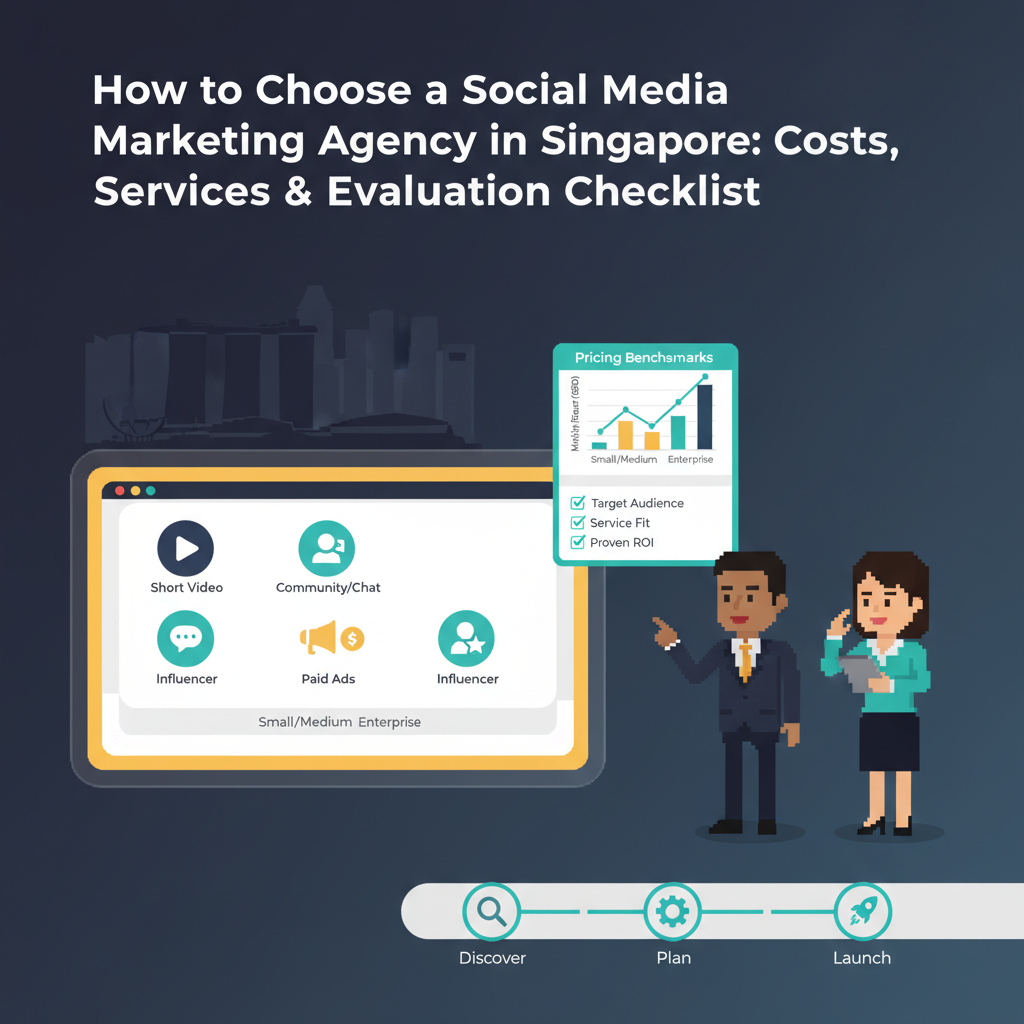
Singapore's Social Media Landscape in 2025
Singapore's digital infrastructure is among the world's most mature. According to DataReportal's Digital 2025: Singapore report (February 2025), the city-state has 5.16 million active social media users—equivalent to 88.2% of the total population and 92% of all internet users. However, growth has plateaued at just 0.6% year-on-year, signalling a saturated market where winning share depends on engagement depth rather than user acquisition.
The platform hierarchy tells a revealing story. WhatsApp remains the undisputed favourite, with 80% population reach and 30% of users citing it as their top choice. Facebook follows at 72% reach (3.7 million reachable users), maintaining its position as the second-most-used network and the top source of social referral traffic despite reputation fatigue. Instagram holds 54% reach with 3.15 million users, though overall usage is flat—the real shift is toward Reels consumption.
YouTube dominates with 88% reach, matching total social addressable reach, and users spend approximately 30 hours per month in-app. TikTok, the fastest-growing platform, reaches 65% of adults aged 18+ (3.63 million users), up 7.4% year-on-year, with users spending an extraordinary 34 hours 29 minutes per month on the platform. LinkedIn shows remarkable density in Singapore: 82% of the total population and 96% of adults aged 18+ are registered members (4.8 million), making it exceptionally valuable for B2B and employer branding initiatives.
The audience profile skews toward the "digitally mature core": 25-34 year-olds represent approximately 31% of adult social users, while 35-44 year-olds add another 23%. This 25-44 demographic holds significant decision-making purchasing power and responds best to practical, time-saving value propositions rather than hype-driven messaging. Gender distribution is nearly even at 47.6% female and 52.4% male across all social identities.
Singaporeans' primary motivations for social media use reveal important targeting insights. According to GlobalWebIndex data, 48.5% use social platforms to keep in touch with friends and family, 40.6% to fill spare time, and 35.3% to read news. However, only 11.7% follow formal news brands, and 71% express concern about fake content—a critical consideration for brand messaging and claim substantiation. Content categories followed most include food personalities (24.7%), TV and streaming channels (22.7%), and entertainment or meme pages (20.1%).
Video-first formats dominate consumption patterns: 40% watch music videos weekly, and 27.6% watch comedy or viral videos. Crucially, 63% of internet users research brands directly on social networks, and 34.5% rely solely on social for discovery. This means a viable Singapore marketing funnel must show up in both Google search results and TikTok, Instagram, and YouTube search bars.
Emerging trends shaping brand interactions
Several macro trends are reshaping how brands should approach social media strategy in Singapore and across Southeast Asia in 2025.
Short-video commerce is coming of age. TikTok Shop, Instagram Reels Shopping, and YouTube Shorts are converging into a seamless ecosystem where product search, shoppable video, and checkout happen without leaving the feed. DataReportal notes this as social commerce's "coming-of-age" phase, while Campaign Asia calls it a "maturing omnichannel expectation." For brands, this means treating product pages and TikTok videos as the same asset and optimising vertical video for search keywords.
Social search is eating portions of Google's territory. Gen Z across Southeast Asia now consults Instagram and TikTok first for restaurant recommendations, fashion styling advice, and even financial guidance. This shift demands that every piece of video content include SEO discipline: closed captions, descriptive file names, and keyword-rich text overlays. Brands should answer questions natively within social platforms rather than pushing users toward external site clicks.
Creator storytelling now outperforms transactional influencer posts. According to WARC data highlighted by Marketing-Interactive, creator-led storytelling drives 3.5 times higher engagement than standard paid media. Brands are shifting budgets from one-off influencer shout-outs to long-arc partnerships that weave products into personal narratives. This reflects Singaporeans' relative scepticism toward overt endorsements—influencer and creator ads represent only 5.5% of Singapore's digital ad spend (US$106 million in 2024), compared to higher percentages in neighbouring markets.
Authenticity and trust have become non-negotiable. With 71% of Singaporeans concerned about "what's real online," transparent sourcing, behind-the-scenes content, and third-party validation matter enormously. Singapore's Protection from Online Falsehoods and Manipulation Act (POFMA) also pushes brands toward rigorous claim substantiation. Winning teams balance bold storytelling with proof points and regulatory compliance.
AI-assisted but human-led creative is the new standard. Dentsu's 2025 CMO study found that 87% of regional CMOs still expect "more human creativity and empathy," even as generative tools accelerate asset production. The winning formula pairs prompt-driven ideation with on-the-ground cultural nuance, especially in linguistically diverse markets like Malaysia and Indonesia.
Platform fragmentation is compressing attention spans. Singaporeans now use more than 7 platforms monthly, yet total daily social time fell 8.4% to 2 hours 2 minutes. Brands must deliver snackable messages that travel across ecosystems, then retarget high-intent users with deeper content on YouTube or owned channels.
Mobile and desktop usage are now equally important in Singapore. Daily internet time splits exactly 50:50 between mobile and desktop/tablet (3 hours 17 minutes each). While checkout may skew mobile, research and high-consideration purchases—such as B2B SaaS or high-ticket electronics—still see sizeable desktop usage. Campaign sequencing should reflect this dual-screen rhythm.
To see how an integrated agency already navigates these shifts in practice, explore Hamilton & Sherwind’s digital marketing services and social media portfolio.
Service Models & Pricing Benchmarks
Social media agencies typically offer three primary pricing models, each suited to different business needs and risk profiles.
Retainer vs project vs performance-based fees
Retainer-based pricing is the most common model for ongoing social media management. Under this structure, you pay a fixed monthly fee for a defined scope of work—typically including content creation, community management, reporting, and strategic planning across specified platforms. Retainers provide predictability and allow agencies to build deep familiarity with your brand over time. They work best for businesses seeking consistent, long-term presence and are willing to commit to multi-month engagements (usually 6-12 months minimum). The downside is that you're paying whether or not results materialise, and scope creep can become an issue if deliverables aren't clearly defined.
Project-based pricing suits one-off initiatives: a product launch campaign, a rebrand rollout, or a specific content series. You pay a fixed fee for a defined deliverable with a clear start and end date. This model offers flexibility and is ideal for testing an agency's capabilities before committing to a retainer. However, project work can be less cost-effective per unit of output than retainers, and agencies may deprioritise project clients in favour of retainer accounts.
Performance-based pricing ties fees directly to measurable outcomes: cost-per-lead, cost-per-acquisition, or revenue-share models. This aligns agency incentives with your business goals and can be attractive for e-commerce or lead-generation campaigns. However, performance-based models require robust tracking infrastructure, clear attribution, and agreement on what constitutes a "conversion." They also tend to work best for campaigns with high transaction volume; for brand-building or awareness work, attribution becomes murky.
Many agencies now offer hybrid models: a base retainer covering core management plus performance bonuses if KPIs are exceeded. This balances predictability with upside potential.
Typical cost ranges for SMEs vs enterprises
Pricing varies significantly based on agency tier, scope, and your company size. Here are realistic benchmarks for Singapore and Southeast Asia:
For SMEs (annual revenue SGD 1-10 million):
- Entry-level retainer: SGD 2,000–5,000 per month. Typically covers 2-3 platforms, 8-12 posts per month, basic community management, and monthly reporting. Often delivered by junior teams or agencies with lower overhead.
- Mid-tier retainer: SGD 5,000–12,000 per month. Includes 3-4 platforms, 15-20 posts per month, paid social management (SGD 2,000–5,000 ad spend), influencer outreach, and fortnightly strategy calls.
- Project work: SGD 3,000–15,000 per project, depending on complexity. A product launch campaign might cost SGD 8,000–12,000; a content series, SGD 5,000–8,000.
For mid-market companies (annual revenue SGD 10-100 million):
- Retainer: SGD 12,000–30,000 per month. Covers 4-6 platforms, 30-40 posts per month, paid social management (SGD 10,000–30,000 ad spend), creator partnerships, crisis management protocols, and weekly strategy calls.
- Project work: SGD 15,000–50,000 per project. Integrated campaigns with video production, influencer coordination, and paid amplification.
For enterprises (annual revenue >SGD 100 million):
- Retainer: SGD 30,000–100,000+ per month. Full-service management across 6+ platforms, 50+ posts per month, significant paid social budgets (SGD 50,000–200,000+), dedicated account teams, custom reporting dashboards, and strategic advisory.
- Project work: SGD 50,000–200,000+ per project. Large-scale campaigns with production, talent coordination, and integrated media buying.
Important context: Singapore's per-capita social ad spend is approximately triple the Southeast Asian average (Statista, 2025), reflecting premium CPM rates. Agencies operating in Singapore typically charge 20-40% more than regional counterparts in Malaysia or Thailand for equivalent services.
Red flags in pricing:
- Agencies quoting significantly below market rates often cut corners on strategy, creative quality, or reporting accuracy.
- Agencies that bundle ad spend management without transparency on media buying margins (typically 10-20% of ad spend).
- Contracts with no performance metrics or exit clauses; you should always have a 30-day termination clause.
If you’d like to benchmark these figures against real integrated scopes, you can browse Hamilton & Sherwind’s portfolio of work and digital marketing case studies.
Evaluation Checklist for Selecting a Social Media Marketing Agency Singapore
Before signing any contract, ask these ten questions to assess whether an agency is genuinely equipped to drive results for your business and to avoid common pitfalls that many Singapore brands encounter when choosing a partner.
10 essential questions to ask during vetting
- What is your experience in my specific industry? Generic social media expertise is insufficient. Ask for case studies or references from competitors or adjacent sectors. An agency that has managed campaigns for fintech, e-commerce, or B2B SaaS will understand your audience's pain points and regulatory constraints far better than a generalist.
- How do you approach strategy development? Listen for a structured process: audience research, competitive analysis, platform selection rationale, and goal-setting before any content is created. Agencies that jump straight to "we'll post daily on TikTok" haven't done their homework.
- What platforms do you recommend for my business, and why? A strong agency will explain why certain platforms align with your audience and objectives. For instance, if you're a B2B SaaS company, LinkedIn should feature prominently; for a fashion brand targeting Gen Z, TikTok and Instagram Reels are non-negotiable. Beware agencies that recommend all platforms equally.
- How do you measure success, and what are your typical KPIs? Vanity metrics (likes, followers) are meaningless. Insist on business-aligned KPIs: cost-per-lead, conversion rate, customer acquisition cost, brand search volume lift, or revenue attribution. Ask how they track these and what tools they use (e.g., Google Analytics 4, Shopify, HubSpot).
- What is your content creation process, and who owns creative? Understand whether the agency creates content in-house or outsources. Ask about revision rounds, approval workflows, and how they balance brand guidelines with platform-native best practices. A good agency will explain how they optimise for each platform's algorithm and user behaviour.
- How do you stay current with platform algorithm changes? Social platforms update constantly. Ask what training or certifications team members hold (e.g., Meta Blueprint, TikTok Creator Academy). Do they attend industry conferences? Do they have a process for testing new features?
- What is your approach to paid social advertising? If your budget includes paid spend, ask how they manage it. Do they use platform native tools or third-party management platforms? What's their process for A/B testing? How do they prevent ad fatigue? What's their typical ROAS (return on ad spend) range for your industry?
- How often will we communicate, and what reporting will we receive? Establish cadence: weekly, fortnightly, or monthly check-ins? What does the monthly report include? Insist on custom dashboards showing progress toward your specific KPIs, not just platform-generated analytics. Ask for a sample report.
- What happens if we're not seeing results after three months? A confident agency will outline a review process and be willing to adjust strategy. Red flags: agencies that blame external factors entirely or refuse to discuss underperformance.
- What is your team structure, and who will be my primary contact? Understand who owns your account. Will you have a dedicated account manager, or will you be passed between junior team members? What's the escalation path if issues arise? Ask for bios of key team members and their experience.
If you want to see how a strategic process translates into real work, Hamilton & Sherwind’s social media portfolio is a useful reference when comparing answers across agencies.
Red flags & common pitfalls to avoid
Certain warning signs should prompt you to walk away from an agency partnership:
Guaranteed results or unrealistic promises. No agency can guarantee viral content, a specific follower count, or a predetermined ROI. Social media is influenced by countless variables outside any agency's control. If an agency promises "10,000 new followers in 30 days" or "guaranteed 5x ROAS," they're either inexperienced or dishonest.
Lack of transparency on ad spend. If the agency manages your paid social budget, you should have real-time access to ad account dashboards. Agencies that hide ad spend details or take undisclosed margins are a liability. Standard practice is 10-20% margin on ad spend; anything higher should be explicitly negotiated.
No clear contract or exit clause. A professional agency will provide a written statement of work outlining deliverables, timelines, payment terms, and termination conditions. Avoid long-term lock-in contracts without a 30-day exit clause. If an agency resists this, it's a red flag.
Slow or evasive communication. During the vetting process, how quickly do they respond to emails? How thorough are their answers? If they're slow or vague now, they'll be worse once you're a client. Communication is a proxy for professionalism.
One-size-fits-all approach. Agencies that propose identical strategies for all clients haven't done proper discovery. Your strategy should be tailored to your audience, competitive landscape, and business objectives.
Weak portfolio or vague case studies. Ask to see specific campaigns they've run. If they can't share details due to NDAs, they should at least describe results in quantifiable terms: "We increased engagement rate from 1.2% to 3.8% over six months" or "We generated 250 qualified leads at a cost of SGD 45 per lead." Vague claims like "we grew their presence significantly" are meaningless.
Overreliance on vanity metrics. If an agency's pitch focuses heavily on follower growth or likes rather than business outcomes, they're optimising for the wrong things. Follower count is a lagging indicator; engagement rate, conversion rate, and revenue impact are what matter.
No mention of brand safety or compliance. In Singapore, regulatory compliance (POFMA, advertising standards) is non-negotiable. An agency should proactively discuss how they ensure claims are substantiated and content complies with local regulations. If they don't mention this, they're not thinking strategically.
Unwillingness to share references. A reputable agency will provide 2-3 client references you can contact. If they refuse or offer only vague testimonials, that's suspicious.
For a benchmark of what strong creative and strategic work looks like, you can reference Hamilton & Sherwind’s branding portfolio and social media marketing services overview.
Specialist vs Full-Service Agencies: Pros, Cons & Use Cases
The choice between a specialist agency and a full-service firm depends on your needs, budget, and strategic priorities.
Specialist agencies focus on one discipline: social media, influencer marketing, video production, or paid advertising. Their advantages include deep expertise, often lower costs than full-service firms, and the ability to attract top talent in their niche. A specialist social media agency will have refined processes, proprietary tools, and a portfolio of proven campaigns. The downside is coordination: if you need integrated campaigns spanning social, email, PR, and paid search, you'll need to manage multiple vendors.
Full-service agencies offer integrated services: strategy, creative, media buying, PR, SEO, and more under one roof. The advantage is seamless coordination and a single point of accountability. A full-service agency can orchestrate a cohesive brand narrative across all channels. The downside is that social media may not be their core strength—they might treat it as an add-on to traditional advertising or PR work. Full-service agencies also tend to be more expensive.
Hybrid approach: Many successful brands use a specialist social media agency as their core partner, supplemented by specialists for video production, influencer management, or paid media buying. This balances expertise with coordination.
Hamilton & Sherwind operates as an integrated, creative agency—connecting branding, digital marketing, and social media campaigns—which can give brands a practical middle ground between pure specialist and large network agency models.
Industry examples of successful collaborations
E-commerce brands typically benefit from specialist social media agencies paired with performance marketing specialists. A Singapore-based fashion e-commerce brand might work with a social specialist to build community and brand awareness on TikTok and Instagram, while a separate performance agency manages conversion-focused paid campaigns on Google and Facebook. This separation of concerns—brand-building vs. direct response—allows each team to optimise for their specific objective.
B2B SaaS companies often succeed with full-service agencies that understand both social strategy and thought leadership. A SaaS firm needs integrated campaigns: LinkedIn content and ads for lead generation, webinar promotion, case study distribution, and PR support. A full-service agency can orchestrate this holistically, whereas a social-only specialist might miss the broader narrative.
Financial services and regulated industries require agencies with deep compliance expertise. A Singapore fintech company, for instance, needs an agency that understands POFMA, MAS (Monetary Authority of Singapore) advertising guidelines, and data privacy regulations. Specialist agencies in regulated verticals often have legal review processes built into their workflows.
Hospitality and food brands thrive with specialist social agencies that excel at visual storytelling and influencer partnerships. A Singapore restaurant group might partner with a social specialist to manage Instagram and TikTok, coordinate with food influencers, and run user-generated content campaigns. The specialist's deep platform knowledge and creator network are invaluable here.
Enterprise corporations often use full-service agencies for brand campaigns and specialist agencies for specific initiatives. A multinational corporation might retain a full-service agency for corporate communications and brand campaigns, while hiring a specialist for a targeted TikTok campaign aimed at Gen Z recruitment.
You can see how this plays out in real work by reviewing Hamilton & Sherwind’s advertising portfolio and video portfolio, where integrated and specialist executions often sit side by side.
Implementation Timeline & Onboarding Expectations
Understanding the onboarding process and realistic timelines helps set expectations and avoid frustration when you start working with a social media marketing agency in Singapore.
Kick-off meetings, asset handovers and first-90-day goals
Week 1-2: Discovery and kick-off. The agency should conduct a comprehensive discovery process: interviews with key stakeholders, review of existing brand assets, competitor analysis, and audience research. A formal kick-off meeting should establish project governance, communication cadence, approval workflows, and success metrics. Expect the agency to deliver a discovery brief outlining findings and initial strategic recommendations.
Week 2-3: Asset handover and access provisioning. You'll need to provide the agency with access to social media accounts, brand guidelines, product information, customer data (anonymised), and any existing content libraries. The agency should provide a detailed asset checklist to ensure nothing is missed. This is also when you'll grant access to analytics platforms (Google Analytics, platform native analytics, CRM systems if applicable).
Week 3-4: Strategy and content calendar development. The agency presents a detailed social media strategy covering platform selection, content pillars, posting cadence, paid media approach, and KPI targets. A 90-day content calendar should be drafted, showing planned posts, campaigns, and key dates. This is your opportunity to provide feedback and align on creative direction before execution begins.
Month 2-3: Content production and campaign launch. The agency begins creating and scheduling content. Expect weekly or fortnightly check-ins to review performance, discuss emerging opportunities, and adjust tactics. Paid campaigns should launch during this period, with daily monitoring and optimisation.
Month 3: 90-day review and strategy adjustment. By the end of the first quarter, you should have sufficient data to assess performance. The agency should present a comprehensive report showing progress toward KPIs, learnings from the first 90 days, and recommended adjustments for the next quarter. This is a critical checkpoint: if results are off-track, the agency should articulate why and propose concrete changes.
Realistic expectations for first-90-day outcomes:
- Follower growth: 10-30% growth is typical for a new or dormant account, depending on starting size and paid investment. Established accounts with strong existing followings may see slower percentage growth but higher absolute numbers.
- Engagement rate: Expect 2-4 weeks before engagement metrics stabilise as the algorithm learns your content. By week 8-12, you should see a clear trend (improving, flat, or declining).
- Paid campaign performance: ROAS (return on ad spend) typically improves over the first 4-6 weeks as the algorithm optimises. By week 12, you should have enough data to identify winning creative and audience segments.
- Lead generation: If social is driving leads, expect 50-100 qualified leads in the first 90 days, depending on your industry and ad spend. Cost-per-lead should stabilise by week 8.
- Brand awareness metrics: Search volume for your brand name, website traffic from social, and brand mention sentiment should show positive trends by month 3, though these are lagging indicators.
Common pitfalls to avoid:
- Expecting immediate results. Social media algorithms need time to learn. Patience through weeks 1-4 is essential.
- Changing strategy too frequently. Resist the urge to pivot based on week-one data. Give campaigns at least 4 weeks to mature.
- Unclear approval workflows. Establish a clear process for content approval upfront. Delays in approvals will derail timelines.
- Insufficient paid budget. Organic reach is limited in saturated markets like Singapore. Allocate at least SGD 2,000-5,000 per month in paid spend to see meaningful results.
- Lack of internal alignment. Ensure all stakeholders (marketing, sales, product, leadership) understand the strategy and KPIs. Misalignment will create friction and second-guessing.
For a sense of how campaign timelines fit into broader brand journeys, you can reference integrated projects in Hamilton & Sherwind’s event portfolio and digital marketing portfolio.
Making the Final Decision: Summarising the Best-Fit Criteria
Choosing a social media marketing agency is ultimately about finding a partner whose expertise, values, and working style align with your business. Here's a framework for making the final decision:
Assess strategic fit. Does the agency understand your industry, audience, and business model? Have they asked thoughtful questions during the vetting process? Do their recommendations feel tailored or generic? A good fit means the agency can articulate your target audience's pain points and explain why specific platforms and tactics will resonate.
Evaluate team capability. Beyond the agency's brand, assess the individuals who will work on your account. Are they experienced? Do they communicate clearly? Will you have a dedicated account manager or be shuffled between junior staff? Request bios and LinkedIn profiles of key team members. If possible, ask to speak with them directly.
Verify track record. Request case studies and references from similar companies. Ask specific questions: What was the starting point? What tactics did they use? What were the results? How long did it take to see ROI? A strong track record in your vertical is worth paying a premium for.
Align on metrics and accountability. Ensure the agency is willing to be measured against business outcomes, not vanity metrics. Insist on clear KPIs, regular reporting, and a process for course-correction if results underperform. A confident agency will welcome this accountability.
Consider cultural fit. You'll be working closely with this team for months or years. Do they communicate in a style you prefer? Are they proactive or reactive? Do they seem genuinely interested in your success, or are they just going through the motions? Trust your gut on this.
Evaluate cost-effectiveness. Price matters, but it's not the only factor. A cheaper agency that delivers mediocre results is more expensive than a premium agency that drives real business impact. Compare total cost of ownership: agency fees plus ad spend plus your internal time investment. What's the expected ROI?
Test before committing long-term. If possible, start with a 3-month project or trial retainer rather than a 12-month contract. This allows both parties to assess fit before making a larger commitment. Most reputable agencies will accept this.
Trust the process. Once you've selected an agency and signed a contract, give them space to execute. Micromanaging or constantly second-guessing will undermine their effectiveness. Establish clear communication cadence and decision-making authority upfront, then trust the process.
Ready to Find Your Ideal Social Media Partner?
Selecting the right social media marketing agency is a pivotal decision that can accelerate your brand's growth or drain resources if misaligned. The Singapore market in 2025 demands partners who understand both the nuanced platform landscape and the cultural sophistication of your audience.
At Hamilton & Sherwind, we combine strategic expertise with creative excellence and AI-enabled insights to deliver measurable results for brands across Singapore and Southeast Asia. Whether you're an SME scaling your first major campaign or an enterprise optimising a complex multi-platform strategy, we're equipped to guide you through every phase—from discovery to execution to optimisation.
If you're ready to evaluate your social media strategy or explore a partnership with an agency that truly understands the Singapore market, we'd love to discuss your goals. Contact us today for a confidential consultation. Let's build something remarkable together.