

The role of modern creative agencies
In an era where brand attention spans are measured in seconds and customer journeys span dozens of touchpoints, the role of a creative agency has fundamentally transformed. What once was a straightforward business—buying newspaper space and writing copy—has evolved into a sophisticated orchestration of strategy, storytelling, technology, and data. Today’s creative agency serves as a strategic partner that bridges the gap between business ambition and cultural relevance, translating market opportunities into compelling brand experiences that drive measurable outcomes.
The modern creative agency is no longer simply a production house. It’s a catalyst for growth, a keeper of brand consistency across fragmented channels, and increasingly, a source of competitive advantage in markets where differentiation is harder than ever to achieve. Whether you’re launching a new product, repositioning your brand, or accelerating growth into new markets, understanding what a creative agency does—and when you need one—has become essential knowledge for any marketing leader or business owner.
Defining the creative agency model
History: From print shops to omnichannel
The story of the creative agency is a story of adaptation. It begins in 1842 when Volney B. Palmer pioneered the concept of “space brokering” in newspapers—buying column-inches wholesale and reselling them to merchants. For decades, that was the entire business. There was no creative input, no strategy, just transaction.
The real transformation came in 1875 when Francis W. Ayer introduced the “open contract,” shifting loyalty from publishers to advertisers and establishing the commission-based compensation model that would define the industry for over a century. To justify that 15% fee, Ayer did something radical: he hired full‑time copywriters and art directors. The creative agency, as we know it, was born. Historical accounts of early advertising practice from the Museum of American Advertising and trade histories confirm this evolution from space brokerage to integrated creative services.
The early twentieth century saw the rise of “reason‑why” advertising—copywriters moved ads from simple product notices to persuasive narratives that explained why consumers should care. Then came the scientific era: figures like Claude Hopkins helped systematise testing and introduced concepts similar to what we now call unique selling propositions. By the 1960s, the Creative Revolution—led by well‑documented industry pioneers such as Bill Bernbach and David Ogilvy—elevated advertising to an art form, producing iconic campaigns like “Think Small” and “The Man in the Hathaway Shirt” that proved creative excellence could drive business results. Contemporary analyses in books such as The King of Madison Avenue by Kenneth Roman provide detailed case evidence of this shift.
For decades, the model remained relatively stable: a full‑service agency would handle strategy, creative, media buying, and production under one roof. But the internet changed everything. The first clickable banner ad appeared in 1994, and suddenly the 15% media commission model began to crumble. Clients started unbundling work, hiring specialised web shops, SEO firms, and social‑media boutiques. Agencies scrambled to acquire digital capabilities or build them from scratch.
By the mid‑2010s, the industry had entered an omnichannel era. A creative agency today doesn’t just produce a TV spot or a print ad. It orchestrates paid, owned, and earned touchpoints across a customer’s entire journey—from shoppable livestreams to retail media networks to personalised email sequences. The “product” might be a motion identity system, an experience‑led website, or a suite of performance‑optimised social assets. Modern creative teams blend copywriters and art directors with UX designers, motion designers, and marketing‑ops specialists.
Agency vs consultancy: Blurred lines explained
For much of the twentieth century, the distinction between a creative agency and a management consultancy was clear. Agencies created campaigns; consultancies advised on strategy and operations. Over the last decade, that line has blurred dramatically.
Large consultancies have acquired established creative shops—high‑profile deals such as Accenture’s acquisition of Droga5 and Deloitte Digital’s acquisitions of design studios are widely reported in business media. These moves reflect a fundamental shift: clients increasingly want integrated partners who can connect boardroom strategy with customer‑facing brand experiences.
Meanwhile, traditional creative agencies have been moving upstream, standing up business‑consulting and commerce divisions to compete for strategy budgets that were once the exclusive domain of consulting firms.
The result is a spectrum rather than two discrete categories. On one end, you have pure‑play creative agencies focused on idea generation and campaign execution. On the other end, you have consultancies that have bolted creative studios onto strategy and implementation offerings. In the middle, you have hybrid players—some agencies that have become more strategic, some consultancies that have become more creative.
Two practical differences still matter for clients:
- Pace and culture – Agencies are built for speed, cultural insight and experimentation. Consultancies are built for rigour, governance, and complex stakeholder management.
- Commercial model – Agencies are generally more open to tying parts of their fees to campaign performance. Consultancies typically retain time‑and‑materials or transformation‑fee models.
For most brands in Singapore and Southeast Asia, the question is less “agency or consultancy?” and more “Which partner can connect strategy, creative and execution in a way that fits our scale, risk profile and timelines?”
Key service pillars and specialties
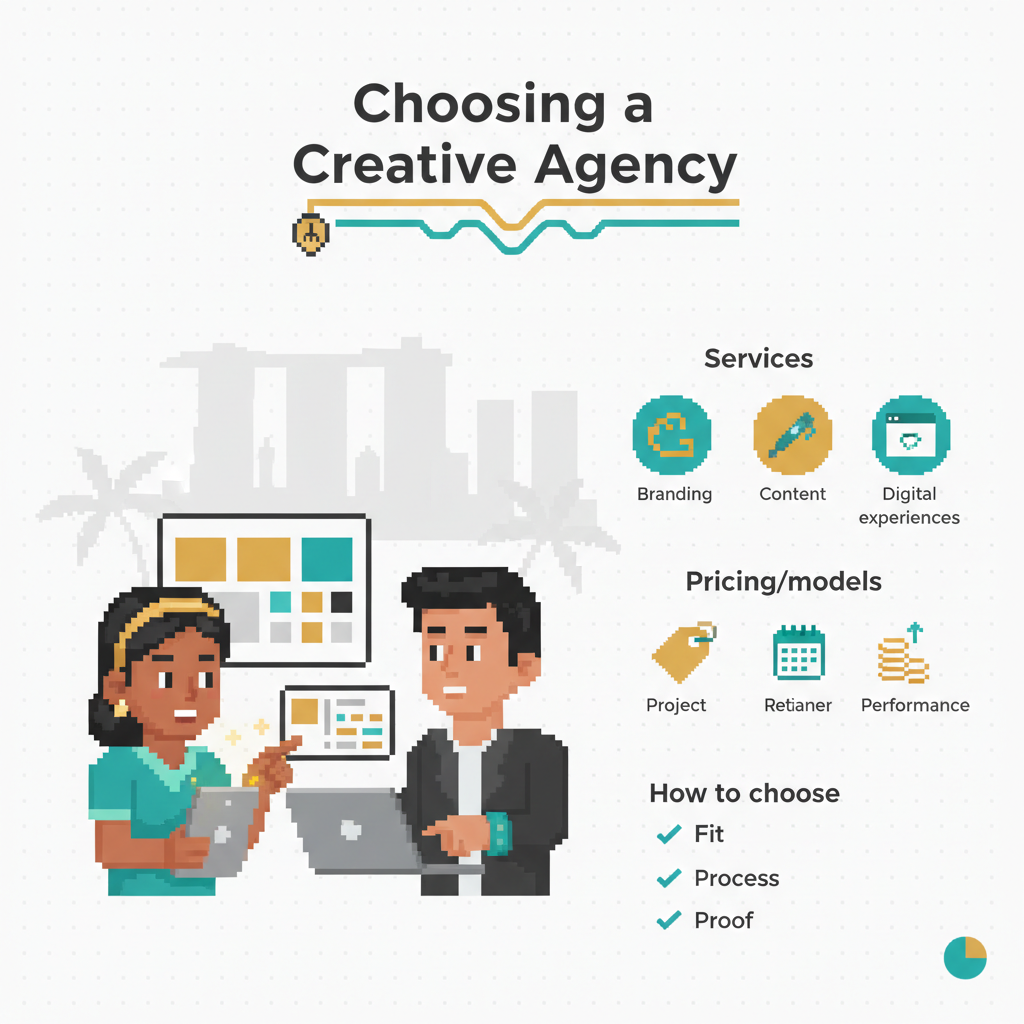
A modern creative agency typically organises its capabilities around three interconnected pillars: branding and identity, content and storytelling, and digital experience and development. Understanding what each pillar encompasses will help you evaluate whether an agency can deliver what your business needs.
Branding and identity
Branding work has evolved far beyond designing a logo and writing a style guide. Today, a strong branding agency or creative services agency approaches identity as a strategic and modular platform designed for continuous content creation across dozens of channels.
A typical process includes:
- Research and brand strategy – Interviews, competitive audits, and workshops to clarify your positioning, audience, and value proposition.
- Verbal identity – Messaging frameworks, tone‑of‑voice guidelines, naming systems, and narrative structures that can stretch from sales decks to social captions.
- Visual identity – Logos, colour palettes, typography, layout systems, illustration styles and, increasingly, motion principles.
For a mid‑market brand in Singapore/SEA, a modern identity system must scale seamlessly from a 16‑pixel favicon to a trade‑show booth or retail display without requiring a complete redesign each time. Leading agencies design flexible logo kits, responsive layouts, and motion behaviours that can be reused across campaigns.
Crucially, the output is no longer just a PDF brand guideline. Many creative agencies now deliver digital design systems—component libraries and tokens that plug into tools like Figma and popular content‑management platforms. This allows your in‑house designers, marketers and even AI‑assisted tools to generate on‑brand assets at scale.
Hamilton & Sherwind’s own branding services are a good example of this end‑to‑end brand transformation approach, moving from insight to identity to activation.
Content and storytelling
The content and storytelling pillar is where a creative marketing agency or content marketing agency builds a “studio inside the agency” to produce multi‑format creative at scale.
Key elements include:
- Content strategy – Channel mapping, editorial themes, audience personas, and SEO research that identify what stories to tell and where.
- Editorial and copy – Long‑form articles, campaign narratives, scripts, email flows, and thought‑leadership content.
- Social and video – Short‑form videos, carousels, live streams, creator collaborations, and social‑first campaigns.
For brands in Singapore and the region, this often means balancing:
- High‑context local storytelling (using cultural nuances, language preferences and local influencers).
- Regional scalability (adapting the same core idea for markets such as Malaysia, Indonesia, Thailand and the Philippines).
- Performance requirements (ensuring creative can be tested and optimised quickly on platforms like Meta, TikTok, YouTube and programmatic display).
Modern agencies embed analytics and experimentation into this pillar. They don’t just post and hope; they set hypotheses, run A/B tests on thumbnails, headlines and hooks, and iterate based on data from ad platforms and analytics tools.
If you are considering a creative agency partner, look for case studies where content work directly contributed to measurable outcomes—lead volume, online sales uplift, or campaign ROI—not just impressions.
Digital experience and development
The digital experience pillar covers everything related to how your audience experiences your brand online—from your website and landing pages to microsites, campaign hubs and interactive tools.
Typical services from a digital creative agency include:
- UX research and strategy – User interviews, journey mapping and analytics reviews to uncover friction points and opportunities.
- UI/visual design – High‑fidelity interface design that aligns with your brand system and works across devices.
- Front‑end and back‑end development – Implementation using modern frameworks and content‑management systems.
- Optimisation and experimentation – CRO (conversion‑rate optimisation), page‑speed improvements, and ongoing UX enhancements.
Well‑run creative agency services ensure that digital work is deeply connected to campaign creative and brand storytelling. For example:
- A launch campaign includes landing pages designed specifically for media traffic, rather than dumping users on a generic homepage.
- A video or social campaign drives traffic to a clear, persuasive journey with tailored content and offers.
- Analytics and attribution are planned at the start so you can see how creative is performing across the funnel.
Singapore and regional brands are increasingly using creative agencies to re‑platform legacy websites, improve mobile experience and build campaign microsites faster than in‑house IT teams can support.
Is it time to hire a creative partner?
Not every business needs a creative agency all the time. But there are specific inflection points where partnering with an external team can create outsized value—or protect you from costly missteps.
Triggers: New launches, rebrands, growth sprints
Common triggers that signal it may be time to engage a creative agency include:
- New product or category launches
Launching a new product, service or sub‑brand—especially into a competitive or unfamiliar market—demands a clear story, distinctive creative and channel‑specific execution. An agency that has done launches across multiple categories can help you avoid re‑inventing the wheel and bring proven patterns for awareness, acquisition and conversion. - Rebranding and repositioning
M&A, leadership changes, competitive pressure or category shifts may make your current brand feel outdated or misaligned. A rebrand is high‑stakes: get it wrong and you confuse loyal customers; get it right and you unlock fresh growth. Because it touches everything (internal culture, customer experience, digital assets, offline environments), it is an area where an experienced branding agency can guide you end‑to‑end. - Aggressive growth phases
When your business enters a growth sprint—new markets, rapid hiring, ambitious revenue targets—your internal team often cannot produce the volume and variety of creative assets required. A creative ad agency or creative marketing agency can deploy a multi‑disciplinary pod to support always‑on campaigns while your internal team focuses on strategy and stakeholder management. - Digital experience overhauls
If website conversion is stagnant, mobile experience is poor, or you’re shifting to new platforms (e.g. headless CMS, e‑commerce integrations), a creative agency with strong digital capabilities can accelerate the transformation, reduce technical risk and ensure the new experience still feels on‑brand. - Capability or bandwidth gaps
Sometimes the trigger is simpler: you have a lean in‑house team that is excellent at BAU (business‑as‑usual) work but lacks specific skills (motion design, web development, integrated campaign strategy) or the spare capacity to take on a large initiative without burning out. Rather than rush hires or overload your team, a project‑based engagement with an agency can bridge that gap.
If you recognise one or more of these triggers, it may be time to at least explore what a creative agency partnership could look like for your organisation.
Choosing the right fit: Criteria and red flags
Selecting the right creative partner can be the difference between a frustrating, expensive misalignment and a relationship that compounds value for years.
Evaluating case studies and industry experience
When you review proposals from a creative agency, don’t just skim the visuals. Look for answers to six questions in each case study:
- What was the business challenge?
Is it clearly stated, and similar to your situation (e.g. low awareness, low conversion, complex stakeholder environment)? - Who was the audience and what insight did they uncover?
Strong agencies show they understand people, not just platforms. - What was the core idea?
Can they explain the creative platform in a sentence or two? - How was it executed across channels?
Do you see consistency from brand, to content, to digital experience? - What were the results?
Are there concrete metrics (e.g. uplift in leads, sales, engagement, NPS) rather than vague statements? - What did they learn and improve?
Do they show iteration and optimisation, or just a one‑off burst of activity?
It can also help to benchmark case studies against your own sector. If you’re in B2B, you want to see evidence of complex decision journeys and long sales cycles. If you’re in FMCG or retail, you want examples of high‑velocity campaigns and shopper marketing.
You can explore Hamilton & Sherwind’s portfolio to see how this kind of storytelling is used to connect strategy, creative and results across government campaigns, SMEs and global brands.
Culture, communication and project management
Great creative work is built on trust and communication. Even the most talented agency will struggle if there is a poor cultural fit or weak project management.
Key things to assess:
- Chemistry and values – Does the agency listen carefully and challenge your thinking constructively? Do they seem curious about your business, or only eager to talk about themselves?
- Ways of working – Ask how they handle briefs, approvals, feedback and change requests. A mature agency can explain its process clearly and flexibly.
- Transparency – Look for visibility into timelines, scope, and resourcing. Do you know who will be working on your account day‑to‑day, not just the pitch team?
- Tooling – Are they able to plug into your preferred tools (e.g. Slack, Asana, Teams) or provide a clear alternative?
Project management rigour is especially important if you operate across multiple markets or business units. Ask to see a sample project plan or governance structure for a similar project.
Hamilton & Sherwind’s integrated approach—combining digital marketing services, social, branding and production under one roof—is an example of how process and culture can be aligned for Singapore/SEA organisations.
Creative marketing agency vs niche specialists
You will often be choosing between:
- A full‑service creative marketing agency that can handle strategy, creative, media and digital in one place.
- Niche specialists who focus on one channel or discipline (e.g. a social‑first creative shop, a UX agency, a video production house).
There is no one “right” answer, but you can use a simple lens:
Choose a full‑service creative marketing agency when:
- You need a new brand platform or integrated campaign that must live across many touchpoints.
- Your internal team lacks capacity to coordinate multiple vendors.
- You want one partner accountable for results across the funnel.
Choose niche specialists when:
- You already have a strong brand platform and strategy, and you just need deep craft in one area (e.g. TikTok content, AR experiences, performance‑creative).
- Your internal marketing or brand team can play “orchestra conductor” across multiple partners.
Many brands in Singapore/SEA use a hybrid approach: a lead creative agency responsible for brand coherence and strategy, combined with a small number of specialist partners. The key is to ensure everyone shares a common brief, KPIs and brand system.
Budgeting, pricing models and ROI tracking
Once you’re confident a partner is strategically and creatively suitable, the next questions are practical: How do they price? What will it cost? How will you know if it’s working?
Engagement structures: Project, retainer, value‑based
Most creative agencies offer three main pricing models.
1. Project‑based engagements
You agree on a fixed scope, deliverables and fee. For example:
- Brand identity and guidelines
- A campaign concept plus a specific number of key visuals and adaptations
- A website or microsite build
This model is suitable when:
- The brief is clear and time‑bound.
- You want to “test the waters” with an agency before a longer relationship.
- Budget needs to be tightly controlled.
Be sure the proposal clearly defines:
- What is included (deliverables, rounds of revisions, formats).
- What is not included (e.g. media buying, extra variants, translations).
- How change requests will be handled.
2. Retainer or subscription models
Here, you pay a recurring monthly or quarterly fee for ongoing access to an agency team. A retainer might cover:
- A set number of campaign concepts per quarter.
- Monthly content production (e.g. a defined number of social assets, landing pages, email templates).
- Strategic support, reporting and optimisation.
Retainers are useful when:
- You have continuous creative needs across the year.
- You want the agency to feel like an extension of your team.
- You prefer to avoid re‑briefing and onboarding for every campaign.
Look for clarity on:
- How priorities are set each month.
- What happens if needs change (e.g. can you trade social assets for video edits?).
- How performance is measured and reported.
3. Value‑based or performance‑linked fees
Some agencies are open to linking a portion of their fees to outcomes such as:
- Lead volume or quality.
- Sales uplift for a specific product line.
- Engagement or conversion metrics.
This usually works best where:
- Attribution is relatively clear (e.g. a specific landing page and campaign).
- Both sides can access reliable data.
- You already have some baseline performance to compare against.
For many brands, a hybrid model (project or retainer with a modest performance component) balances risk and reward.
In‑house vs freelancers vs agency: Pros and cons
It’s also useful to compare working with a creative agency to building in‑house capability or relying on freelancers:
- In‑house team
- Pros: deep brand knowledge, immediate availability, close collaboration with other departments.
- Cons: limited external perspective, harder to scale up/down quickly, may struggle with highly specialised work.
- Freelancers/independent specialists
- Pros: flexible, cost‑effective for small tasks, access to niche skills.
- Cons: requires strong internal project management, inconsistent availability, harder to align to a single strategic direction.
- Creative agency
- Pros: integrated strategy, creative and production; access to a broad team; structured process; external perspective.
- Cons: higher apparent day‑rate; risk of mismatch if selection and briefing are not done carefully.
A practical approach for many organisations is:
- Use in‑house resources for BAU content and internal communications.
- Maintain a trusted pool of freelancers for overflow or specialised tasks.
- Partner with a creative agency for key initiatives such as brand transformations, regional campaigns and major product launches.
Key takeaways for confident decision‑making
The creative agency model has evolved from simple media brokerage to a strategic, omnichannel partner that blends brand, content and digital experience. For marketing leaders and business owners in Singapore and Southeast Asia, a good creative agency can:
- Clarify and sharpen your brand story.
- Produce consistent, high‑quality creative at speed across channels.
- Help you launch, reposition or scale with less guesswork and more data‑backed decisions.
To choose the right partner:
- Start with your business problem, not just a list of assets you think you need.
- Assess strategic depth and craft through real case studies and team conversations.
- Check cultural fit and ways of working, especially around communication and project management.
- Align on scope, pricing and success metrics before you sign.
And remember: this is a partnership, not a purchase. When you find the right creative agency, they become an extension of your leadership team—helping you navigate change, create work your customers care about and build a brand that stands out in a crowded market.
If you’d like to explore how an integrated creative partner can support your brand—from branding to digital marketing, social and content—reach out to Hamilton & Sherwind’s team. We’d be happy to discuss your next campaign or transformation and see how we can help.
You can contact us here to start the conversation.