

Intro
AI-assisted social media production is moving from a niche capability to a core operating model for brands, creators, and in-house teams across Singapore and the broader SEA region. The shift matters because it directly addresses three persistent pressures: speed to publish (time-to-market), channel fragmentation (managing native formats across TikTok, Instagram, YouTube, LinkedIn, and emerging live-commerce formats like TikTok Shop and Shopee Live), and creative fatigue (the relentless demand for fresh, relevant content). When executed well, AI-enabled workflows unlock faster iteration, more localized relevance, and more scalable experimentation—without sacrificing brand integrity.
For marketing leaders, social media managers, and founders in SEA, AI-assisted production offers a practical path to:
- Shorten concept-to-publish cycles across many markets and languages.
- Maintain a coherent brand voice while tailoring content for local nuances.
- Improve asset variety through AI-generated scripts, visuals, and edits that can be quickly tested and refined.
- Free up skilled teams to focus on strategy, storytelling, and higher-order creative thinking rather than repetitive production tasks.
This playbook frames how to implement AI-assisted creative production in a Singapore/SEA context—balancing ambitious efficiencies with rigorous guardrails for quality, ethics, and cultural nuance. It blends practical workflows, platform-specific realities, and governance essentials to help brands in retail, F&B, e-commerce, fintech, and lifestyle sectors move from pilot projects to scalable, responsible AI-driven social programs.
Section 1 — Understanding AI-assisted creative production for social media
What “AI-assisted” means vs full automation
- AI-assisted production means AI acts as a strategic co-pilot: it can ideate concepts, draft scripts, create visuals, assemble edits, localize copy, and run QA checks, but humans retain oversight at key decision points (brand guardrails, final approvals, sensitive cultural cues). It is not yet a fully autonomous brain that can replace human judgment in dynamic brand storytelling.
- Full automation would imply end-to-end generation and publication without human review. In practice, SEA contexts—multilingual markets, cultural sensitivities, and platform-specific norms—benefit most from a hybrid approach: strategic input from humans combined with AI-powered execution.
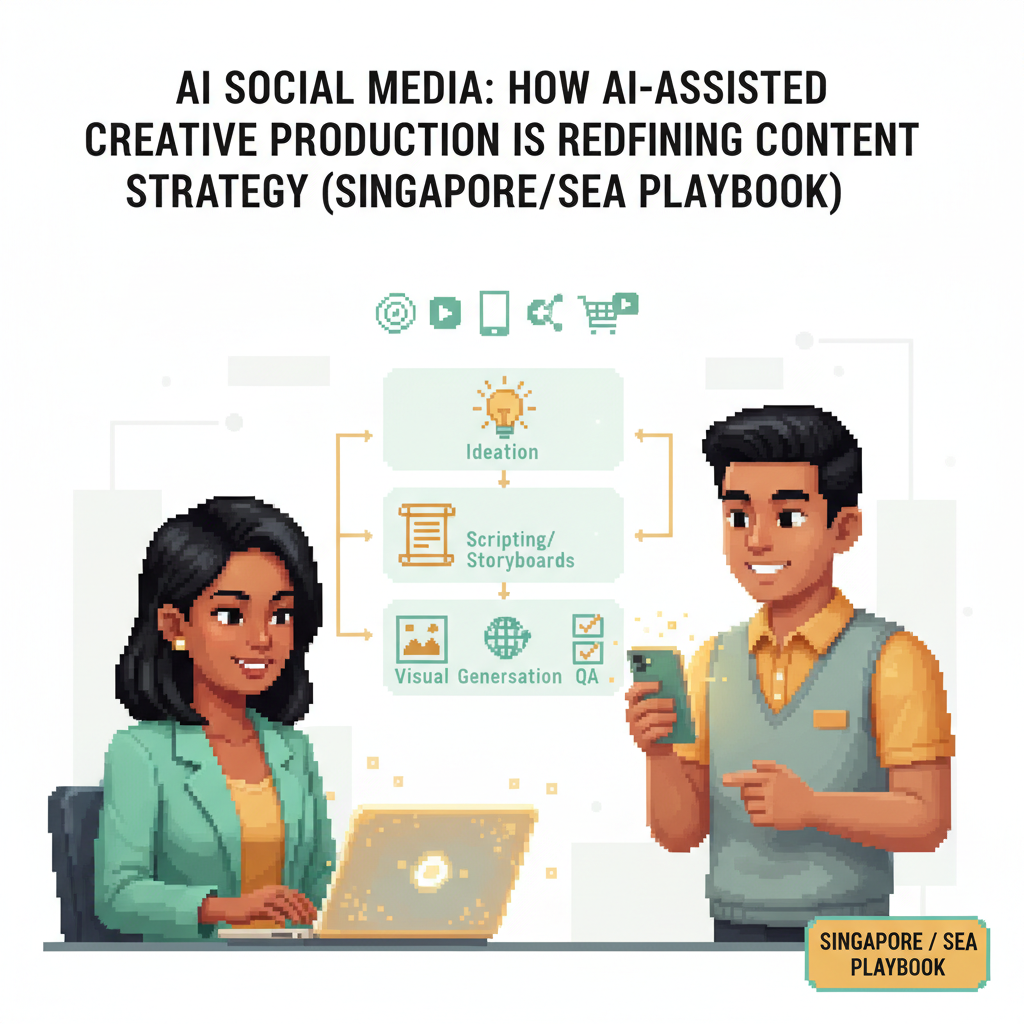
Where AI helps: ideation, scripting, visual generation, editing, versioning, localisation, QA
- Ideation and concept framing: AI can surface content angles aligned to regional events, seasonal moments, and local preferences, accelerating initial creative cones.
- Scripting and captioning: AI drafts hooks, opening lines, longer captions, and multilingual variants that can be refined for tone and accuracy.
- Visual generation: AI-assisted graphics, storyboard visuals, and short video elements (lower-thirds, overlays, thumbnails) that can be quickly iterated for multiple markets.
- Editing and assembly: AI can assemble cut versions for different formats (TikTok, Reels, Shorts) from a single concept, applying platform-specific aspect ratios and pacing.
- Versioning and localisation: From a single creative concept, AI generates language variants, regionally tuned visuals, and culturally resonant references to fit EN/CN/MS/ID/TH markets common in SEA.
- QA and compliance checks: AI pre-flags potential brand-safety issues, cultural inconsistencies, or inaccurate claims, offering a first-pass gate before human review.
Limits: brand safety, hallucinations, cultural nuance
- Brand safety: AI outputs must be curated to avoid misrepresentations, sensitive topics, or misattribution. A human-in-the-loop step is essential for final approval, especially for fintech and health-adjacent messaging.
- Hallucinations: AI can generate plausible-sounding but incorrect content (facts, figures, or product details). Always verify with subject-matter experts and add fact-check checkpoints in the workflow.
- Cultural nuance: SEA markets span multiple languages, dialects, and regional idioms. Local language review and cultural adaptation are non-negotiable to prevent tone-deaf or misinterpreted content.
- Guardrails and guardbands: Establish baseline safeguards (do/don’t lists, tone sliders, and sample-approved prompts) to prevent drift in brand voice or inappropriate imagery.
Section 2 — Core AI tools for social media management and content creation
Categories: planning/calendars, copy and captioning, image/video generation, repurposing, scheduling, analytics
- Planning/calendars: AI-assisted calendars that suggest content windows, seasonality, and cross-platform repurposing opportunities.
- Copy and captioning: AI-generated drafts, translations, and tone-tuned variants aligned with brand voice.
- Image/video generation: Text-to-image and video generators for visuals, thumbnails, and overlays; quick storyboard creation.
- Repurposing: Automated adaptation of assets across formats and platforms (TikTok to YouTube Shorts, Carousels to Reels) while maintaining core messaging.
- Scheduling: AI-backed publish timing that considers audience behavior across SEA time zones and platform-specific peak moments.
- Analytics: AI-driven insights from performance data, with recommendations for creative iterations, audience targeting tweaks, and format optimization.
Decision criteria: data privacy, brand voice customisation, prompt libraries, integrations (Meta/TikTok), team workflows
- Data privacy: Prioritize tools with clear data-handling practices, on-device vs cloud processing trade-offs, and minimization of sensitive data exposure.
- Brand voice customization: Tools should support guardrails for tone, vocabulary, and style, plus easy onboarding of your brand voice dictionary. See how we craft voice systems in our branding work.
- Prompt libraries: A well-managed library of prompts (captions, hooks, visuals, CTAs) enables consistent outputs and faster iteration across markets.
- Integrations: Look for native or robust integrations with Meta platforms and TikTok. For platform guidance, refer to Meta AI information labeling and TikTok Business Center.
- Team workflows: Ensure collaborative workspaces with version control, approval workflows, and role-based access to protect brand integrity. Our digital marketing services team can help you streamline this.
SEA lens: bandwidth and device constraints, multilingual markets (EN/CN/MS/ID/TH), emerging platforms (TikTok Shop, Shopee Live)
- Bandwidth and devices: In SEA, many teams rely on mobile devices and limited bandwidth; choose lighter-weight templates, offline capabilities, and efficient asset formats to keep speed with lower latency.
- Multilingual markets: Provide robust multilingual support for EN/CN/MS/ID/TH and relevant dialects; ensure voice consistency and culturally resonant expressions.
- Emerging platforms: Prepare for live-commerce and seamless shopping experiences on TikTok Shop and Shopee Live by generating platform-tailored assets and optimized product videos. For production support, explore our video production in Singapore capabilities.
Section 3 — AI-generated content for social platforms
Platforms: Instagram Reels, TikTok, YouTube Shorts, LinkedIn
- Instagram Reels: Short, visually polished, on-brand vertical content; emphasize quick hooks, captions on screen, and shop-ready overlays. See platform best practices via YouTube Creator Academy for video storytelling fundamentals applicable across Shorts and Reels.
- TikTok: Native, fast-paced, authentic style content with strong hooks; focus on native sound usage, on-trend formats, and authentic creator-led storytelling. For SEA business guidance, consult TikTok Business Center.
- YouTube Shorts: Compelling, snackable content that can lead to longer-form videos or evergreen content; cross-linking to longer assets adds depth.
- LinkedIn: Professional, educational content with clear value props; emphasis on thought leadership, whitepapers, product explainers, and region-focused case studies.
Formats: UGC-style videos, product explainers, founder-led content, how-to micro-tutorials, social-first carousels
- UGC-style videos: User-generated aesthetics with credibility and social proof; emphasize authenticity and relatability. Browse our portfolio for examples of social-first creative.
- Product explainers: Clear value propositions, simplified diagrams, and localized language that simplifies complex concepts.
- Founder-led content: Personal narratives from founders or regional leaders to build trust and brand humanity.
- How-to micro-tutorials: Bite-sized, actionable tips that educate quickly and drive engagement.
- Social-first carousels: Engaging multi-panel sequences optimized for mobile; each panel should advance a micro-story or key benefit.
Creative patterns that work in SEA: hook-first storytelling, local slang/visuals, short subtitles, numerals in overlays, price/offer upfront
- Hook-first storytelling: Begin with a surprising angle or value proposition in the first 1–2 seconds to capture attention across SEA feeds.
- Local slang/visuals: Incorporate regionally familiar terms, visuals, and cultural cues to enhance resonance.
- Short subtitles: Many SEA viewers watch without audio; use clear, legible subtitles in relevant languages.
- Numerals in overlays: Use numerals and on-screen text to improve readability across diverse audiences.
- Price/offer upfront: Present the value proposition or offer early to boost comprehension and intent.
Section 4 — Best practices for integrating AI into your workflow
The “3-layer” workflow: human strategy, AI assist, human QA
- Layer 1 — Human strategy: Define objectives, audience segments, regional focus, and brand guardrails.
- Layer 2 — AI assist: Generate concepts, drafts, visuals, and local variants; perform initial optimization and formatting.
- Layer 3 — Human QA: Final check for accuracy, tone, legal/compliance, and cultural sensitivity before publish. Use a rapid approval loop to keep speed without compromising quality.
Prompt engineering templates for captions, hooks, CTAs, and visuals
- Captions (SEA, EN): Template — “Write a concise, energetic caption in [language] for a [product category] targeting [audience], with a [brand voice: professional/confident/friendly] tone, include 2–3 hashtags, and end with a CTA to [action]. Example prompt: [paste your product outline or key feature].”
- Hooks (TikTok/Reels): Template — “Create a 4-second hook for a [topic] in [language] that highlights [unique selling point], uses a local reference, and ends with a question to encourage comments.”
- CTAs: Template — “Provide a clear CTA in [language] for a [platform] video that invites viewers to [action], keeps it under 12 words, and aligns with the brand voice.”
- Visuals: Template — “Generate a vertical 9:16 concept art for a [theme], with [color palette], [brand logo placement], and on-screen text in [language].”
Brand voice playbook: samples, do/don’t lists, tone sliders
- Samples: Provide a handful of short brand voice samples in different tones (e.g., confident, warm, pragmatic) and map to specific audience intents.
- Do/don’t lists: Concrete guidance on what content is acceptable (e.g., avoid buzzwords unless authentic, avoid exaggeration, avoid stereotypes) and what to avoid (e.g., misrepresentation, overly aggressive sales pitches).
- Tone sliders: A spectrum from 0 (very formal) to 10 (high energy). Use tone slider recommendations to adapt content per platform and market.
Governance checklist: naming conventions, asset taxonomy, rights management for AI outputs
- Naming conventions: Standardized naming for assets (brand, platform, format, language, version) to enable quick retrieval and audit trails.
- Asset taxonomy: Taxonomies for assets (titles, descriptions, tags, usage rights, embargo dates) to support licensing and reuse guidelines.
- Rights management: Track origin, usage rights, and licenses for AI-generated outputs; ensure compliance with platform policies such as Meta AI info labels and platform disclosure expectations.
Section 5 — Governance, ethics, and authenticity in AI social media
Disclosures for synthetic media when relevant
- Transparency: When content uses synthetic media or AI-generated voices/images, consider disclosures appropriate to the audience and platform. Transparent labeling helps sustain trust and reduces misinterpretation (see Meta’s AI information labeling guidance).
- Consistency with regulations: Align disclosures with platform guidance and regional expectations, especially for content that could be interpreted as promotional or educational.
UGC and creator collaborations: ensuring transparency, avoiding deepfake risks
- Transparency in partnerships: Clearly identify UGC and creator collaborations; disclose sponsorships and paid promotions per platform guidelines.
- Deepfake risk management: Avoid misleading deepfakes or misleading representations; if AI-generated likenesses are used, ensure consent and accurate portrayal.
Avoiding bias and respecting cultural norms in SEA
- Bias mitigation: Review AI outputs for biased representations or stereotypes; incorporate diverse regional perspectives into prompts and validation steps.
- Cultural respect: Use local consultants or language experts to verify translations, idioms, and visuals; avoid content that could be perceived as disrespectful or offensive across SEA cultures.
Section 6 — Measuring impact: metrics, ROI, and governance
Benchmarks to track
- Cost per asset (CPA*): Monitor production costs relative to total output; track changes as AI-enabled workflows scale.
- Time-to-first-draft: Measure the time from brief to first deliverable; a key indicator of workflow efficiency.
- Content throughput per week: Volume of assets produced per week across platforms; helps assess capacity gains.
- Creative fatigue indicators: Track repetition rates, engagement decay, or audience fatigue signals to ensure content remains fresh.
- Holdout tests: Maintain control assets to validate AI-driven improvements against non-AI variants.
Experiment design: split tests, creative iterations, “laddered” learnings
- Split tests: Compare AI-generated variants against human-created baselines; test across platforms and languages.
- Creative iterations: Use iterative cycles to refine hooks, visuals, and captions; emphasize rapid learning and adaptation.
- Laddered learnings: Build a progressive ladder of insights—from asset-level learnings to campaign-level patterns—informing future content strategy.
North-star metrics for SEA commerce
- ROAS and CVR from social: Track revenue and conversion rates attributable to social media content, considering cross-channel influences.
- Retention effects of content cadence: Assess whether regular, AI-assisted content cadence improves audience retention, repeat visits, and long-term engagement.
For regional benchmarks and adoption context, see DataReportal: Digital 2024 Singapore and Meltwater’s Singapore social media statistics. For tooling overviews used by teams globally, review Zapier’s best AI social media management tools. APAC-specific strategy insights are available on Think with Google (APAC).
Conclusion — What’s next for AI in social media
AI-assisted creative production is not a luxury but a scalable capability for SEA brands seeking faster time-to-market, greater localization, and more efficient content supply. As platforms evolve and audience expectations shift toward authentic, locally relevant storytelling, AI becomes a powerhouse for experimentation, optimization, and learning. The strategic path is not about replacing people but designing workflows where humans set the strategy, AI accelerates execution, and humans QA to ensure quality, ethics, and cultural resonance.
30/60/90-day practical plan for a Singapore brand
30 days: Set the baseline and pilot scope
- Define one core concept and map assets across three SEA markets (EN, a local SEA language, and a regional variant).
- Establish the 3-layer workflow (strategy, AI assist, human QA) and create a brand voice playbook with do/don’t lists and tone sliders. Our branding practice can assist.
- Select 2–3 platforms (e.g., TikTok and Instagram; LinkedIn for fintech) and build a minimal AI asset library (prompts, templates, and starter visuals). Explore social media services for playbooks and execution.
- Implement governance: naming conventions, asset taxonomy, and rights management checklist; prepare disclosure guidelines for synthetic media if relevant.
60 days: Expand and optimize
- Roll out AI-assisted workflows to 2–3 more markets or product categories; introduce additional formats (UGC-style videos, how-to tutorials, social-first carousels).
- Create a plug-and-play prompt library for captions, hooks, CTAs, and visuals; establish a central content calendar with platform-specific slots and localization variants.
- Begin holdout tests and laddered experiments to measure impact on time-to-first-draft, asset throughput, and early engagement signals; track initial ROI indicators (CPA reductions, asset cost efficiency). Our digital marketing team can help with analytics and experimentation.
90 days: Scale and governance refinement
- Scale AI-assisted production across all core markets and add live-commerce content for SEA platforms (TikTok Shop, Shopee Live) with platform-tailored assets. See our video production in Singapore support.
- Refine metrics dashboards to include ROAS, CVR from social, retention effects, and cross-platform performance; tighten brand guardrails and compliance checks.
- Establish a regional center of gravity for AI content operations, with localized subject-matter experts, language specialists, and a cross-functional governance council to sustain quality, ethics, and authenticity. Review our portfolio and blog for case examples and insights.
Ready to build a practical, ethical, and scalable AI-assisted social media program for Singapore and SEA? Let’s design your 30/60/90-day plan together. Contact Hamilton & Sherwind.