

AI Marketing: Strategies, Tools & ROI for Modern Businesses
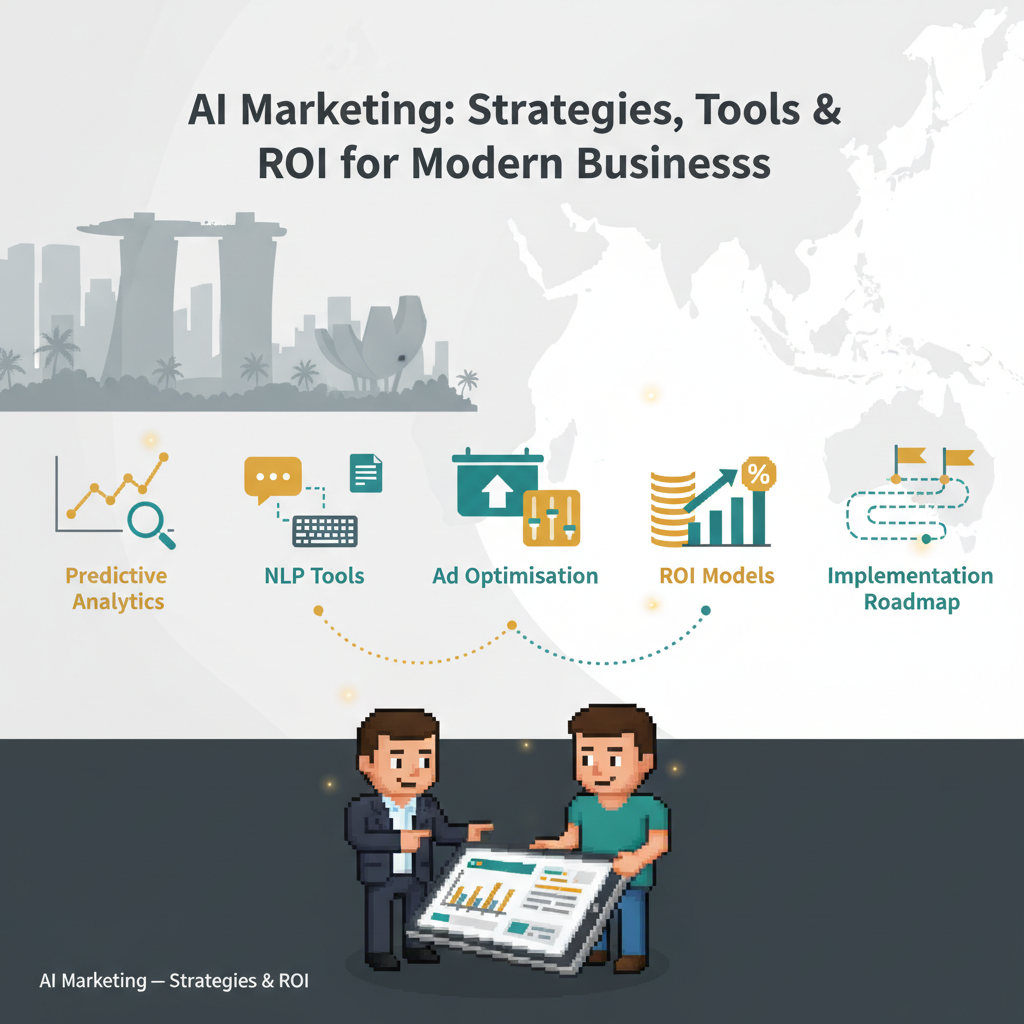
Introduction – Why Artificial Intelligence Became Marketing’s Game-Changer
The marketing landscape has undergone a seismic shift. What once required teams of analysts, creative directors, and strategists working in silos can now be orchestrated by intelligent systems that learn, adapt, and optimize in real time. Artificial intelligence marketing has moved from a futuristic concept to an operational necessity for businesses competing in Southeast Asia’s fast-moving digital economy.
The numbers tell a compelling story. According to a 2025 AWS study cited by FintechNews Singapore, 48% of Singaporean businesses now use AI in some part of their operations—up from 40% just a year earlier. That translates to roughly 27,000 Singapore companies adopting AI for the first time in the past 12 months, or approximately three companies every hour. More impressively, 82% of these adopters report an average 19% lift in revenue, while 90% cite significant productivity gains (figures as reported in FintechNews Singapore’s coverage of the AWS study: https://fintechnews.sg).
But why has AI marketing become so critical? The answer lies in the convergence of three forces: the explosion of consumer data, the rise of mobile-first shopping behaviors, and the deprecation of traditional tracking methods. Southeast Asian consumers now spend over four hours daily in-app, expecting hyper-personalized content and instant assistance. Simultaneously, 80–90% of shoppers across ASEAN markets rely on algorithmic recommendations before making purchases, as reported in regional e‑commerce studies from Google, Temasek and Bain (see the latest “e‑Conomy SEA” report: https://economysea.withgoogle.com). Brands that fail to harness AI in digital marketing risk becoming invisible in this attention-scarce environment.
This article explores how AI marketing tools, strategies, and use cases are reshaping competitive advantage for businesses across the region. Whether you’re a founder evaluating your first AI investment or a marketing leader scaling existing systems, this guide provides the strategic and tactical insights needed to navigate the transformation.
The Evolution of Data-Driven Promotion: From Rule-Based Automation to AI Marketing
Key milestones in machine learning and generative models
The journey to modern AI marketing spans more than a decade of breakthroughs, each unlocking new capabilities for marketers.
In 2012, AlexNet’s victory in the ImageNet competition sparked the deep-learning revolution. Within two to three years, computer vision technology began powering visual search and dynamic creative optimization in ad-tech platforms. This was the first time machines could “see” and understand images at scale—a capability that would later transform how brands create and optimize visual advertising.
The 2014 emergence of sequence-to-sequence recurrent neural networks (RNNs) enabled early chatbots and machine translation, technologies that proved invaluable for cross-border e-commerce in ASEAN. Suddenly, a Singapore retailer could serve customers in Indonesia, Thailand, and Vietnam with localized, conversational experiences.
The 2017 “Attention Is All You Need” paper introduced the Transformer architecture, fundamentally changing how machines process language. This breakthrough made large-scale language understanding feasible and jump-started the era of hyper-personalized copywriting and product-recommendation engines. Google’s 2018 release of BERT (Bidirectional Encoder Representations from Transformers) democratized contextual SEO optimization and intent-matching, giving marketers tools to understand what customers actually meant when they searched (see the original BERT paper at https://arxiv.org/abs/1810.04805).
The 2020 launch of GPT-3, with its 175 billion parameters, marked a watershed moment. For the first time, a large language model (LLM) was accessible via API, and Southeast Asian MarTech startups immediately began embedding AI copy-generation into social-commerce tools. Shopee sellers could suddenly generate product descriptions; TikTok Shop merchants could draft promotional copy at scale.
By 2022, Stable Diffusion and Midjourney democratized synthetic image and video production, slashing creative-asset costs for direct-to-consumer (D2C) brands across the region. A small fashion startup in Bangkok could now generate dozens of product variations without hiring a photographer or designer.
The 2023 release of GPT-4 with plugins brought reliable long-form generation and analytics-code writing capabilities. Singapore agencies adopted these tools for campaign planning, reducing the time from brief to execution. By 2024, Retrieval-Augmented Generation (RAG) stacks went mainstream, allowing banks and telcos in Singapore to roll out private-data LLM chat experiences—customer service powered by AI that understood proprietary business rules and customer history.
Today, in 2025, agentic workflows (systems like AutoGen and Devin-style agents) are reaching production pilots. SEA marketers are testing fully-automated media-buying and CRM copy iteration, where AI systems not only execute tasks but also make strategic decisions about budget allocation and audience targeting.
How consumer behaviour shifts accelerated adoption
Consumer expectations have evolved faster than many organizations anticipated. The mobile-first, always-on nature of Southeast Asian digital life has created new demands that traditional marketing cannot meet.
First, there’s the search for relevance and immediacy. SEA consumers expect “for-me” content—messaging, offers, and product recommendations tailored to their specific context, preferences, and purchase history. This expectation has pushed brands toward AI-driven micro-segmentation, where audiences are divided not into dozens of segments but into thousands, each receiving uniquely personalized messaging.
Second, trust in algorithmic recommendations has grown dramatically. IDC research shows that recommendation engines now rank among the top three AI use cases adopted by SEA firms (see IDC’s APAC AI adoption reports at https://www.idc.com). Shopee and TikTok Shop have trained consumers to expect AI-powered “For You” feeds, and this expectation has spilled over into email, SMS, and website experiences. Brands that don’t leverage recommendation engines are leaving revenue on the table.
Third, the surge in short-form video consumption—TikTok, Instagram Reels, YouTube Shorts—has created an insatiable demand for creative content. A single brand might need to produce 50–100 video variations per month to test messaging, formats, and creative angles. Generative AI tools have made this volume economically feasible.
Fourth, post-pandemic consumer behavior has normalized 24/7 service expectations. WhatsApp Business chatbots, often powered by LLMs, are now the first-touch support channel for banks, airlines, and government agencies in Singapore. Customers expect instant responses, and AI-powered conversational interfaces deliver this at scale.
Finally, the deprecation of third-party cookies across Asia has forced brands to rethink audience targeting. Without granular tracking data, companies are turning to AI to model look-alike audiences and perform predictive attribution. This shift has accelerated AI adoption among performance marketers who previously relied on pixel-based tracking.
Core Components Every Team Needs to Understand
Predictive analytics and customer segmentation
At the heart of AI marketing lies predictive analytics—the ability to forecast customer behavior and identify high-value segments before they convert.
Predictive analytics in marketing typically involves three core techniques. RFM analysis (Recency, Frequency, Monetary value) uses historical transaction data to score customers by how recently they purchased, how often they buy, and how much they spend. AI enhances this by identifying non-obvious patterns: a customer who hasn’t purchased in six months but has high lifetime value might be a priority for a win-back campaign, while a frequent small-ticket buyer might be a candidate for upselling.
Lookalike modeling uses machine learning to identify prospects who resemble your best customers. Rather than relying on demographic data alone, AI systems analyze behavioral patterns—browsing history, content engagement, purchase timing—to find similar prospects in your audience database or on advertising platforms. For a Singapore fintech company, this might mean identifying professionals aged 25–40 with specific spending patterns and financial goals, then finding similar prospects across Malaysia and Indonesia.
Churn prediction is perhaps the most valuable application. By analyzing customer engagement metrics, support interactions, and usage patterns, AI models can identify customers at risk of leaving before they actually do. A telecommunications company in Thailand might discover that customers who reduce their data usage by 30% within a month are three times more likely to switch providers. Armed with this insight, the company can proactively offer retention incentives.
The business impact is substantial. APAC firms cite a 30% improvement in customer experience (CX) scores after AI investments in predictive analytics, according to IDC research on customer experience in Asia-Pacific (https://www.idc.com).
Natural language processing for content and chatbots
Natural language processing (NLP) has transformed how brands create and deliver marketing messages at scale.
Content generation is the most visible application. AI tools can draft email subject lines, social media captions, product descriptions, and even long-form blog posts. A Singapore e-commerce company might use AI to generate 50 variations of a product description, each optimized for different customer segments or search intents. The tool understands that a luxury handbag description for a high-income segment should emphasize craftsmanship and heritage, while the same product for a value-conscious segment should highlight durability and versatility.
More sophisticated NLP applications involve sentiment analysis and intent detection. By analyzing customer reviews, social media mentions, and support tickets, AI systems can identify emerging product issues, competitive threats, or shifts in customer sentiment. A hotel chain in Bali might discover through sentiment analysis that guests consistently praise the breakfast but criticize the WiFi speed—insights that should inform both marketing messaging and operational priorities.
Chatbots and conversational AI represent the most direct customer-facing application of NLP. Modern LLM-powered chatbots can handle complex, multi-turn conversations, understand context, and even empathize with customer frustrations. Banks in Singapore have deployed RAG-based chatbots that can answer questions about specific account details, loan products, and regulatory requirements by retrieving information from proprietary databases in real time. These systems handle 60–70% of customer inquiries without human intervention, freeing support teams to focus on complex cases. McKinsey’s work on AI in customer service reports similar impact ranges for AI-enabled service models (see McKinsey’s “The future of customer care” at https://www.mckinsey.com).
The efficiency gains are remarkable. A 2025 BCG survey found that APAC firms using AI-powered customer service reduced response times by 40% and improved first-contact resolution rates by 25% (as reported in BCG’s customer experience and AI research: https://www.bcg.com).
Computer vision for visual ad optimisation
Computer vision—the ability of machines to interpret and analyze images—has revolutionized how brands create and optimize visual advertising.
Visual search is one application. Customers can now upload a photo of a product they like, and AI systems identify similar items in a retailer’s catalog. A shopper in Jakarta sees a dress on Instagram, takes a screenshot, and uploads it to Shopee’s visual search tool, which returns matching or similar dresses from the platform’s inventory. This bridges the gap between inspiration and purchase.
Dynamic creative optimization (DCO) uses computer vision to test thousands of ad variations automatically. An AI system might generate 100 versions of a banner ad—varying the product image, background color, headline, and call-to-action—then serve each version to different audience segments. The system learns which combinations drive the highest click-through rates and conversion rates, then allocates budget accordingly. A D2C fashion brand in Thailand might discover that images featuring local models outperform international models by 35%, or that lifestyle shots outperform product-only shots by 20%. Meta has documented similar lifts for advertisers adopting dynamic ads and creative optimization in its marketing science reports (https://www.facebook.com/business/news).
Product recognition in ads is another emerging capability. Computer vision can identify products in user-generated content (UGC), influencer posts, and competitor ads. A beverage company might scan Instagram for mentions of its brand, automatically identify the product in photos, and measure brand visibility across influencer content. This provides real-time insights into how the brand is being represented in the wild.
The ROI is compelling. Brands using AI-powered visual optimization report 15–25% improvements in ad performance metrics (click-through rate, conversion rate, return on ad spend) compared to manually-optimized campaigns, similar to ranges highlighted in Google’s AI-powered Performance Max case studies (https://ads.google.com).
Quantifying Benefits: Cost Savings, Revenue Uplift and Brand Loyalty
Southeast-Asian case studies and benchmarks
The financial case for AI marketing is increasingly clear, with concrete examples emerging across the region.
A Singapore-based fintech company implemented AI-powered customer segmentation and personalized email campaigns. By using predictive analytics to identify high-value prospects and tailoring messaging to each segment, the company increased email conversion rates from 2.1% to 3.8%—an 81% improvement. With an email list of 500,000 subscribers and an average customer lifetime value of SGD 2,500, this translated to an incremental revenue of approximately SGD 4.25 million annually.
An Indonesian e-commerce platform deployed AI-powered product recommendations across its website and mobile app. The recommendation engine analyzed browsing history, purchase patterns, and similar-customer behavior to suggest products. Within six months, the platform increased average order value by 23% and reduced cart abandonment by 18%. For a platform processing SGD 50 million in annual GMV (gross merchandise value), this represented SGD 11.5 million in incremental revenue. These ranges are consistent with uplift figures cited in McKinsey’s global personalization benchmarks, where personalized recommendations can drive 10–30% revenue growth (https://www.mckinsey.com/business-functions/growth-marketing-and-sales).
A Thai hotel chain implemented an AI-powered chatbot for customer service and booking inquiries. The chatbot handled 65% of incoming queries, reducing the workload on the customer service team by 40 hours per week. At an average cost of THB 400 per hour (approximately SGD 15), this represented annual labor savings of THB 832,000 (SGD 31,200). Additionally, the chatbot’s 24/7 availability improved booking conversion rates by 12%, generating incremental revenue of THB 2.4 million (SGD 90,000) annually.
A Malaysian direct-to-consumer (D2C) beauty brand used generative AI to create product descriptions, social media captions, and email copy. Previously, the team spent 120 hours per month on copywriting. AI tools reduced this to 30 hours per month (for review and refinement), freeing the team to focus on strategy and creative direction. The cost savings were MYR 18,000 per month (SGD 5,400), or MYR 216,000 annually (SGD 64,800).
These examples illustrate a consistent pattern: AI marketing delivers ROI through three mechanisms—revenue uplift (higher conversion rates, larger order values), cost reduction (labor savings, operational efficiency), and risk mitigation (churn prediction, fraud detection).
Calculating incremental ROI and payback period
To evaluate whether an AI marketing investment makes sense for your business, you need a framework for calculating ROI and payback period.
Start by identifying the specific use case. Are you implementing AI for customer segmentation, content generation, chatbots, or recommendation engines? Each has different cost structures and revenue impacts.
Next, quantify the baseline. What is your current performance? For email marketing, this might be open rate (15%), click-through rate (2%), and conversion rate (1.5%). For customer service, it might be average handle time (8 minutes) and first-contact resolution rate (60%). For product recommendations, it might be click-through rate on recommendations (3%) and conversion rate (0.8%).
Then, estimate the improvement. Based on industry benchmarks and case studies, what uplift can you realistically expect? Conservative estimates: email conversion rates improve by 20–30%, chatbot resolution rates improve by 15–25%, recommendation engine conversion rates improve by 10–20%. More aggressive estimates (with strong implementation and optimization): 40–60% improvements are possible.
Calculate the financial impact. If you’re improving email conversion rates by 25%, and your email list is 100,000 subscribers with an average order value of SGD 80 and a 2% baseline conversion rate, the incremental revenue is:
100,000 subscribers × 2% baseline conversion × 25% improvement × SGD 80 = SGD 40,000 per month, or SGD 480,000 annually.
Now, subtract the costs. AI marketing tools typically cost SGD 500–5,000 per month depending on scale and sophistication. Implementation costs (data integration, team training, initial setup) might be SGD 10,000–50,000. Ongoing labor costs for optimization and monitoring might be SGD 2,000–5,000 per month.
Total annual cost: SGD 30,000 (tool) + SGD 30,000 (labor) + SGD 20,000 (implementation, amortized) = SGD 80,000.
Payback period: SGD 80,000 / SGD 480,000 = 0.17 years, or approximately two months.
This is a simplified example, but it illustrates the framework. Most AI marketing investments in Southeast Asia show payback periods of 3–9 months, with ongoing ROI of 300–500% annually, consistent with Deloitte and McKinsey AI-in-marketing ROI ranges reported across global case studies (e.g., Deloitte’s “State of AI in the Enterprise”: https://www2.deloitte.com).
Leading Tools and Platforms Compared by Use Case and Budget
Content creation suites, ad-buying engines, CRM enhancers
The AI marketing tools landscape is fragmented but rapidly consolidating. Here’s a breakdown by category and use case.
Content Creation Suites are designed for teams that need to generate copy, images, and video at scale. Tools like OpenAI’s ChatGPT, Anthropic’s Claude, and specialized platforms like Copy.ai or Jasper focus on text generation. They excel at drafting email subject lines, social media captions, product descriptions, and blog outlines. For image generation, Midjourney, Stable Diffusion, and Adobe Firefly offer different trade-offs between quality, speed, and cost. Video generation tools like Synthesia and Runway are emerging but still require significant human direction.
Budget tier: free to SGD 100/month for basic access; SGD 500–2,000/month for team plans with higher usage limits.
Best for: D2C brands, agencies, content-heavy businesses. If you already work with a creative partner like Hamilton & Sherwind, you can integrate these tools into a broader digital marketing service stack rather than treating them as standalone solutions.
Ad-Buying Engines automate the process of purchasing digital advertising inventory and optimizing bids in real time. Google’s Performance Max, Meta’s Advantage+ Shopping Campaigns, and platforms like Marin Software or Skai use machine learning to allocate budget across channels, adjust bids based on predicted conversion probability, and test creative variations. These tools are particularly powerful for e-commerce businesses with large product catalogs and diverse audience segments.
Budget tier: typically integrated into advertising platforms (Google Ads, Meta Ads Manager) at no additional software cost, though some standalone platforms charge SGD 1,000–5,000/month.
Best for: e-commerce, performance marketing, multi-channel campaigns.
CRM Enhancers layer AI on top of existing customer relationship management systems. Platforms like Salesforce Einstein, HubSpot’s AI features, and specialized tools like Segment or mParticle use machine learning to predict customer churn, identify upsell opportunities, and automate lead scoring. They integrate with your existing CRM to enrich customer data and recommend next-best actions.
Budget tier: SGD 500–3,000/month depending on data volume and feature set.
Best for: B2B companies, subscription businesses, high-touch sales organizations.
Integration tips for existing MarTech stacks
Most businesses don’t start from scratch. You likely have existing tools—email platforms, analytics systems, advertising accounts, CRM software. The key to successful AI marketing adoption is integrating new tools with your existing stack.
First, audit your current tools and data flows. Map out where customer data lives (CRM, email platform, analytics, advertising accounts) and how it currently moves between systems. Identify data silos—information trapped in one system that should be accessible elsewhere.
Second, prioritize integration points. Rather than trying to integrate everything at once, start with the highest-impact connections. For an e-commerce business, this might be connecting your product catalog to your email platform so that AI-powered recommendations can reference real inventory and pricing. For a SaaS company, it might be connecting your CRM to your analytics platform so that AI can correlate customer behavior with revenue outcomes.
Third, invest in data infrastructure. Many AI tools require clean, well-structured data. Before implementing an AI marketing tool, ensure that your customer data is accurate, complete, and consistently formatted. This might involve data cleaning, deduplication, and standardization—unglamorous work that’s essential for AI success.
Fourth, start with APIs and webhooks rather than manual integrations. Most modern marketing tools offer APIs that allow real-time data exchange. This is more reliable and scalable than manual exports and imports.
Finally, establish governance. Who owns the data? Who has access to AI-generated insights? How do you ensure that AI recommendations align with brand values and regulatory requirements? These questions become more important as AI systems make more decisions autonomously.
A 5-Step Implementation Roadmap for First-Time Adopters
Data audit & goal alignment
Before selecting tools or hiring consultants, you need clarity on what you’re trying to achieve and what data you have to work with.
Start with a data audit. Catalog all the customer data your organization currently collects: transaction history, browsing behavior, email engagement, support interactions, demographic information, and firmographic data (for B2B). Assess data quality: Is it accurate? Complete? Consistently formatted? How far back does it go? Are there significant gaps?
Next, identify your highest-impact use cases. What marketing challenges are costing you the most money or limiting growth? Is it low email conversion rates? High customer acquisition costs? Poor product recommendation performance? Churn? Start with the use case that has the clearest ROI and the best data foundation.
Then, align on goals. Don’t just say “improve email performance.” Be specific: “Increase email conversion rate from 1.5% to 2.0% within six months.” Establish baseline metrics and success criteria. How will you measure success? What’s the minimum improvement that justifies the investment?
Finally, secure stakeholder buy-in. AI marketing requires cross-functional collaboration. You need support from IT (for data integration), finance (for budget), and operations (for process changes). Communicate the business case clearly: the problem you’re solving, the expected ROI, and the timeline.
Pilot projects and success metrics
Rather than a company-wide rollout, start with a pilot project—a limited scope, time-bound experiment that tests your hypothesis and builds organizational confidence.
A good pilot project has these characteristics: it’s focused on a single use case (not multiple), it involves a subset of your customer base or marketing channels (not everything), it has a clear success metric, and it’s time-bound (typically 4–12 weeks).
Example pilot: “Implement AI-powered email segmentation and personalization for our top 50,000 email subscribers (out of 200,000 total) over eight weeks. Success metric: increase email conversion rate from 1.5% to 1.8% (a 20% improvement). If successful, we’ll expand to the full list.”
During the pilot, measure everything. Track not just the primary metric (conversion rate) but also secondary metrics (open rate, click-through rate, unsubscribe rate, revenue per email). Monitor for unintended consequences: Does personalization increase unsubscribe rates? Does the AI system make recommendations that feel irrelevant or creepy to customers?
Establish a feedback loop. Weekly check-ins with the team implementing the pilot. What’s working? What’s not? What surprises have emerged? Be prepared to adjust your approach based on real-world results.
Document learnings. What did you learn about your customers? Your data? Your team’s capabilities? These insights will inform the next phase of rollout.
Scaling safely with governance and ethics
Once your pilot succeeds, the temptation is to scale aggressively. Resist it. Scaling requires governance—clear policies about how AI systems are used, who has access to AI-generated insights, and how you ensure ethical and responsible use.
Establish an AI governance committee. This should include representatives from marketing, IT, legal, and compliance. The committee’s role is to review new AI use cases, ensure they align with company values, and identify potential risks (bias, privacy, regulatory). Regulators such as the Monetary Authority of Singapore (MAS) have already issued FEAT principles (Fairness, Ethics, Accountability, Transparency) for AI in financial services (see MAS FEAT principles: https://www.mas.gov.sg), which offer useful guidance even for non-financial sectors.
Develop an AI ethics framework. How do you ensure that AI recommendations don’t discriminate against protected groups? How do you handle customer privacy? What’s your policy on transparency—do customers know they’re receiving AI-personalized recommendations? Singapore’s Monetary Authority published FEAT principles for AI in finance; similar guardrails are being drafted for marketing data use across the region.
Implement monitoring and auditing. AI systems can drift over time. A recommendation engine that was fair and accurate when deployed might become biased if the underlying data changes. Establish regular audits to check for bias, accuracy, and alignment with business objectives.
Train your team. AI marketing tools are only as good as the people using them. Invest in training so that your team understands how the tools work, what their limitations are, and how to interpret their recommendations critically.
Finally, communicate transparently with customers. If you’re using AI to personalize their experience, consider being explicit about it. Transparency builds trust and can actually increase customer engagement.
What’s Next? Emerging Trends and Skills to Watch
Autonomous campaign orchestration
The next frontier in AI marketing is autonomous campaign orchestration—systems that not only execute marketing tasks but also make strategic decisions about what to do, when to do it, and how to allocate resources.
Imagine a system that monitors customer behavior in real time, identifies when a customer is at risk of churning, automatically selects the most effective retention offer based on that customer’s history and preferences, chooses the optimal channel (email, SMS, push notification) and timing, executes the campaign, and measures the result. If the campaign succeeds, the system learns and applies that learning to similar customers. If it fails, the system adjusts its approach.
This is no longer science fiction. Agentic workflows—systems like AutoGen and Devin-style agents—are reaching production pilots in 2025. SEA marketers are testing fully-automated media-buying and CRM copy iteration. A Singapore fintech company might deploy an agent that autonomously manages its customer acquisition campaigns: analyzing performance data, identifying underperforming audience segments, reallocating budget to high-performing segments, and testing new creative variations—all without human intervention.
The implications are profound. Autonomous systems can optimize at a speed and scale that humans cannot. They can test thousands of hypotheses simultaneously and learn from the results. They can adapt to market changes in real time.
But they also introduce new risks. Autonomous systems can make mistakes at scale. They can perpetuate biases in data. They can optimize for the wrong objective (e.g., maximizing clicks rather than profitable customers). Governance becomes even more critical.
Hyper-personalisation at scale
Personalization has been a marketing buzzword for years, but AI is making true hyper-personalization feasible at scale.
Current personalization typically involves segmenting customers into 10–50 groups and delivering the same message to everyone in each group. Hyper-personalization means creating a unique experience for each individual customer—or even for each interaction.
This is possible because AI systems can process vast amounts of data and generate unique content in real time. A customer visiting your website sees a homepage tailored to their browsing history, purchase history, and inferred preferences. They receive product recommendations based on their specific needs. They see pricing and offers optimized for their willingness to pay. They receive email subject lines and content crafted specifically for them.
The business impact is substantial. Brands using hyper-personalization report 20–40% improvements in conversion rates and 15–30% improvements in customer lifetime value, in line with findings from McKinsey’s personalization research (https://www.mckinsey.com/business-functions/growth-marketing-and-sales/our-insights/the-value-of-getting-personalization-right-or-wrong).
But hyper-personalization also raises ethical questions. When does personalization become manipulation? When does data collection become invasive? How do you ensure that AI systems don’t exploit customer vulnerabilities?
These questions will shape the evolution of AI marketing in the coming years. Brands that navigate them thoughtfully—balancing personalization with privacy, optimization with ethics—will build stronger customer relationships and more sustainable competitive advantages.
Conclusion – Turning Insight into Sustainable Competitive Advantage
Artificial intelligence is not a marketing trend. It’s a fundamental shift in how marketing works. The transition from rule-based automation to intelligent, learning systems is as significant as the shift from print to digital.
For Southeast Asian businesses, the opportunity is immense. The region’s mobile-first consumers, high digital adoption rates, and rapidly growing e-commerce markets create ideal conditions for AI marketing. Companies that master AI marketing tools and strategies will capture disproportionate market share. Those that don’t will find themselves at a competitive disadvantage.
The path forward is clear: start with a specific, high-impact use case. Build a strong data foundation. Implement with governance and ethics in mind. Measure rigorously. Scale thoughtfully. Invest in your team’s capabilities.
The 48% of Singaporean businesses already using AI in some part of their operations are ahead of the curve. But adoption is accelerating. Within two years, AI marketing will be table stakes, not a differentiator. The question is not whether to adopt AI marketing, but how quickly you can do so responsibly and effectively.
The businesses that will thrive in the next five years are those that view AI not as a tool to replace human judgment, but as a tool to augment it. AI handles the repetitive, data-intensive work—segmentation, content generation, bid optimization. Humans provide strategy, creativity, and ethical judgment. Together, they create marketing that’s more effective, more efficient, and more human.
To explore how AI fits with broader brand and campaign work, you can also review Hamilton & Sherwind’s core service areas and examples:
- Branding and positioning services
- Digital marketing capabilities
- Social media and creative campaigns
- Integrated marketing services overview
- Selected portfolio of brand and digital work
- Blog insights and playbooks
Ready to explore AI for your marketing?
Discuss your AI marketing roadmap, pilot ideas, and ROI model with the Hamilton & Sherwind team here: https://hamiltonsherwind.com/contact/