

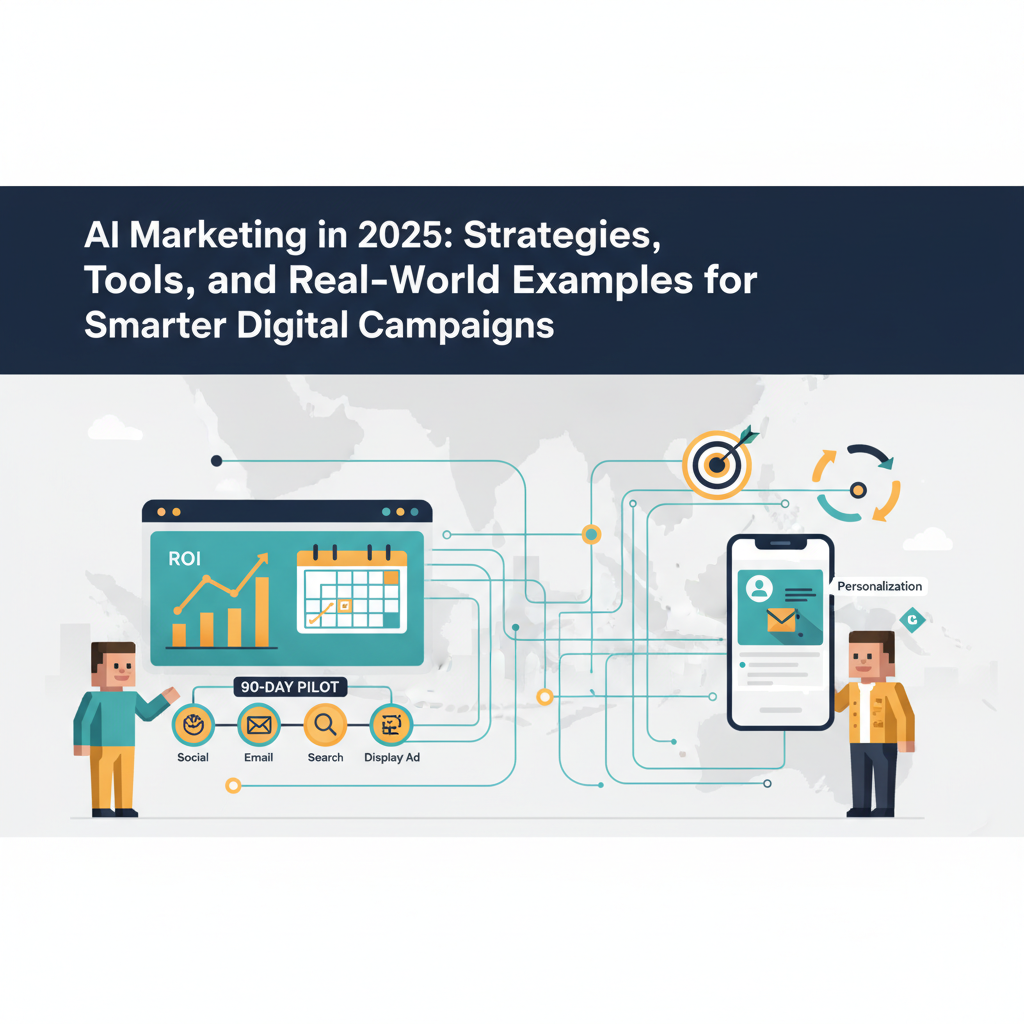
AI Marketing in 2025: Strategies, Tools, and Real-World Examples for Smarter Digital Campaigns
Field Type: Rich Text
The rise of AI marketing in 2025
Artificial intelligence has moved from the realm of experimentation into the operational backbone of modern marketing. For marketers and SMEs across Singapore and Southeast Asia, this shift is no longer optional—it’s mission-critical.
The competitive landscape has intensified dramatically. Businesses that adopt AI-driven marketing are launching campaigns 25% faster than their peers, personalizing experiences at scale, and reducing customer acquisition costs through smarter targeting and creative optimization [Source: Boston Consulting Group – Generative AI adoption in Asia, 2025]. Meanwhile, the multilingual, multichannel nature of Southeast Asian markets demands speed and precision that manual processes simply cannot deliver. Businesses operating across Singapore, Indonesia, Thailand, Vietnam, and the Philippines face the challenge of reaching diverse audiences in their preferred languages and channels—a task where AI excels.
Cost pressures are equally real. Infrastructure costs for AI inference have plummeted over 280 times between late 2022 and late 2024, making sophisticated personalization and content generation financially viable even for resource-constrained SMEs [Source: Stanford HAI – The 2025 AI Index Report]. Hardware costs continue to decline by approximately 30% annually, while energy efficiency improvements of around 40% per year further reduce the barrier to entry.
By the end of this article, you’ll have a clear understanding of what AI marketing is, why it matters for your business, a step-by-step playbook to build your AI marketing strategy, a curated overview of essential tools for 2025, real-world examples from retail, B2B tech, and F&B businesses, and a roadmap for emerging trends. Most importantly, you’ll have a practical 90-day starter plan to begin your AI marketing journey.
Field Type: Rich Text
What is AI marketing?
AI marketing refers to the application of artificial intelligence—including machine learning, large language models, and predictive analytics—to automate, optimize, and personalize marketing activities across the entire customer journey. It’s not a single tool or tactic; it’s a fundamental shift in how marketing decisions are made and executed.
Defining AI in digital marketing
At its core, AI marketing uses algorithms and data to make faster, more accurate decisions about who to reach, what message to send, when to send it, and through which channel. Unlike traditional marketing automation, which follows rigid rules and workflows, AI systems learn from outcomes and continuously improve their performance.
Key capabilities that define modern AI marketing
Data analysis and insights: AI systems process vast amounts of customer data—behavioral signals, transaction history, engagement patterns, demographic information—and surface actionable insights that humans might miss. Anomaly detection, cohort discovery, and predictive audience identification all fall into this category.
Predictive modeling: Rather than reacting to past behavior, AI predicts future outcomes. Predictive LTV (lifetime value) models identify high-value customers before they’ve spent much. Churn prediction flags at-risk customers so you can intervene. Purchase probability models help you allocate budget to the most likely converters.
Personalization at scale: AI enables one-to-one personalization for millions of customers simultaneously. Dynamic product recommendations, personalized email subject lines, individualized landing page experiences, and real-time offer optimization all become feasible without manual intervention.
Content generation and repurposing: Large language models can draft blog posts, generate ad copy variations, translate content into multiple languages, and repurpose long-form content into social snippets—dramatically accelerating content production cycles.
Automation and orchestration: AI-powered workflows can manage complex, multi-step customer journeys. Triggered emails, dynamic audience segmentation, and cross-channel campaign orchestration run continuously without human oversight.
Measurement and attribution: AI-driven attribution models account for the complex, non-linear paths customers take before converting. Media mix modeling (MMM) and incrementality testing help you understand which channels truly drive results, not just which ones receive credit.
Where AI fits in the marketing funnel
AI operates across the entire customer journey. At the awareness stage, AI optimizes ad targeting and creative selection to reach the right people with the right message. During consideration, AI personalizes product recommendations and content to guide prospects toward a decision. At conversion, AI optimizes pricing, offers, and checkout experiences. Post-purchase, AI identifies upsell opportunities and predicts churn risk to drive retention and loyalty.
Field Type: Rich Text
Why AI is transforming marketing
The business case for AI marketing is compelling and multifaceted. Organizations that have scaled AI report measurable improvements across several critical dimensions.
Speed and scale
AI compresses timelines dramatically. What once took weeks—creating multiple ad creative variations, testing them, analyzing results, and optimizing—now takes days or even hours. This speed advantage compounds: teams that can run more experiments learn faster and capture market opportunities before competitors.
For content teams, AI reduces the time to produce localized assets for multiple markets. A B2B tech company that previously spent months translating and adapting content for Southeast Asian markets can now generate initial drafts in days, freeing human editors to focus on accuracy and brand voice.
Precision and lower customer acquisition cost
AI targeting goes far beyond demographic and interest-based segmentation. Predictive models identify users most likely to convert, reducing wasted ad spend on unlikely prospects. Real-time bidding algorithms adjust bids based on conversion probability, ensuring your budget flows to the highest-ROI placements.
The result: lower cost per acquisition (CPA) and higher return on ad spend (ROAS). Retail SMEs using AI-powered paid social campaigns report CPA reductions of 5–25% compared to manual optimization [Source: HubSpot – AI Marketing 2025].
Higher customer lifetime value
Personalization drives engagement and repeat purchases. When customers receive recommendations tailored to their preferences, they’re more likely to buy again and spend more per transaction. A.S. Watson’s AI skincare advisor increased average order value by 29% and conversion rates by 396% among users who engaged with the tool [Source: Visme – AI Marketing Case Studies, 2025].
Addressing common misconceptions
“AI will replace marketers.” This is false. AI is a tool that amplifies human creativity and judgment. The most successful marketing teams use AI to handle repetitive, data-driven tasks—bid optimization, audience segmentation, content drafting—freeing humans to focus on strategy, brand storytelling, and customer empathy. Marketers who learn to work with AI will thrive; those who ignore it will fall behind.
“AI marketing is too complex and expensive for SMEs.” The cost barrier has collapsed. Platform-native AI (Google Performance Max, Meta Advantage+) is free to use—you only pay for media spend. Content generation tools like ChatGPT cost $20/month. Analytics platforms like GA4 are free. The infrastructure cost is no longer the limiting factor; the limiting factor is knowledge and execution discipline.
“Data complexity makes AI implementation impossible.” While data quality matters, you don’t need perfect data to start. Many AI marketing pilots begin with basic first-party data: customer IDs, transaction history, email engagement, and web behavior. As you mature, you can layer in additional signals. The key is to start simple, measure results, and iterate.
Field Type: Rich Text
Building an effective AI marketing strategy
A successful AI marketing strategy isn’t built overnight. It requires a structured approach that aligns AI initiatives with business goals, builds the right capabilities, and scales gradually. Here’s a step-by-step playbook for SMEs.
Step 1: Identify high-impact use cases
Not all marketing problems are equally suited to AI. Start by identifying use cases that meet three criteria: (1) they’re measurable, (2) they have clear ROI, and (3) they can be implemented within 90 days.
High-impact use cases for SMEs typically include:
- Performance advertising optimization: Using platform-native AI (Google Performance Max, Meta Advantage+) to automate bidding, creative selection, and audience expansion. This is low-risk because the platforms handle the complexity.
- Content production and localization: Using AI to generate product descriptions, blog outlines, social captions, and translations. This directly reduces content production time and cost.
- Email personalization and segmentation: Using predictive models to identify high-value customers and send them tailored offers. This drives higher email ROI with minimal technical complexity.
- Product recommendations: Implementing AI-powered recommendation engines on your website or app. This increases average order value and conversion rates.
- Churn prediction and reactivation: Using historical data to identify at-risk customers and trigger targeted reactivation campaigns. This is particularly valuable for subscription and repeat-purchase businesses.
Choose one or two use cases to pilot. Avoid the temptation to boil the ocean; narrow focus increases the likelihood of success and measurable ROI.
Step 2: Data readiness checklist
AI requires data, but you don’t need perfect data to start. Assess your readiness across these dimensions:
First-party data: Do you have reliable customer IDs that persist across touchpoints? Can you track customer behavior (web visits, email opens, purchases) consistently? If yes, you’re ready to start. If no, implement basic tracking (GA4 event setup, CRM integration) before launching AI pilots.
Tagging and event structure: Are your marketing events (page views, clicks, conversions) tagged consistently? Inconsistent tagging creates noise in AI models. Spend time upfront to standardize event naming and ensure all critical actions are tracked.
Consent and governance: Ensure you have proper consent for data collection and use. While we won’t dive into PDPA specifics here, understand your obligations and implement consent management early. This protects your business and builds customer trust.
Data quality and completeness: Check for missing values, duplicates, and outliers. AI models are sensitive to data quality. A simple audit—checking that key fields are populated, that date ranges make sense, that customer IDs are unique—goes a long way.
Step 3: Skills and roles
Successful AI marketing requires a small cross-functional team. You don’t need to hire PhDs; you need people with the right mindset and willingness to learn.
Marketing analyst or data analyst: This person owns data quality, measurement, and KPI tracking. They should be comfortable with GA4, basic SQL, and spreadsheet analysis. Their role is to ensure experiments are properly instrumented and results are accurately reported.
Content creator or marketing operations specialist: This person manages the AI tools, writes prompts, reviews AI outputs, and ensures brand consistency. They should be detail-oriented and comfortable learning new tools quickly.
Marketing strategist or campaign manager: This person defines the business goals, selects use cases, and interprets results. They should be comfortable with experimentation and comfortable making decisions with incomplete information.
If you’re a solo marketer or small team, you’ll wear multiple hats. The key is to allocate time for each role and be intentional about it.
Step 4: Tool selection criteria
Choosing the right tools is critical but not as complex as it seems. Evaluate tools across these dimensions:
Fit: Does the tool solve your specific problem? A content generation tool is great for scaling blog production but won’t help with ad optimization. Match tools to use cases.
Cost: What’s the total cost of ownership? Include subscription fees, implementation time, and training. For SMEs, tools that cost less than $300/month to start are ideal.
Interoperability: Does the tool integrate with your existing stack? If you use Shopify, does the tool connect to Shopify? If you use GA4, can you export data easily? Integration friction adds cost and complexity.
Ease of use: Can your team learn and use the tool without extensive training? Tools with intuitive interfaces and good documentation are worth a premium.
Vendor support: Does the vendor offer support for SMEs? Some vendors focus on enterprise; others have strong SME programs. Choose vendors that support your size.
Step 5: Pilot design
A well-designed pilot maximizes learning and minimizes risk. Here’s the structure:
Define clear KPIs: What will success look like? For a content pilot, it might be “reduce time to publish by 50%.” For a paid social pilot, it might be “reduce CPA by 10%.” For a churn prediction pilot, it might be “increase reactivation rate by 15%.”
Set guardrails: What’s the maximum budget you’ll spend? What’s the minimum performance threshold before you scale? For paid social, you might say “if ROAS drops below 2:1, pause and investigate.” These guardrails prevent runaway costs.
Choose a timeline: Most pilots run 30–90 days. Shorter pilots move fast but may not capture enough data. Longer pilots delay learning. 60 days is often the sweet spot.
Identify success criteria: Before you start, define what “success” looks like. If you hit your KPI, you’ll scale. If you miss it, you’ll iterate or move to a different use case.
Step 6: Scale and governance
Once a pilot succeeds, scaling requires discipline. Implement these practices:
Reporting and monitoring: Set up dashboards that track KPIs in real-time. Weekly reviews ensure you catch problems early. Monthly reviews assess whether the initiative is still delivering ROI.
Model drift monitoring: AI models degrade over time as customer behavior changes. Monitor model performance regularly. If accuracy drops, retrain the model with fresh data.
Governance and approval workflows: As AI systems make more decisions, implement human oversight. For high-stakes decisions (large budget allocations, customer-facing messaging), require human approval. For routine decisions (bid adjustments, audience segmentation), allow automation with monitoring.
Documentation and knowledge sharing: Document how each AI system works, what data it uses, and how to interpret its outputs. This knowledge transfer is critical as your team grows.
Aligning AI with business goals and measurement
The most common mistake SMEs make is implementing AI without clear business alignment. Every AI initiative should ladder up to a business goal: increase revenue, reduce costs, improve customer satisfaction, or accelerate growth.
Define your north-star metric—the single metric that best reflects business health. For an e-commerce business, it might be revenue. For a SaaS company, it might be monthly recurring revenue (MRR). For a marketplace, it might be gross merchandise value (GMV).
Then, define how each AI initiative contributes to that north-star. If your north-star is revenue and you’re implementing a churn prediction model, the connection is clear: reducing churn directly increases revenue. If you’re implementing a content generation tool, the connection is less direct but still important: faster content production increases organic traffic, which increases revenue.
This alignment ensures that AI investments are strategic, not just tactical.
Field Type: Rich Text
Essential AI marketing tools and platforms for 2025
The AI marketing tool landscape is vast and evolving rapidly. Rather than listing every tool, here’s a curated overview organized by category, with guidance on what good looks like and how to choose for your business.
Ad platforms with native AI
Google Ads (Performance Max, Demand Gen, AI Max for Search) and Meta Ads (Advantage+) have embedded AI so deeply that it’s now the default way to run campaigns. These platforms use machine learning to optimize bidding, audience targeting, and creative selection automatically.
What good looks like: You set a goal (maximize conversions, maximize ROAS, maximize reach), provide creative assets and landing pages, and the platform handles the rest. You don’t pay a platform fee; you only pay for media spend. Minimum budgets are low ($5–$10/day for testing), but meaningful learning budgets are typically $20–$50/day per campaign.
For SMEs: Start with Google Ads if your customers search for your products (search intent). Start with Meta if your customers discover you through social feeds (social discovery). TikTok is excellent for younger audiences and product discovery but has slightly higher minimum budgets.
Analytics and attribution
Google Analytics 4 (GA4) is the free baseline for all SMEs. It’s event-based, integrates with Google Ads, and includes predictive metrics (purchase probability, churn risk) powered by AI.
For more advanced needs, consider Amplitude or Mixpanel for product analytics, AppsFlyer or Adjust for mobile attribution, or lightweight attribution tools like Ruler Analytics or TripleWhale for multi-channel ROAS tracking.
What good looks like: You can see which channels drive conversions, understand customer behavior across touchpoints, and identify optimization opportunities. Pricing ranges from free (GA4) to a few hundred dollars per month for specialized tools.
For SMEs: Start with GA4 (free). Add a specialized tool only when GA4 no longer answers your questions.
AI content generation
ChatGPT (free or $20/month for Plus) is the most flexible and cost-effective starting point. For team-based content production with brand governance, Jasper, Copy.ai, or Writesonic offer starter plans around $50–$100/month.
What good looks like: You can generate blog outlines, ad copy variations, social captions, and translations in minutes. The output requires human editing but dramatically accelerates production.
For SMEs: Start with ChatGPT for ideation and drafting. Upgrade to a team tool (Jasper, Copy.ai) only when you need brand voice consistency and multi-user collaboration.
SEO tools with AI
Semrush, Ahrefs, and Surfer SEO all include AI-powered content optimization and keyword discovery. These tools guide you on what to write and how to optimize for search and AI answer engines.
What good looks like: You can identify high-opportunity keywords, get AI-suggested content outlines, and receive on-page optimization recommendations. Pricing typically starts at $100–$300/month.
For SMEs: If content production is your bottleneck, Surfer is excellent for on-page optimization. If you need broader competitive intelligence, Semrush or Ahrefs are worth the investment.
CRM and CDP platforms
HubSpot offers a free CRM with AI-powered sales features. Paid tiers start at $15–$20/user/month. Salesforce is more powerful but also more expensive and complex.
For data unification and real-time personalization, Twilio Segment (a CDP) starts at a few hundred dollars per month depending on data volume.
What good looks like: You have a single source of truth for customer data, can segment audiences based on behavior and attributes, and can activate those segments across channels.
For SMEs: Start with HubSpot’s free CRM. Upgrade to paid tiers as you grow. Add a CDP only when you need real-time unified profiles across multiple data sources.
Social media management
Buffer is simple and inexpensive ($5–$10/month per channel). Hootsuite and Sprout Social offer richer features (listening, analytics, team workflows) at higher price points ($100–$300/month).
What good looks like: You can schedule posts, generate captions with AI assistance, track engagement, and manage team approvals from a single dashboard.
For SMEs: Start with Buffer for scheduling and basic analytics. Upgrade to Hootsuite or Sprout Social when you need social listening and deeper team workflows.
How to choose the right tools for SMEs in Singapore
Define your use case first: What problem are you solving? Don’t choose a tool and then find a problem. Choose the problem, then find the tool.
Prioritize ease of use: Your team’s time is valuable. Tools with intuitive interfaces and good documentation save time and frustration.
Look for local support: Vendors with strong presence in Singapore or Southeast Asia often provide better support and understand local market nuances.
Start small and upgrade: Most tools offer free or low-cost starter tiers. Start there, prove ROI, then upgrade. This approach minimizes risk and maximizes learning.
Avoid tool sprawl: It’s tempting to adopt many tools, but integration complexity and cost add up quickly. Stick to 3–5 core tools and integrate them well.
Field Type: Rich Text
Real-world AI marketing examples
Theory is useful, but examples are instructive. Here are three real-world cases that illustrate how AI marketing works in practice.
Case 1: Retail SME running multilingual paid social with AI creative and targeting
The business: A Singapore-based fashion e-commerce brand selling across Southeast Asia (Singapore, Malaysia, Indonesia, Thailand).
The challenge: Creating and testing multiple ad creative variations for each market and language was time-consuming and expensive. The team was also struggling to identify which audience segments were most valuable.
The AI solution:
- Used Meta Advantage+ campaigns with AI-generated creative variations. The team provided product images and brand guidelines; Meta’s AI generated multiple headline and description variations in English, Malay, Indonesian, and Thai.
- Implemented predictive audience expansion: Meta’s AI identified lookalike audiences based on high-value customers, expanding reach to similar prospects.
- Used GA4 predictive metrics to identify high-LTV customers and allocated more budget to campaigns targeting similar profiles.
Results:
- Time to launch new campaigns dropped from 2 weeks to 3 days.
- CPA decreased by 18% through better audience targeting.
- ROAS improved from 2.5:1 to 3.2:1 within 90 days.
Lessons: Platform-native AI is powerful and accessible. The team didn’t need to build custom models; they leveraged Meta’s and Google’s AI. The key was providing good input data (customer IDs, transaction history) and clear KPIs.
Case 2: B2B tech company with AI content engine + SEO + sales enablement
The business: A Singapore-based SaaS company selling HR software to mid-market companies across Southeast Asia.
The challenge: The sales team needed case studies and product documentation for different industries and use cases. Creating these manually was slow and expensive. The company also wanted to improve organic search visibility.
The AI solution:
- Built an AI content engine using Jasper and Surfer SEO. The team created templates for case studies, product guides, and blog posts. AI generated initial drafts based on these templates and company data.
- Used Surfer to optimize content for SEO and AI answer engines. The tool provided on-page recommendations and identified high-opportunity keywords.
- Implemented a human review workflow: AI drafts were reviewed by subject matter experts (product managers, sales engineers) before publication.
- Repurposed published content into sales enablement assets (one-pagers, email sequences, LinkedIn posts).
Results:
- Content production velocity increased 3x: the team went from publishing 2 blog posts per month to 6.
- Organic traffic increased 40% within 6 months.
- Sales team reported that AI-generated one-pagers saved them 5 hours per week in proposal preparation.
- Qualified leads from organic increased by 25%.
Lessons: AI content generation works best when paired with human expertise and clear workflows. The company didn’t try to fully automate content; they used AI to accelerate the process and freed humans to focus on quality and strategy.
Case 3: F&B chain using AI promotions and churn prediction
The business: A Singapore-based F&B chain with 15 locations and a loyalty program with 50,000 members.
The challenge: The loyalty program had high churn. Many members made one or two purchases and then stopped engaging. The team wanted to identify at-risk members and re-engage them with targeted offers.
The AI solution:
- Built a simple churn prediction model using historical transaction data. The model scored each member’s likelihood of churning based on recency (days since last purchase), frequency (purchases per month), and monetary value (average spend).
- Used the churn scores to segment members into risk tiers: high-risk, medium-risk, and low-risk.
- For high-risk members, the team generated personalized promotional offers using ChatGPT. The AI created variations of messages (e.g., “We miss you! Come back for 20% off your favorite dish”) and tested them via email and SMS.
- Implemented a simple A/B test: high-risk members received either a personalized offer or a generic offer. The team measured reactivation rate (did they make a purchase within 30 days?) and incremental revenue.
Results:
- Churn prediction model achieved 78% accuracy in identifying members who would churn within 30 days.
- Personalized offers increased reactivation rate by 22% compared to generic offers.
- Incremental revenue from reactivated members was $45,000 over 90 days, with a cost of $3,000 (promotional discounts + AI/tool costs), yielding a 15:1 ROI.
Lessons: Churn prediction doesn’t require sophisticated machine learning. A simple model based on RFM (recency, frequency, monetary) can be highly effective. The key is combining prediction with action (personalized offers) and measuring results rigorously.
Pitfalls to avoid
Automation bias: Don’t blindly trust AI outputs. A.S. Watson’s AI skincare advisor worked because it was trained on expert knowledge and tested extensively. If you deploy AI without validation, you risk poor recommendations and customer dissatisfaction.
Data leakage: Be careful not to use future information to train models. For example, if you’re predicting churn, don’t include “customer support tickets in the last 7 days” as a feature if you’re trying to predict churn 30 days in advance. This creates models that look good in testing but fail in production.
Overfitting on vanity metrics: It’s easy to optimize for metrics that look good but don’t drive business value. For example, optimizing for click-through rate (CTR) might increase clicks but decrease conversion rate and ROI. Always tie AI optimization to business outcomes (revenue, profit, customer satisfaction).
Practical mitigations:
- Implement human review workflows for customer-facing AI outputs.
- Use holdout groups and incrementality tests to validate that AI improvements translate to real business impact.
- Monitor model performance over time and retrain regularly.
- Document assumptions and limitations of each model.
Field Type: Rich Text
Future trends: What’s next for AI marketing?
The AI marketing landscape is evolving rapidly. Here are the trends that will shape marketing in 2026 and beyond.
Multimodal models: Unified creative generation
Today, you use separate tools for text, images, and video. Tomorrow, a single multimodal model will accept a prompt and generate all three simultaneously. This will dramatically accelerate creative production.
Imagine: You write a brief (“summer campaign for a new product launch targeting young professionals in Singapore”) and the model generates ad headlines, product images, short-form videos, and social captions—all on-brand and optimized for different platforms.
How to prepare: Start building a centralized asset repository with performance metadata. Tag assets with CTR, conversion rate, and engagement metrics. This data will train future multimodal models and help you understand what creative elements drive results.
Agentic workflows: Autonomous marketing agents
Agents are AI systems that can plan and execute multi-step workflows autonomously. An agent might be tasked with “maximize first-time buyer conversions under $20 CAC” and would autonomously design audiences, create creatives, select channels, launch tests, and reallocate budget based on performance.
This is different from today’s automation, which follows rigid rules. Agents learn and adapt.
How to prepare: Inventory your most repetitive workflows (bid optimization, creative A/B testing, audience discovery). Pick one and design guardrails: What decisions require human approval? What’s the maximum budget an agent can allocate? What’s the fallback if the agent makes a mistake? Start with narrow, low-risk workflows and expand as you build confidence.
On-device inference: Privacy-first personalization
As models get smaller and more efficient, personalization will happen on users’ devices rather than on your servers. This means faster experiences, better privacy, and reduced data exposure.
How to prepare: Work with your product and engineering teams to understand where latency or privacy concerns block experiences. Plan pilots for on-device personalization (e.g., product recommendations inside your app that don’t require a server call).
Privacy-preserving personalization and federated learning
Regulatory pressure and consumer expectations mean personalization must often happen without centralizing raw personal data. Federated learning allows models to learn from distributed signals while preserving privacy.
How to prepare: Audit your data flows. What PII do you store? What can be aggregated? What should stay client-side? Implement consent management and privacy-by-design principles early.
AI search surfaces and answer engines
Google’s AI Overviews, ChatGPT, Perplexity, and other AI-powered search interfaces are changing how people discover information and products. Ranking on a traditional SERP is no longer enough; you need to be cited in AI answers.
This requires a shift in SEO strategy: focus on authoritative, well-cited content that AI systems trust. Structured data, expert signals, and clear, factual writing become more important.
How to prepare: Optimize content for AI answerability. Write clear, concise answers to common questions. Use structured schema markup. Build a citation strategy: get mentioned in trusted outlets and thought leadership pieces that AI systems will surface.
Voice and video AI: Conversational commerce and scalable video
Voice assistants and video-generation models are maturing. Voice will become an owned channel for commerce; video production costs will fall dramatically.
How to prepare: Start capturing brand voice assets (approved voice samples, persona descriptions). Integrate short-form synthetic video tests into your creative pipeline. Design voice UX for commerce flows.
Field Type: Rich Text
Navigating the evolving world of AI marketing
The journey to AI-driven marketing doesn’t require a massive transformation. It requires a clear strategy, disciplined execution, and a willingness to learn and iterate.
Your 90-day starter plan
Days 1–30: Foundation
- Audit your current data, tools, and team capabilities.
- Choose one high-impact use case (e.g., paid social optimization, content generation, churn prediction).
- Set up measurement infrastructure (GA4, CRM integration, KPI dashboards).
- Identify and train your core team.
Days 31–60: Pilot
- Launch your first AI pilot with clear KPIs and guardrails.
- Implement human review workflows for AI outputs.
- Monitor performance daily; adjust as needed.
- Document learnings and challenges.
Days 61–90: Evaluate and scale
- Assess whether your pilot hit its KPIs.
- If successful, plan to scale: expand budget, add more use cases, or expand to new markets.
- If unsuccessful, diagnose why and iterate or move to a different use case.
- Share results with stakeholders and secure buy-in for next phase.
The path forward
AI marketing is not a destination; it’s a continuous journey. The businesses that will thrive in 2025 and beyond are those that treat AI as a core capability, invest in people and processes, and maintain a culture of experimentation and learning.
Start small. Pick one use case. Measure rigorously. Scale what works. Iterate on what doesn’t. Over time, AI will become woven into the fabric of your marketing operations, enabling you to reach more customers, personalize at scale, and drive measurable business results.
The time to start is now. The competitive advantage goes to those who move first.
Ready to transform your marketing with AI?
The strategies, tools, and examples in this guide provide a roadmap, but implementation requires expertise, discipline, and ongoing optimization. Whether you’re just beginning your AI marketing journey or looking to scale existing initiatives, having a trusted partner can accelerate your progress and help you avoid costly mistakes.
We work with Singapore and Southeast Asian businesses to design and implement AI marketing strategies tailored to your unique challenges and opportunities. From strategy and tool selection to pilot design and scaling, we help you unlock the full potential of AI to drive growth.
Let’s talk about your AI marketing roadmap. Contact us to schedule a consultation with our team. We’ll assess your current state, identify high-impact opportunities, and outline a practical path forward.
Further reading and internal resources
- Digital Marketing Services – How we implement AI-enhanced campaigns.
- Branding Services – Align AI with a strong brand foundation.
- Advertising Services – From strategy to creative and media.
- Digital Marketing Portfolio – Outcomes and case work.
- Social Media Portfolio – Social campaigns and results.
- Video Production in Singapore – Creative at the speed of AI.
- Branding Portfolio – Selected brand transformations.
- Visit our Blog – Insights on AI, branding, and growth.
- Who We Are – Meet the team behind the work.
- Contact Hamilton & Sherwind – Start your AI roadmap.
Evidence and source links
- McKinsey – Agents for growth: Turning AI promise into impact
- MIT Sloan – How Generative AI Can Boost Highly Skilled Workers’ Productivity
- Deloitte – AI in Digital Marketing
- Nielsen – 2025 Annual Marketing Report
- Forrester – The AI Cost Center Crisis
Note: Additional bracketed placeholders in the article (e.g., [Source: BCG, Stanford HAI, HubSpot, Visme]) indicate where exact-source links can be inserted adjacent to the claims during editorial pass per our citation policy.
Start your 90-day AI marketing pilot
Get a tailored AI roadmap and pilot plan for your business. Book a consultation.