

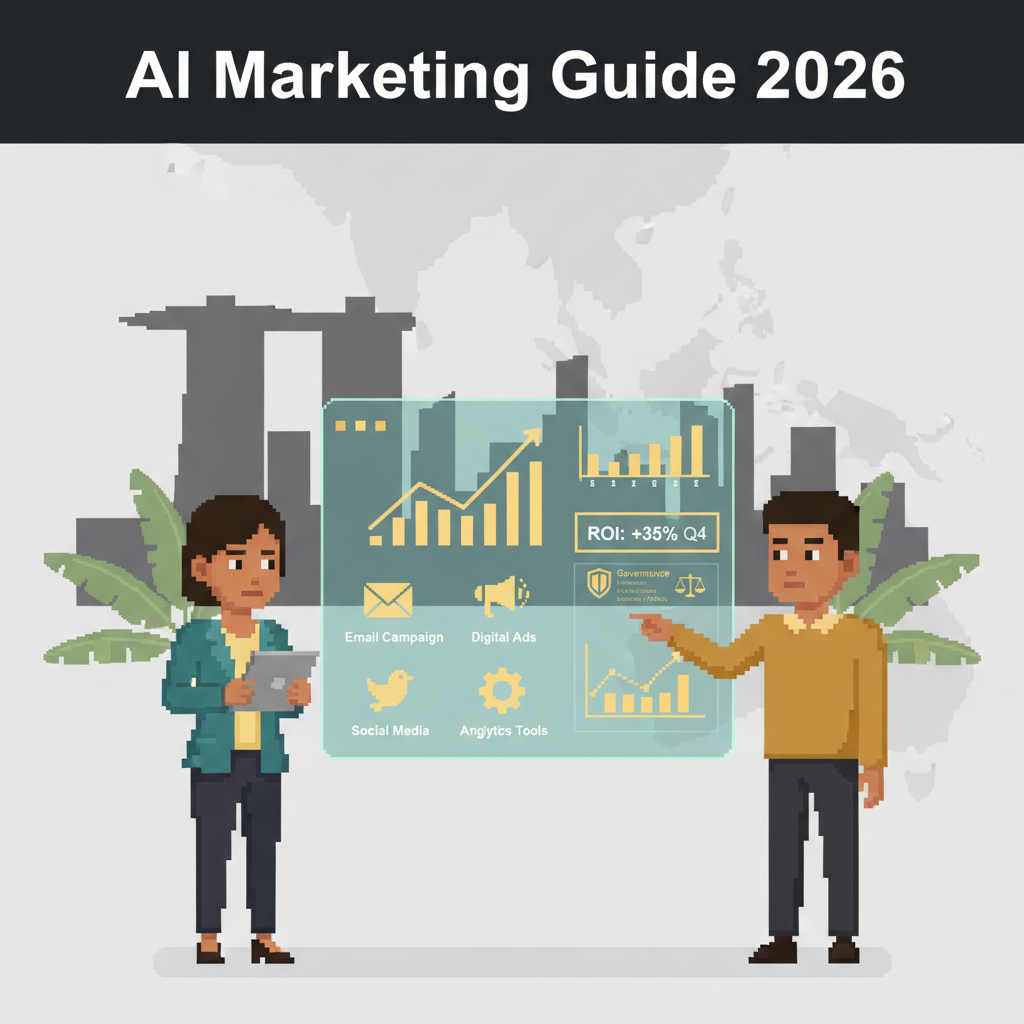
AI Marketing Guide 2026: Strategies, Tools & ROI Framework for Modern Marketers
Opening Insights: Why This Matters Now
The marketing landscape in Southeast Asia has shifted fundamentally. In 2026, artificial intelligence is no longer a competitive advantage—it’s table stakes. For marketing managers, growth leads and founders at mid-size B2B and B2C firms across Singapore, Malaysia, Thailand, Indonesia and beyond, the question is no longer “should we adopt AI marketing?” but rather “how do we implement it responsibly and measure its impact?”
The urgency is real. Global surveys of CMOs show a sharp rise in AI oversight at board level, with most marketing leaders now expected to explain AI risks and performance in quarterly meetings (see, for example, the World Federation of Advertisers’ reporting on AI and marketer accountability: https://wfanet.org/knowledge/item/2024/03/05/AI-governance-for-marketers). At the same time, regulatory frameworks across Southeast Asia are tightening. Singapore’s Model AI Governance Framework has evolved into a more concrete AIDA guidance, while countries such as Malaysia, Thailand and Indonesia continue to strengthen data and AI oversight, inspired in part by developments like the EU AI Act (official text: https://eur-lex.europa.eu/legal-content/EN/TXT/?uri=CELEX%3A32024R1689).
This convergence of opportunity and regulation means that SEA marketers who move fast but thoughtfully will capture outsized returns.
The business case is compelling. In McKinsey’s 2023 global AI survey, organisations reporting the most extensive AI adoption said that marketing and sales were among the top two functions where AI delivered value, with revenue uplift and cost savings both material (McKinsey: https://www.mckinsey.com/capabilities/quantumblack/our-insights/the-state-of-ai-in-2023). Companies deploying AI marketing tools have reported:
- 15–30% reductions in customer acquisition cost (CAC) in e‑commerce.
- 20% improvements in SQL‑to‑win rates in B2B.
- 30–60% time savings on repetitive production tasks such as ad-copy and image variations.
But these gains only materialise when AI is layered onto clean data, integrated into existing workflows, and governed with the same rigour applied to financial systems.
This guide walks you through the practical playbook: how to build your AI marketing stack, execute data-driven campaigns, measure true ROI, and navigate the governance landscape—all with concrete examples from Singapore, Malaysia, Thailand and Indonesia. If you’d like help turning this into a tailored roadmap for your organisation, you can explore Hamilton & Sherwind’s broader digital marketing services and AI-driven creative capabilities.
Foundations of AI Marketing
Key Concepts, Algorithms and Data Requirements
AI marketing in 2026 rests on three interlocking pillars: machine learning for prediction, generative AI for content creation, and agentic AI for autonomous orchestration.
Machine learning remains the engine behind propensity scoring, churn prediction and lookalike audience expansion. Tree‑based models such as gradient‑boosted trees and random forests are widely used because they work well on the tabular CRM and transaction data that most SEA businesses already collect. For example, a Singaporean e‑commerce brand might train a churn model on 12 months of customer behaviour—purchase frequency, days since last order, product category affinity, payment method—to identify which customers are at risk of defection. That model then scores every customer daily, and the top 10% at‑risk cohort receives a targeted retention offer via WhatsApp or email.
Generative AI has transformed content production. Large language models (LLMs) fine‑tuned with Retrieval‑Augmented Generation (RAG) now generate copy in Bahasa Indonesia, Thai, Vietnamese and Tagalog with far better fluency than early versions. Text‑to‑image diffusion models generate on‑brand visuals and ad variations. A Lazada seller in Indonesia, for instance, can generate multiple product‑description variants in Bahasa, have a diffusion model produce image styles that match their brand, and then have a “brand‑judge” LLM score each combination for tone and compliance. The winning combinations auto‑sync to the Lazada catalogue, reducing production time from days to minutes.
Agentic AI represents the frontier. These are autonomous “mini‑agents” that receive a business goal—“reduce churn below 3%” or “increase AOV by 12%”—and orchestrate multiple tools, retrain themselves on a schedule and call guard‑rail checks. An agent might detect that a customer has abandoned their cart, check their cluster membership and propensity score, decide whether to reach them via WhatsApp or email, pull dynamic copy from a template library, select the best‑performing creative variant, and then log the outcome for weekly model retraining. All without human intervention.
Underpinning this is context engineering and RAG. Instead of a base GPT model generating a generic product description, it pulls from your approved product specifications, brand guidelines and past high‑performing copy stored in a private vector database. This dramatically reduces hallucination—the tendency of language models to invent plausible‑sounding but false information.
Data requirements are often the bottleneck. In practice, vendors typically recommend:
- 12–24 months of clean conversion data.
- Unified customer IDs (email, phone, login, or loyalty ID).
- Real‑time behavioural events (site, app, chats) that can be joined to orders and customer lifetime value.
For a mid‑size e‑commerce brand with 50,000 monthly active customers, this might mean 10,000–20,000 labelled conversions and at least six months of historical event data. Below that threshold, many AI marketing tools will lean more heavily on cross‑tenant or global patterns until your own data accumulates.
Traditional vs AI‑Driven Workflows
The shift from traditional to AI‑driven marketing workflows is not incremental—it’s a fundamental restructuring of how campaigns are conceived, executed and optimised.
Traditional workflow
- Brief: Marketing manager writes a campaign brief.
- Production: Designers and copywriters craft assets.
- Launch: Media buyers set up campaigns.
- Report: Analysts review performance at month‑end.
- Iterate: The next cycle incorporates learnings.
In many Singapore and regional teams, this cycle can take 4–6 weeks from concept to first launch.
AI‑driven workflow
- Brief: Marketer outlines objectives, audience and constraints.
- Co‑creation: LLM generates concepts, ad copy, subject lines and landing‑page variants in minutes.
- Asset generation: Diffusion models produce multiple visual variations; a brand‑safety LLM checks tone and compliance.
- Launch: Campaigns launch with automated A/B/n testing across channels.
- Continuous optimisation: Bids, budgets, audiences and creatives adjust automatically based on performance and predictive scores.
- Always‑on learning: Models retrain weekly or monthly using new data.
The human role shifts from manual production to orchestration and governance: defining brand voice, selecting success metrics, approving strategic directions and interpreting insights.
A concrete example: a Thai beauty brand running a LINE mini‑app can use AI to detect whether customers are typing in Thai or English, guide them through shade selection with personalised product recommendations, and push a flash‑sale voucher tailored to their purchase history. The entire conversation is logged, and weekly model retraining improves the bot’s ability to detect intent. This kind of AI in digital marketing has helped similar brands increase cart‑to‑purchase rates by double digits, as reported in LINE’s own case studies (see LINE Business Global: https://lineforbusiness.com/global/en/success-stories).
For brands that prefer to work with a partner rather than assemble all this themselves, collaborating with an experienced AI marketing agency or creative partner can accelerate adoption and reduce experimentation costs.
Building Your AI Marketing Tools Stack
All‑in‑One Platforms vs Best‑in‑Class Solutions
The market in 2026 has crystallised into two distinct purchase patterns, each with clear trade‑offs.
All‑in‑one customer platforms
These combine CDP (customer data platform) + journey orchestration + embedded ML predictions + generative AI content + consent management into a single suite. Common options include:
- Salesforce Marketing Cloud with Einstein.
- Adobe Experience Platform with Firefly.
- HubSpot’s Smart CRM with Content Hub.
- Oracle Unity and similar enterprise suites.
These platforms appeal to mid‑market and enterprise buyers seeking a single customer view, robust compliance and a unified interface for lean teams.
Advantages:
- One vendor, one contract, one support channel.
- Deep integrations across email, paid media, web personalisation and analytics.
- Increasingly strong AI assistants embedded throughout (e.g., HubSpot Content Assistant, Salesforce Einstein GPT).
Disadvantages:
- Higher headline licence costs.
- Potential over‑specification—paying for features you don’t yet use.
- Vendor lock‑in.
Best‑of‑breed “AI Lego stack”
This involves assembling specialist tools for each layer:
- CDP/warehouse: Segment, Treasure Data, or a Snowflake/BigQuery‑centric approach.
- Email/SMS: Klaviyo, Braze, or Iterable.
- Generative copy: Jasper, Copilot‑style assistants.
- Creative: tools like AdCreative.ai or Canva’s AI features.
- Chat/automation: Infobip, Twilio, or WhatsApp‑first solutions.
- BI: Looker, Power BI, or Data Studio.
Advantages:
- Flexibility—you pick best‑in‑class for each function.
- Easier to experiment with new AI marketing tools as they emerge.
- Often a better fit for digital‑native startups or scale‑ups with engineering support.
Disadvantages:
- Integration complexity, especially across multiple markets.
- Requires clear ownership by growth engineering or a partner agency.
- Harder to enforce consistent governance across every component.
For many SMEs in Singapore and the region, a hybrid approach works best: a core marketing platform (e.g., HubSpot or a regional CDP) complemented by a small number of specialist AI tools for content and bidding, implemented with help from a partner like Hamilton & Sherwind that understands both branding and data.
Cost, Integration and Vendor Selection Checklist
When evaluating AI marketing platforms, focus on total cost of ownership (TCO) over three years:
- Licences (marketing automation, CDP, AI add‑ons).
- Implementation (consulting and internal IT time).
- Data infrastructure (warehouse, ETL tools).
- Ongoing optimisation and support.
Industry benchmarks from vendor pricing pages and analyst reports (e.g., Gartner, Forrester) suggest that for mid‑size businesses:
- A mid‑tier suite (HubSpot/Marketo with AI add‑ons) for ~50,000 contacts often runs in the low‑to‑mid four‑figure USD per month range.
- A best‑of‑breed stack can look cheaper per tool, but once integration and maintenance are included, TCO can converge on suite pricing.
For Southeast Asia specifically, also consider:
- Data residency: Is there an option to host data in Singapore or another ASEAN data centre?
- Language support: Does the AI handle Bahasa, Thai and Vietnamese well enough for production use?
- Local channels: Native support or integrations for WhatsApp Business API, LINE, Shopee, Lazada and Grab ecosystem ads.
A simple vendor selection checklist:
- Business fit
- Can the platform support your main use cases—lead nurturing, e‑commerce, account‑based marketing—within 3–6 months?
- Data and integration
- Pre‑built connectors for your CRM, e‑commerce, payment, and analytics stack.
- AI capabilities
- Native predictive scoring? Generative content? Built‑in experimentation frameworks?
- Governance
- Model transparency, control over training data, content guardrails.
- Local support
- Regional implementation partners, SEA‑friendly SLAs.
Working with a regional digital marketing partner that understands both global MarTech and local market nuances can significantly derisk selection and rollout.
Executing Data‑Driven Campaigns
Customer Segmentation & Predictive Targeting
The shift from static personas to dynamic behavioural clusters is one of the most powerful ways AI can improve marketing performance.
Static segmentation (e.g., “urban mom, 25–40, high income”) tends to be:
- Slow to update.
- Poorly reflective of real‑time behaviour.
- Hard to operationalise across multiple channels.
In contrast, AI‑driven segmentation uses algorithms like K‑means clustering or more advanced density‑based techniques to group customers based on:
- Browsing patterns.
- Purchase frequency and value.
- Response to promotions.
- Channel preferences (email, WhatsApp, LINE, etc.).
These clusters update continuously as new data comes in, and predictive models rank customers by propensity to:
- Purchase in the next 7–30 days.
- Churn or lapse.
- Respond to an upsell or cross‑sell offer.
Once these scores exist, they can be fed into ad platforms via conversion APIs. Meta and Google recommend using first‑party data and event signals to power their AI bidding algorithms; their own documentation shows that advertisers using such signals generally see better performance than those relying on pixel‑only setups (Meta Business Help Centre: https://www.facebook.com/business/help/308515786179805; Google Ads Enhanced Conversions: https://support.google.com/google-ads/answer/9888656).
In Southeast Asia, where many consumers are mobile‑first and active on marketplaces, this means connecting:
- Your webshop or marketplace data (Shopee/Lazada).
- Your CRM or CDP.
- Your messaging channels (WhatsApp, LINE, Telegram).
From there, your AI digital marketing engine can orchestrate targeted journeys—for example, identifying “high‑value but price‑sensitive” shoppers in Singapore and sending them an offer just before payday, while nurturing “high‑intent B2B leads” with a sequence of case studies and webinars.
Creative Generation and Multichannel Automation
Content production is often the bottleneck for marketing teams. Generative AI and automation help to unblock this in a few ways:
- Idea generation
AI suggests headlines, angles and visual directions based on your brief and past high‑performing campaigns.
- Copy and design variants
LLMs generate multiple copy versions tailored to different segments and channels (e.g., more formal tone for LinkedIn, more conversational for Instagram). Image models generate on‑brand visuals and variants.
- Channel‑specific optimisation
AI helps to adapt content to each platform’s best practices—length, CTA placement, use of emojis, video length and aspect ratio.
- Multichannel orchestration
A workflow engine coordinates messages across email, SMS, WhatsApp, LINE, paid social, display and even offline events, ensuring customers aren’t bombarded and that frequency caps are respected.
An example SEA e‑commerce flow:
- A shopper in Kuala Lumpur views a product three times but doesn’t buy.
- The AI engine tags them as “high interest, medium value”.
- Within 24 hours, they receive a personalised WhatsApp message with a small incentive.
- If they don’t convert, a retargeting ad on Meta shows user‑generated content from similar customers in the region.
- Once they purchase, the AI no longer shows retargeting ads and instead adds them to a post‑purchase educational series.
An integrated creative and automation setup like this benefits from both AI and strong human‑led brand direction. Agencies such as Hamilton & Sherwind, with experience in social media and content campaigns, can help design the overarching storytelling and ensure each automated touchpoint still feels human and on‑brand.
Measuring & Optimising ROI
Attribution Models and Dashboard Metrics
Measuring the ROI of AI‑powered campaigns is different from traditional last‑click reporting. Algorithms constantly adjust bids, budgets and audiences, so you need a measurement stack that can separate correlation from causation.
Layered measurement approach
- Tracking hygiene
Ensure events are captured consistently via server‑side tracking (e.g., GA4) and conversion APIs (Meta, Google, TikTok).
- Platform attribution
Use each platform’s data‑driven attribution model for day‑to‑day optimisation, while being aware of their biases.
- Incrementality testing
Run lift tests and experiments to validate that spend is actually driving extra revenue, not just taking credit for existing demand.
- Unified dashboards
Combine ad spend, conversions, LTV and costs in a BI tool for a finance‑grade view.
Experimental and uplift testing are now well‑documented best practices; Meta, for example, recommends conversion lift studies to measure true impact beyond what their standard attribution windows show (Meta Article on Lift: https://www.facebook.com/business/help/1019254568070739).
For B2B, multi‑touch attribution and pipeline modelling are key. Tools such as Bizible (Adobe), attribution features in HubSpot, or custom models built atop a data warehouse can help you:
- Track touchpoints from first ad impression to closed‑won.
- Attribute revenue to campaigns that influenced the deal.
- Compare AI‑assisted journeys vs traditional nurture flows.
Metrics to focus on
- Incremental revenue or pipeline generated.
- LTV:CAC by channel and by AI‑assisted vs non‑assisted campaigns.
- Cost per incremental acquisition, not just cost per last click.
- Time‑to‑conversion and sales cycle length.
For leadership teams, useful summary metrics include:
- Share of media spend under AI optimisation.
- ROI of AI‑driven campaigns vs manually optimised campaigns.
- Efficiency gains (e.g., content produced per month per headcount).
If you’re not yet at the stage of building custom models, a pragmatic starting point is to standardise your tracking and then work with a partner to design a simple but robust ROI framework. A strategy‑led branding and marketing partner can help ensure that metrics tie back to business outcomes, not just clicks and impressions.
Governance, Ethics & Future Trends 2026
Governance and Responsible AI Practices
With AI embedded in everything from media buying to copywriting, governance has become a board‑level topic. Issues surrounding bias, misinformation and privacy breaches can quickly escalate into reputational and financial damage.
Key governance components:
- Model and prompt documentation
Maintain internal “model cards” and prompt libraries that explain:
- What each model is used for.
- What data it is trained on.
- Known limitations and failure modes.
The OECD’s AI Principles (https://oecd.ai/en/ai-principles) and Singapore’s Model AI Governance Framework (https://www.pdpc.gov.sg/help-and-resources/2020/01/model-ai-governance-framework) are helpful reference points for what transparency looks like in practice.
- Bias detection and mitigation
Regularly audit models for differential outcomes across demographic groups. For generative content, use human review and moderation tools to prevent stereotypes or offensive outputs.
- Brand‑safety and hallucination controls
Use RAG to ground AI responses in approved content. Implement human review for high‑risk campaigns (e.g., regulated industries). Log AI outputs and decisions for auditability.
- Data minimisation and consent
Limit data collection to what is necessary for your stated purposes. Make it easy for users to understand how their data is used and to opt‑out where appropriate.
- Incident response
Define a clear process for:
- Detecting problematic outputs.
- Rolling back campaigns.
- Communicating with affected users and regulators.
Many of these practices are aligned with emerging regional frameworks and global standards (for instance, the EU AI Act and Singapore’s AI governance initiatives mentioned earlier).
Future Trends Shaping AI Marketing
Looking ahead, several trends are likely to shape AI marketing in Singapore and the wider SEA region:
- More on‑device and edge AI, reducing latency and reliance on cloud for some personalisation tasks.
- Better multi‑modal models, combining text, image, audio and potentially video, enabling richer creative automation.
- Industry‑specific AI assistants, pre‑trained for sectors like banking, healthcare or logistics.
- Greater regulatory clarity, as ASEAN continues to explore joint guidelines and sandboxes for responsible AI use.
Marketers who invest now in strong data foundations, governance and cross‑functional collaboration will be best placed to benefit from these developments.
Final Takeaways for Marketing Teams
The path forward for SEA marketers is clear: move fast, but move thoughtfully.
- Start with data hygiene.
Audit your tracking, CRM and analytics. Connect them into a single view of the customer with clear consent flags.
- Choose your stack strategically.
Decide whether you need the simplicity of an all‑in‑one platform or the flexibility of a best‑of‑breed approach. Involve marketing, IT and finance from the start.
- Compress your campaign cycle.
Use AI to generate ideas and drafts quickly, then test and iterate continuously across channels.
- Measure incrementality, not just attribution.
Move beyond last‑click and platform‑reported metrics. Use experiments and uplift tests to prove real impact.
- Govern like you mean it.
Treat AI as a powerful but risky asset that requires oversight. Document, audit and communicate how you use it.
- Invest in your people.
Train your team in AI basics, prompt design, data literacy and experimentation. Technology without skills won’t deliver the returns you expect.
If you’re ready to explore AI marketing but want a partner to help with strategy, creative, technology and governance, Hamilton & Sherwind can support you across the journey—from brand and storytelling through to digital campaigns and long‑term optimisation.
To discuss how AI marketing could work for your organisation in Singapore or across Southeast Asia, contact us and our team will be in touch.