

AI Marketing Automation in Singapore: The 2025 Playbook for SMEs
Why AI marketing automation matters now for small businesses — quick definition and real-world impact
AI marketing automation is the use of machine learning and AI-driven rules to run repetitive marketing tasks, predict customer intent, personalize messages at scale, and orchestrate cross‑channel journeys with minimal manual effort. For Singapore and Southeast Asia (SEA) SMEs, this is now an operational lever that compresses marketing effort, improves conversion, and helps small teams act like much larger ones.
Why now? Regional reports show rapid SME digitalisation and rising AI uptake. Singapore’s IMDA reports near‑universal baseline digital adoption among SMEs and a jump in reported AI adoption from about 4% to 14.5% in a single year, with PSG-supported AI solutions showing cost‑savings in practice (IMDA — Singapore Digital Economy 2025). At the SEA level, the Google e‑Conomy SEA report highlights continuing double‑digit digital growth and consumer openness to AI-driven experiences. McKinsey also stresses that firms combining digitized processes with AI capture the largest productivity and revenue gains — useful guidance for SMEs deciding where to invest first (McKinsey — AI and Southeast Asia).
Case example (illustrative): A Singapore D2C merchant implements a three‑message abandoned‑cart flow (email + SMS) plus product recommendations. Within two months they recover a measurable share of lost carts and save 10–20 hours/month — outcomes consistent with vendor playbooks and government program findings (Klaviyo Automations; HubSpot Marketing Automation).
What AI marketing automation actually does: core capabilities and common use cases
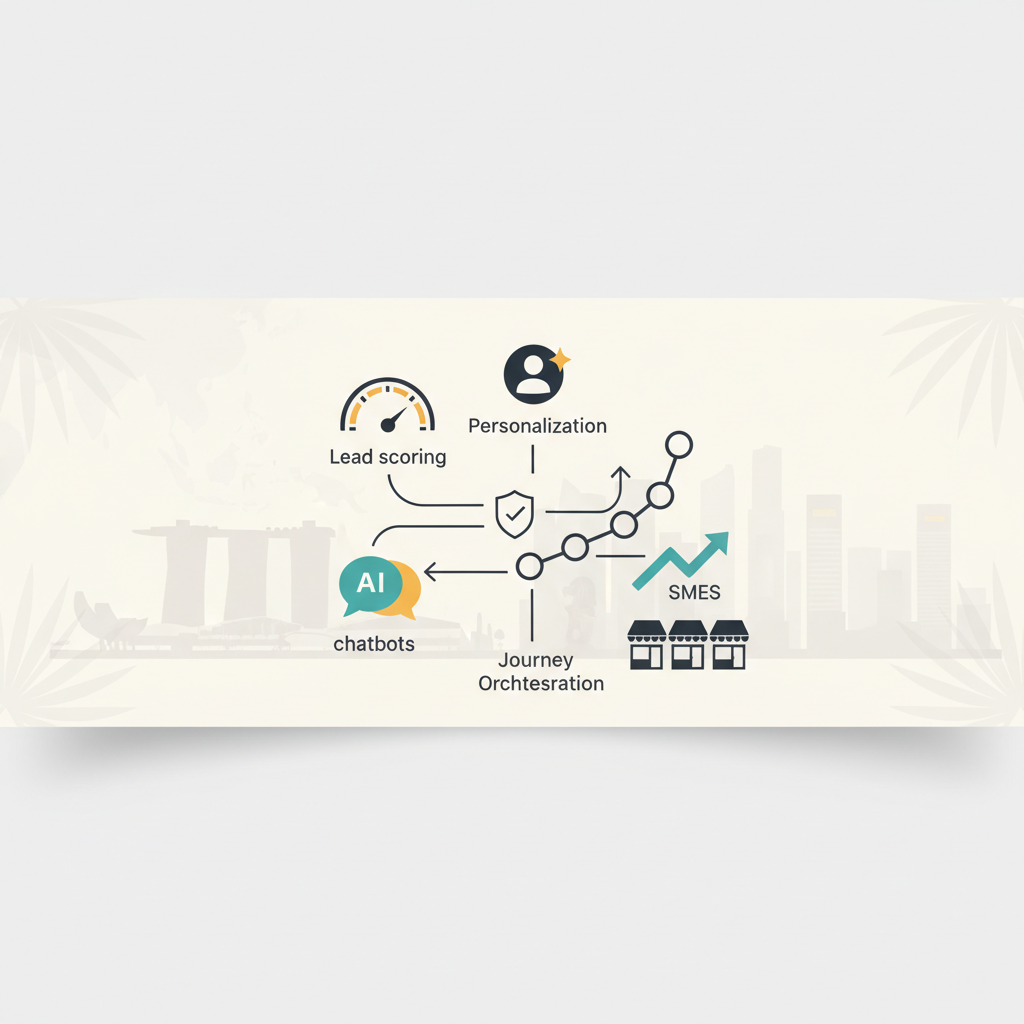
Examples: lead scoring, personalization, chatbots, and orchestration
- Lead scoring and predictive qualification: ML models score leads by fit and intent so sales focuses on high‑probability prospects. Scoring can be vendor-managed (e.g., Salesforce Einstein, HubSpot predictive scoring) or custom ML via a CDP/feature store.
- Personalization at scale: Engines select email blocks, on‑site modules, or recommendations in real time; improves conversion and CLTV when grounded in good data (Adobe marketing automation report; Klaviyo automations).
- Chatbots and conversational automation: Qualify visitors, book meetings, answer FAQs, and trigger follow‑ups; advanced bots combine rules with GenAI and handoff to humans (HubSpot chat; Salesforce messaging).
- Journey orchestration: Visual workflows manage multi‑step, cross‑channel journeys with conditional logic and holdouts (Adobe Experience Platform).
Common SME use cases: Ecommerce (welcome, cart/browse recovery, recommendations); B2B/services (lead capture → scoring → nurture → bookings); Local retail/F&B (loyalty re‑engagement, localized promos, confirmations via SMS/WhatsApp).
When to prioritize which capability (early wins vs long-term builds)
- Early wins (1–3 months): Welcome series, abandoned cart, automated lead routing — quick ROI, supported by templates in HubSpot/Klaviyo/Mailchimp/Zoho.
- Mid-term (3–9 months): Predictive lead scoring, basic recommendations, multi-step nurture with measurement/holdouts.
- Long-term (9–24 months): CDP + real‑time profiles; scale personalization across site, email, and ads; introduce MLOps for custom scoring and uplift modeling (see McKinsey; Forrester).
Benefits and expected ROI for SMEs: revenue, efficiency, and customer value
Typical savings and lift scenarios for small teams
- Revenue uplift: Many analyses and TEIs indicate low single digits to mid‑teens; McKinsey highlights ~3–15% uplift ranges when AI pairs with testing/ops changes (McKinsey).
- Operational time savings: SMEs can reclaim tens of hours/month automating routine workflows; IMDA cites productivity gains among PSG-supported AI adopters (IMDA Singapore Digital Economy 2025).
- CLTV and retention: Vendors report better repeat purchase and AOV from recommendations and lifecycle flows (Klaviyo; Adobe).
Realistic small-team scenarios: D2C store implements cart recovery + welcome + recommendations in 1–3 months; expect 5–12% recovered revenue and 20–60 hours/month saved. B2B SME deploys lead scoring + auto booking; 10–30% improvement in MQL→SQL over 3–9 months (HubSpot patterns).
How to set realistic ROI timelines
- Quick wins: 1–3 months.
- Solid payback: 3–12 months for moderate integration.
- Full value: 12–24 months for cross‑channel personalization and CDP‑dependent work (see Forrester TEI methodology).
Key features and tech stack components to evaluate
Data & integration: Customer Data Platform (CDP) and CRM automation essentials
- CDP / unified profile: Real‑time ingestion, identity stitching, audience exports, warehouse sync (Twilio Segment; Adobe Experience Platform).
- CRM integration: Bidirectional sync, native workflows, record-level identity (HubSpot; Salesforce).
- Event capture & SDKs: Reliable site/shop events for timely personalization and scoring.
- Privacy & consent: Consent capture, suppression lists, retention controls (see PDPC Model AI Governance Framework).
Features: AI lead scoring, AI email marketing automation, chatbots, and orchestration
- AI lead scoring: Model explainability, retraining cadence, integration to routing/workflows (Salesforce Einstein, HubSpot).
- AI email automation: Dynamic content, AI subject-line suggestions, deliverability, SMS integration (Klaviyo, Mailchimp).
- Chatbots: Channel coverage (web, WhatsApp), human fallback, CRM/ticketing integration.
- Orchestration: Visual journey builder, cross‑channel triggers, holdouts, throttling (Adobe, Salesforce).
Pragmatic guidance: For rapid pilots, use bundled tools (HubSpot, Mailchimp, Klaviyo, Zoho). As complexity grows, move toward CDP + best‑of‑breed engines (e.g., Segment + Klaviyo).
Step-by-step implementation playbook for small businesses
Phase 1 — Assess data readiness and pick a pilot use case (0–4 weeks)
- Assign sponsor and owner (executive sponsorship reduces pilot paralysis; see McKinsey).
- Data audit: CRM, orders, web events, email history, ad pixels. Score readiness Good / Needs Cleanup / Missing.
- Choose a pilot: frequent, measurable flows (cart recovery, welcome, lead scoring).
- Baseline KPIs and measurement: conversion windows, attribution method.
- Quick tech check: confirm CRM, execution engine, and event capture; consider lightweight CDP (Twilio Segment).
Phase 2 — Configure workflows, templates, and measurement (1–3 months)
- Build an MVP flow with one AI decision point (e.g., score threshold).
- Instrument events and IDs end‑to‑end; set a holdout/control group for causal measurement (Optimizely; Forrester).
- Monitor deliverability, early KPIs, and model outputs; iterate on content, timing, and thresholds.
- Keep runbooks and rollback plans for automated actions.
Phase 3 — Iterate, scale, and governance (3–12+ months)
- Productionize: monitoring, retraining schedule, model cards, incident logs.
- Scale: replicate flows for other segments/channels; add uplift models and recommendations.
- Governance: human‑in‑the‑loop thresholds, privacy & consent checks, vendor audits (see PDPC Model AI Governance Framework).
- Upskill the team and document playbooks.
Common pitfalls, compliance, and governance (practical safeguards)
- Inventory AI systems; appoint owners; establish an approvals board for automated actions (PDPC governance principles).
- Data minimization and consent: collect only what’s needed; manage opt‑ins/opt‑outs and retention (PDPC).
- Bias checks: subgroup tests, remove sensitive attributes, set human review gates (see OECD AI principles).
- Explainability and customer notices for profiling/automated decisions.
- Human‑in‑the‑loop for high‑impact decisions; monitoring and incident response with alerts.
- Engineering best practices: Google Responsible AI; Salesforce AI ethics.
Measuring success and optimizing models
KPIs, experiments, and dashboard templates
- Business: conversion rate, incremental revenue, cohort CLTV, AOV.
- Funnel: open → click → session → conversion per flow.
- Operational: hours saved, routing time.
- Model: AUC/ROC, precision@k, calibration, drift, complaints/unsubscribes.
Use randomized holdouts for incrementality (Optimizely; Forrester). For small samples, prefer sequential rollouts and canary testing before full automation.
When to move from rules to predictive models
- Rules work for low volume/complexity and simple logic.
- Move to predictive models when volumes grow, many signals must be combined, or you need ranking/prioritization (predictive lead scoring) or 1:1 decisions (personalization at scale).
- Start with vendor-built predictive scoring (HubSpot, Salesforce, Klaviyo) before custom models to reduce MLOps overhead (HubSpot predictive scoring; Salesforce AI).
Quick checklist to start a first 90‑day AI marketing automation pilot
Week 0 (Plan)
- Appoint sponsor + project owner.
- Select pilot use case (welcome, abandoned cart, or lead routing).
- Capture baseline metrics (conversion, revenue, time spent).
- Confirm minimum tech: CRM + email/SMS execution + event capture or CDP.
Weeks 1–4 (Build)
- Run a quick data readiness check; fix top 1–2 gaps.
- Configure the MVP workflow (templates + one AI decision point).
- Implement event instrumentation and a holdout/control group.
Weeks 5–8 (Launch & iterate)
- Launch to a limited cohort; monitor deliverability and early KPIs.
- Run 2–4 iterations on timing, content, and thresholds.
- Keep a rollback plan and human review gate for risky actions.
Weeks 9–12 (Measure & plan scale)
- Evaluate incrementality (holdout vs treatment).
- Document time saved, revenue uplift, and lessons.
- Plan scale: expand segments/channels; formalize governance (model cards, retrain schedule, consent checks).
Illustrative tool paths: Small teams — HubSpot, Mailchimp, Zoho, Klaviyo; Growth — HubSpot CRM + Klaviyo or Segment + Klaviyo; Enterprise — Segment/Twilio or Adobe CDP + Salesforce/Adobe journeys + MLOps.
References: IMDA Singapore Digital Economy; Google e‑Conomy SEA; McKinsey; HubSpot; Klaviyo; Adobe; PDPC.
Related Hamilton & Sherwind services
- Digital Marketing — strategy, orchestration, and performance.
- Branding — ensure consistent storytelling across automated touchpoints.
- Video Production — creative assets that power automated journeys.
Speak with our team
Ready to plan a 90‑day pilot tailored to your SME? Contact us for a scoping call and a copy of our pilot checklist and ROI template.